
The Report We Wanted, and the Answer We Did Not Get
What the Williamtown Varroa origin investigation means to ordinary Australian beekeepers

Biosecurity Buzz
by Mike Allerton
ABA Biosecurity Officer
For many Australian beekeepers, the long-awaited report into the origins of the Varroa mite incursion in the Williamtown area was supposed to bring closure. Instead, it has done something else. It has confirmed that a great deal of work was done, that serious scientific and criminal investigation took place, and that some early theories now look less likely. But it has not delivered the one thing many of us were hoping for, a clear answer.
After all the destruction, all the restrictions, all the arguments, and all the human cost to beekeepers whose hives were euthanised in the eradication phase, the official finding is still that the exact source and timing of the incursion remains unclear. The report states that despite genetic analysis, epidemiological modelling, search warrants, seized evidence, and consultation with the Commonwealth Director of Public Prosecutions, there is still no direct evidence of who brought Varroa in, how it got here, or precisely when it entered Australia.[1]
That is a hard conclusion to swallow.
For the recreational beekeeper, this is not just an academic puzzle. Varroa changed everything. What was once a style of beekeeping built around enjoyment, pollination, honey production, local learning and community has become more technical, more expensive and more stressful. Backyard beekeepers who once worried mainly about swarming, queen failure or a lean season now have to think about mite monitoring, treatment thresholds, product rotation, resistance risk and the health of colonies under constant parasite pressure.
So, when a government investigation into the origin of this disaster ends without a definite answer, disappointment is entirely justified.
A major investigation, but no smoking gun
The report makes clear that this was not a superficial exercise. The Department of Agriculture, Fisheries and Forestry commenced the investigation after information was referred by NSW in May 2023. It involved cooperation with NSW DPIRD and CSIRO, as well as domestic and international inquiries. Search warrants were executed and material was seized for examination.[1]
Later in the report, we learn just how extensive that effort was. Nineteen search warrants were executed around Australia. Investigators seized digital and physical evidence, interviewed multiple persons of interest, and assessed the available material for possible offences under the Biosecurity Act 2015.[1]

Yet after all of that, the department concluded that there was no direct evidence identifying any individual or entity as having committed a biosecurity offence connected to the incursion. It also found no evidence that the owners of properties first infested with Varroa were involved in illegal importation. The Commonwealth Director of Public Prosecutions agreed that there was no prima facie case for prosecution.[1]
That matters! It means some suspicions cannot be supported. But for beekeepers looking for a straight answer, it still leaves the biggest question hanging in the air.
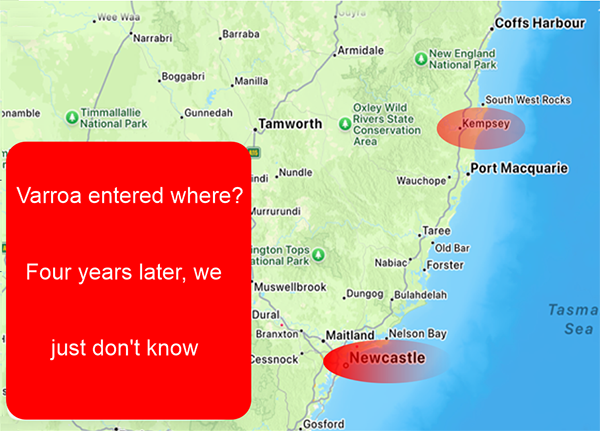
One introduction, apparently, but from where?
Scientifically, the report points toward one likely conclusion. The outbreak appears to have come from a single, small introduction rather than from multiple separate incursions. That conclusion is supported by work from NSW DPIRD, CSIRO and the Australian National University.[1]
ANU’s analysis of mite populations around Newcastle suggested a single introduction event. Virus work on mites and bees from Newcastle and Kempsey also indicated that the Newcastle and Kempsey detections were linked, and did not support the theory of two unrelated introductions.[1]
That is useful as far as it goes. It suggests Australia was likely dealing with one original breach that then spread. But it still does not tell us what pathway that breach followed.
This is where the report becomes deeply frustrating. It says that genetic diversity, hive movements and other data limitations made it impossible to determine the exact source and timing of the introduction.[1] In plain language, by the time the system had enough samples to analyse, the original trail was already muddied.
That should worry every beekeeper in Australia!
The Port of Newcastle theory looks weaker.
In the early days, many assumed the Port of Newcastle must have been the obvious gateway. After all, sentinel hives around the port were where Varroa was first officially detected in June 2022.[1] But the report says later analysis found a heavier infestation some distance away from the port, leading NSW DPIRD to consider it unlikely that the original introduction occurred through hitchhiking bees arriving directly via the port.[1]
That is a significant point. It does not completely rule out a port-related pathway, but it weakens one of the simpler narratives many people had settled on.
Instead of a neat story, the report gives us something messier. It indicates possible origins in Kempsey and or Newcastle, but says the exact source and timing remain unclear. Infestation rates suggested the Newcastle outbreak may have begun sometime between June 2021 and March 2022. By mid-2023, Varroa was also detected in Kempsey, and testing there suggested an introduction around January 2023, though the report warns that the infestation may have begun much earlier.[1]
So even the timeline remains soft at the edges.
A troubling hint in the data.
One sentence in the report will catch the attention of experienced beekeepers. It says that inconclusive data patterns in Kempsey “may suggest Varroa mite suppression by apiarists”.[1]
That is not an accusation. But it is not a throwaway line either.
It raises the possibility that mites may have been reduced before formal detection, whether through informal treatment, management activity or some other factor. For recreational beekeepers, that line lands awkwardly. If suppression happened, why was it not picked up earlier? If it did not happen, what explains the unusual pattern? The report does not answer that.
And that is part of the broader problem. Again and again, the report points toward possibilities, linkages and likely interpretations, but not certainty.
Even the overseas origin remains unsettled.
There was early scientific advice suggesting the mites may have originated in North America, probably Canada.[1] But later CSIRO work said confidence in any conclusion about international origin was low, because once Varroa populations spread through Australia, their genetic signatures changed in ways that made tracing much harder.[1]
NSW DPIRD is continuing to investigate whether viruses carried by Varroa might help identify the overseas source more accurately.[1] That may yet produce something useful, but right now it is still unfinished business. So, after all this time, even the question of which country seeded the incursion remains open.
Why recreational beekeepers should care
Some may say the report is mainly of interest to governments, scientists and people chasing historical accountability. That misses the point. Recreational beekeepers should care because the real issue is not just where Varroa came from. The real issue is whether Australia has learned enough to stop the next exotic incursion.
That is where this report becomes genuinely unsettling. If a single, small introduction can occur, spread, blur its genetic trail, move through beekeeping networks and only later become visible as a national emergency, then the obvious question is this: what exactly prevents it happening again?
If we do not know the pathway with confidence, how do we close it with confidence?
That is not a criticism of the scientists or investigators. In fact, the report shows they worked hard and pulled together a substantial amount of evidence. It is simply the uncomfortable reality of the outcome. The investigation appears to have been serious. The answer is still incomplete.
For hobbyists, that means biosecurity cannot be treated as somebody else’s problem. Recreational beekeepers make up a huge proportion of Australia’s beekeeping population. They are spread across suburbs, towns and rural blocks. They buy second-hand gear, catch swarms, split colonies, move hives to orchards or family properties, and often operate in looser networks than commercial operators. That does not make them a risk group in a moral sense, but it does make them a critical part of surveillance.
In practical terms, it means ordinary beekeepers need to be alert, competent and honest. It means monitoring properly. It means reporting suspect finds. It means understanding that not wanting to know is no longer a harmless attitude. It means recognising that the days of casual neglect are over.
Disappointment is justified, but so is realism
The report closes by calling for continued vigilance, scientific inquiry and cooperation across jurisdictions.[1] That may sound dry, but it is probably the most sensible conclusion available.
Still, it would be dishonest to pretend that this report gives beekeepers closure.
It does not.
What it does give us is a narrower field of possibilities. It suggests the incursion was likely a single small introduction. It suggests the Newcastle and Kempsey outbreaks were linked.
It suggests the simple Port of Newcastle hitchhiker theory is less convincing than many first believed. It suggests criminal wrongdoing cannot be proven on the evidence available. And it confirms that the exact source remains unresolved.[1]
That is useful. But useful is not the same as satisfying.
For the recreational beekeeper, the lasting feeling is likely to be this: after all the hive losses, all the disruption and all the promises that the truth would eventually be uncovered, we are still left with uncertainty.
And uncertainty is dangerous.
Because, if we still cannot clearly explain how Varroa got in, then we cannot honestly claim we know how to stop the next incursion, whether it is another mite lineage, a new parasite, or some other exotic pest or disease of honey bees.
That may be the hardest lesson in the whole report.
Australia has now moved from a Varroa-free nation to a Varroa-management nation. Beekeepers have adapted because they had no choice. But adaptation should not be mistaken for confidence. Many recreational beekeepers will read this report and come away with the same uneasy conclusion.
We still do not really know how the door was opened.
And until we do, we cannot be sure it will stay shut next time.
If we do not know the pathway with confidence, how do we close it with confidence?
Reference
[1] Department of Agriculture, Fisheries and Forestry. Investigation into the origins of the Varroa mite incursion in Williamtown area. Canberra: Commonwealth of Australia, February 2026.
Investigation into the origins of the Varroa mite incursion in Williamtown area
Media Release – DAFF Varroa Investigation Mar 2026
AFB Minimisation Project
The AFB Minimisation Program is a NSW Department of Primary Industry and Regional Development (DPIRD) sponsored ongoing project to map out American Foulbrood (AFB) throughout the state. The department provides the ABA with free honey testing for presence of AFB spores.
Honey testing is an excellent diagnostic tool that can offer early detection of AFB so you can intervene early. This can save your whole apiary. There have been several detections in the program that have triggered a detailed inspection, revealing an AFB infection.
Thanks to Macleay Valley, Cumberland and Illawarra for volunteering to contribute samples to the program. If you’d like your club to contribute shoot me an email and I’ll post out a kit.
Club Presentations
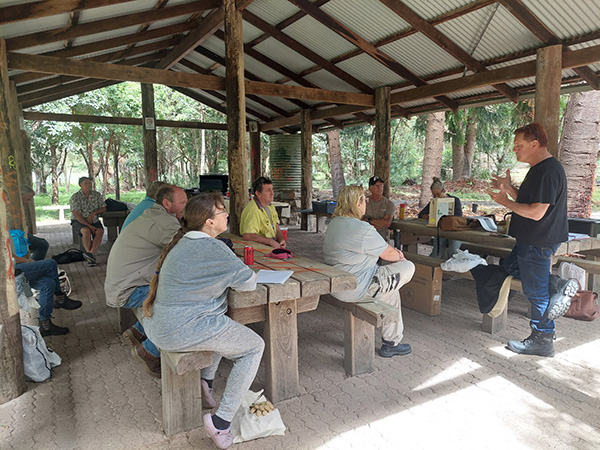
I’m happy to come to your club to talk about your biosecurity issues or other bee related topics. I recently popped up to the Macleay Valley Club to talk at their apiary.
I introduced the Nepean Beekeepers to the back saving hive design from Slovenia, the AZ hive. No more lifting heavy boxes. I’ll soon have all my bees in AZ hives.
I also do online presentations and am happy to join your committee meeting as a guest too.
As I write this, I’ve just talked to the Durham County Beekeeper's Association in North Carolina, USA. They were interested to learn how things were before varroa and how we’re adapting to the new reality.
Interstate clubs facing the initial phase of varroa infestation are keen to know what they’re in for. I’m looking forward to Zooming in to the members of the Moreton Beekeepers Association QLD in April.