
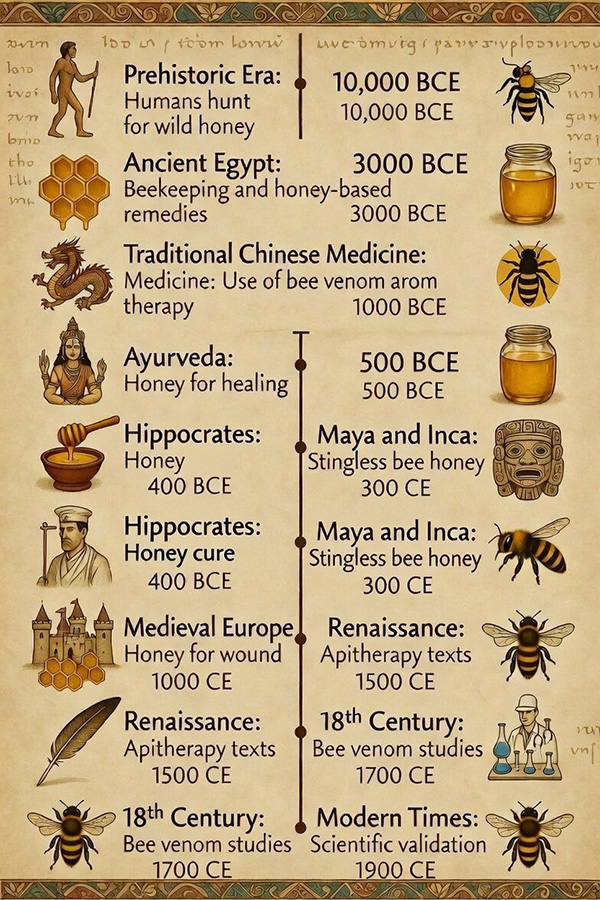
A History of Apitherapy

By Bridget Goodwin PhD
Vice President, International Federation of Apitherapy (IFA)
Founding President, Australian Apitherapy Association (www.apitherapyaustralia.net)
Developer of https://apiuniversity.carrd.co/ International online Training platform for Apitherapy endorsed by the IFA in 2023
Practitioner at https://ozlongevity.com/
Apitherapy, the therapeutic use of bee products like honey, propolis, bee venom, royal jelly, and pollen, ranks among humanity's oldest healing traditions. For thousands of years, civilizations worldwide have harnessed the power of the hive to prevent and treat ailments ranging from wounds and infections to arthritis and digestive issues. Evidence of human-bee interactions dates back to prehistoric times. Cave paintings from around 15,000–8,000 BCE, such as those in Spain's Araña Caves near Valencia, show early honey hunters gathering from wild bees—likely using the sweet harvest for both food and basic remedies.
Organized beekeeping emerged in ancient Egypt around 2600–2000 BCE. Egyptians domesticated bees, viewing them as sacred. Honey appeared in 147 prescriptions in the Ebers Papyrus (c. 1550 BCE) for treating wounds, ulcers, and infections thanks to its antimicrobial properties. Bee stings were applied for joint pain, and propolis helped preserve mummies.
In Traditional Chinese Medicine, bee venom acupuncture (apipuncture) and honey-based remedies have been used for over 2,000 years to address arthritis, infections, and fatigue. Apitherapy is a central plank of Traditional Chinese Medicine, with live bees still in use as medicine in many Chinese hospitals. Ancient texts like the Huangdi Neijing document these practices.
Ayurveda in India classified honey (Madhu) as a key elixir, with types like Makshika deemed medicinally superior. Texts such as the Charaka Samhita highlight its role in digestion, cleansing, and wound healing. Hippocrates, the Greek "Father of Medicine" (c. 460–370 BCE), praised honey as a "natural cure" that cleans sores, heals ulcers, and manages fevers. Greek and Roman physicians continued using bee products as antiseptics and general remedies.
Across the ocean, Maya and Inca cultures in pre-Columbian Central and South America revered stingless bee honey (from species like Melipona beecheii). They applied it for wounds, cataracts, infections, and spiritual healing, with evidence from codices like the Madrid Codex and Yucatán archaeological sites. Incas used propolis as a fever reducer.
These diverse traditions share a common thread: consistent success against infections, inflammation, wounds, digestive problems, and respiratory conditions—knowledge passed down through generations with regional adaptations.
From ancient practices to today, apitherapy forms a continuum. Modern advances bring refined extraction, scientific studies, and clinical trials, yet the core relies on time-tested traditional wisdom.
This aligns with the World Health Organization's definition of traditional medicine as "the sum total of the knowledge, skills, and practices based on the theories, beliefs, and experiences indigenous to different cultures... used in the maintenance of health." The WHO's Traditional Medicine Strategy (2014–2023) encouraged integrating evidence-based traditional approaches—like apitherapy—into national health systems, promoting culturally appropriate, holistic care worldwide.
Apitherapy's global heritage, spanning Egypt to the Americas, underscores its value as a shared human legacy. As beekeepers, we stand at the intersection of ancient wisdom and modern science—safeguarding hives that continue to offer nature's pharmacy.
References:
https://apimedsrbija.rs/en/apitherapy/apitherapy-through-history-and-today/
https://www.bterfoundation.org/bee-venom-therapy
Bava R, et al. Therapeutic Use of Bee Venom and Potential Applications in Veterinary Medicine. Vet Sci. 2023;10(2):119. doi:10.3390/vetsci10020119
Ediriweera ERHSS, Premarathna NYS. Medicinal and cosmetic uses of Bee’s Honey – A review. AYU. 2012;33(2):178-182. doi:10.4103/0974-8520.105233
El-Didamony SE, et al. Bee products: An overview of sources, biological activities and advanced approaches used in apitherapy application. Biotechnol Rep (Amst). 2024;44:e00862. doi:10.1016/j.btre.2024.e00862
https://www.fao.org/4/i0842e/i0842e14.pdf
Gupta and Stangaciu. Apitherapy-Holistic-Healing-Through Honeybee and Bee Products in Countries with Poor Healthcare System. In: Beekeeping for Poverty Alleviation and Livelihood Security. 2014. doi:10.1007/978-94-017-9199-1_152
Khan M. Bee-Derived Therapies: Bridging Ancient Wisdom with Modern Apitherapy. Journal of Apitherapy. 2023;10(7):01-02
Kumar S, et al. Honey infused with herbs: A boon to cure pathological diseases. Heliyon. 2023;10(1):e23302. doi:10.1016/j.heliyon.2023.e23302
https://www.nationalgeographic.com/animals/article/stingless-bees-honey-helping-peruvian-amazon
Negi N, et al. Apitherapy: A Review of Recent Clinical Research in Beekeeping. Plant Archives. 2024;24(SI). doi:10.51470/plantarchives.2024.v24.sp-gabels.028
Sung SH, Lee G. Bee Venom Acupuncture Effects on Pain and Its Mechanisms: An Updated Review. Toxins (Basel). 2021;13(9):608. doi:10.3390/toxins13090608
https://www.thoughtco.com/ancient-maya-beekeeping
Zubair R, Aziz NA. As Smooth as Honey—The Historical Use of Honey as Topical Medication. Jama Dermatology. 2015;151(10):1102. doi:10.1001/jamadermatol.2015.1764
https://www.who.int/health-topics/traditional-complementary-and-integrative-medicine#tab=tab_1