
The Pros and Cons of Slovenian Hives
by Steve “Windy’ Hill
Greetings to all from the wonderful world of Slovenian Beekeeping. I have been keeping bees in ‘true’ Slovenian AŽ hives for just over five years and have found this method of keeping bees very interesting. By ‘true’ AŽ hives I am referring to those hives that are not hybrids such as AŽ – Langstroth hives. As there are so few beekeepers, that I know of, keeping bees in this method, I have been asked to write about the pros and cons.
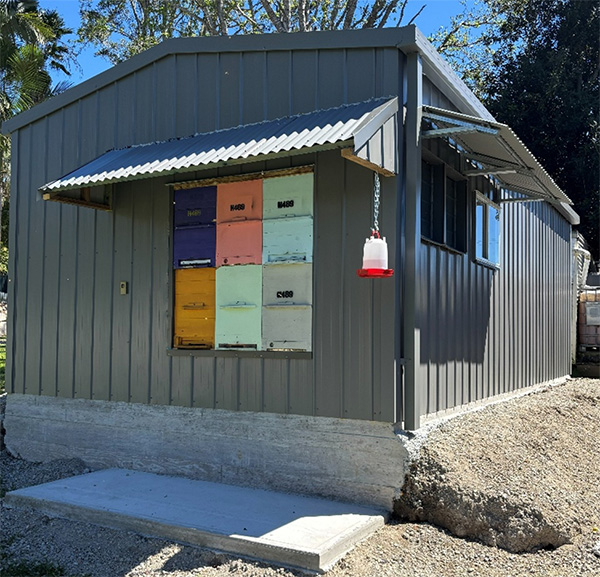
Before I go into detail, a description of what Slovenian Beekeeping is and a description of the AŽ hive will help set the scene as the Slovenian AŽ hive is relatively unknown to Australian beekeepers. The hive is named after it’s designer Anton Žnidersic. Unlike the usual Langstroth hive, the AŽ hive is usually housed in a beehouse with only the front of the beehive exposed to the elements as shown at Figure 1. To quote from the ‘AŽ Beekeeping with the Slovenian hive’ book “to begin using a AŽ hive you must get used to the idea of beekeeping inside and moving frames rather than the whole hive chambers.”
The hive is constructed as a chest with between two and three sections inside depending on how many frames you want inside – 20 or 30. The front requires an inner board which assists with temperature control of the hive. There are entrances at each level as shown at Figure 2, the main one at the bottom and additional ones for each section. This allows the field bees direct access to the honey super if so desired.
The rear of the hive, as shown at Figure 3, is where you will do most of your work. While looking solid, the door has two ventilation flaps, as shown at Figure 4. This allows air flow to the backside of the hive on warm days with a hive full of bees. Slovenian beekeepers produce honey with at least 2% lower water content than in Langstroth hives.
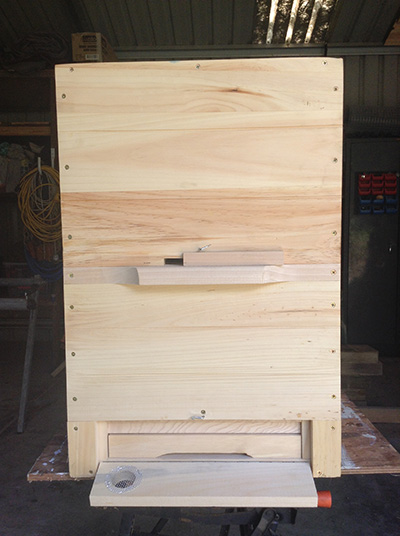
Figure 2 - Front of Hive showing entrances.
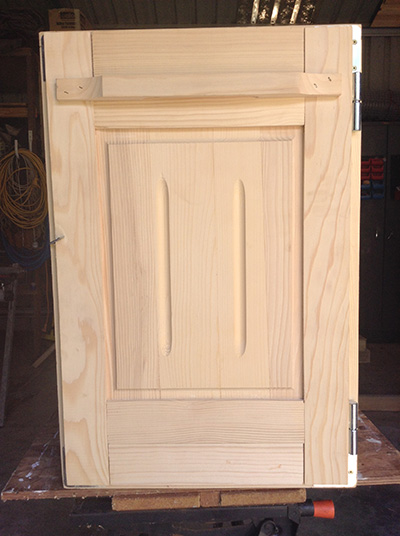
Figure 3- Back of Hive
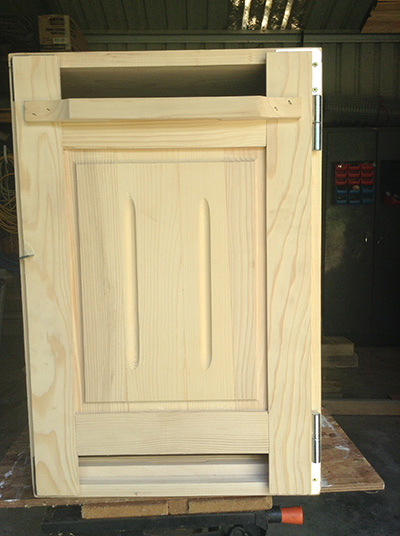
4 - Back of Hive with ventilation flaps open
The inner workings of the hive consist of the Brood area at the bottom and the honey super at the top as shown at Figure 5. The frames are held in place by steel V-shaped spacers at both the front of the hive and on the inner covers. Each of the inner covers can be removed independently allowing quick and easy access to the frames. The frames are supported on three steel bars which run horizontally across the hive in each section. Along with the concave shape of both the top and bottom of each frame the steel bars assist with the reduction of surface connection which reduces propilisation.
The frames are slightly different in the A-Z hive to those of the Langstroth hive as shown in Figure 8 and Figure 9. The AŽ frame is deeper but shorter than the Langstroth frame. This will cause an issue with pre-formed foundation as there will be a gap at the bottom of each frame. Additionally, the AŽ frames are wired vertically.
Another interesting thing about Slovenian beekeeping is that in the 18th century, Austrian Empress Maria Theresa founded one of the very first beekeeping schools in Vienna, and the first teacher of beekeeping at this school was the Slovenian Anton Janša (20 May 1734 - 13 Sep 1773). He was famed as a great theorist and practitioner in beekeeping. You may have noticed his date of birth as World Bee Day is celebrated on 20 May each year in recognition of his contribution to beekeeping.
After working with these hives for the last five years I have noticed several pros and cons of this method of beekeeping. Firstly, let me state that this method of beekeeping is not for everyone as there is a considerable financial layout to obtain the hives. As there were no manufacturers in Australia making ‘true’ Slovenian hives back in 2018 I finished up importing my first hive which, eight years ago, was around the $500 mark, but even constructing my own hives the cost is around $250 per hive. Additionally, there is no-one, that I know of, manufacturing frames, excluders, or the V-shaped spacers here in Australia.
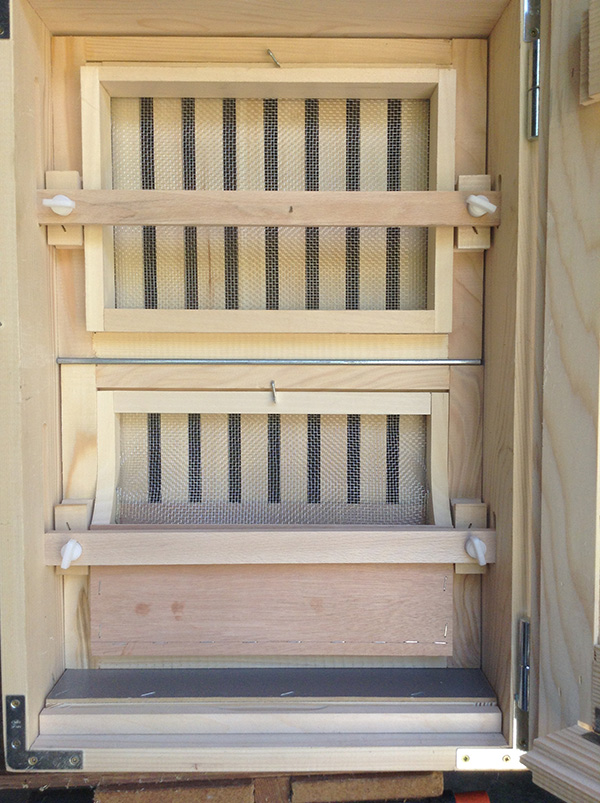
The frames can be made by the beekeeper, but the excluders and spacers need to be imported. Surprisingly, the excluders are comparably priced to standard Langstroth 9 frame excluders.
Some of the pros I have found with working the AŽ hives are as follows:
No heavy lifting – once everything is in place the heaviest item to be lifted is a full frame of honey. This is because every frame is slid in or out of the hive. There is no need to remove the super to get to the brood or vice versa. You just need to remove the inner cover to the required section while leaving the other section in place. This also reduces the number of bees flying around the hive.
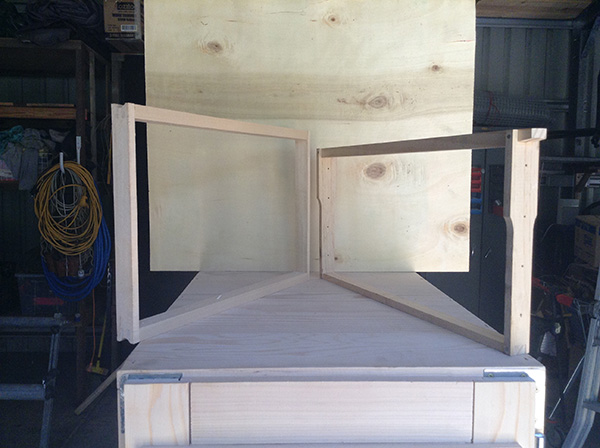
Figure 6 - A-Z Frame (left) v Langstroth Frame (right)
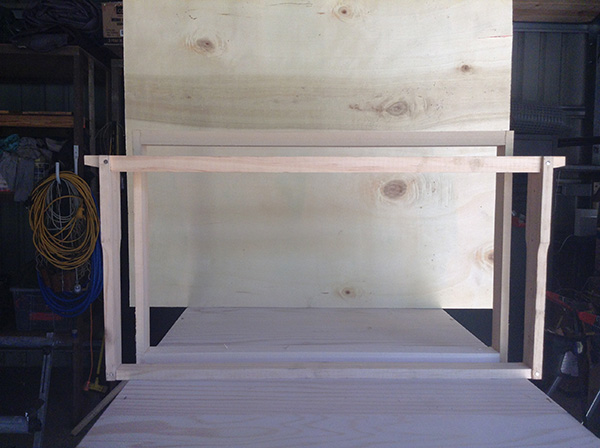
Figure 7 - A-Z Frame (rear) v Langstroth Frame (front)
Can access hives in all weather – because the hives are kept in a shed the beekeeper can work the hives regardless of the weather. I will qualify that by stating if it is raining heavily, it is still not a good idea to work the bees as most of them will be home. I will also admit that being in the shed at the height of summer in a bee suit is rather taxing. Being in a shed allows me to open the back of the hives to quickly assess how they are going. I can observe the bees moving around the back of the frames, and to smell the state of the hive. As all those that have had a slime out can attest, the smell is very overwhelming and distinct.
Suitable for wheelchair bound people – because there is no requirement to lift frames etc, the AŽ hives can be worked sitting down. I have a stool roughly the height of a milk crate which allows me to work my hives which are 40cm off the floor. This will allow people with disability that preclude them from standing to enjoy working with bees.
Full ten frame hives – due to the unique use of the V-shaped spacers, an AŽ hive can take a full 10 frames and maintain the appropriate bee space without overcrowding the hive. This allows even more honey to be taken from a hive. On average, when the honey flow is on, I can take four frames per hive without starving the colony.
And of course, there are some cons to Slovenian hives such as:
Cannot add or remove additional supers – because the hives are constructed as a single unit you cannot add or remove supers on the hive. If you wish to confine the bees to the brood section for any reason, i.e., over wintering in cold climates, then a divider board can be used to replace the queen excluder.
Difficult to relocate – because the hives are normally kept in a shed as a cluster it is difficult to relocate the hives to another apiary. I said difficult, not impossible. I recently had to move my hives to another location while my bee shed was rebuilt. To achieve the move, I rebuilt a 6x4 trailer, as shown at Figure 8, which worked surprisingly well. In Slovenia commercial beekeepers use trucks, as shown at Figure 9, to move their hives around, and process extraction onsite.
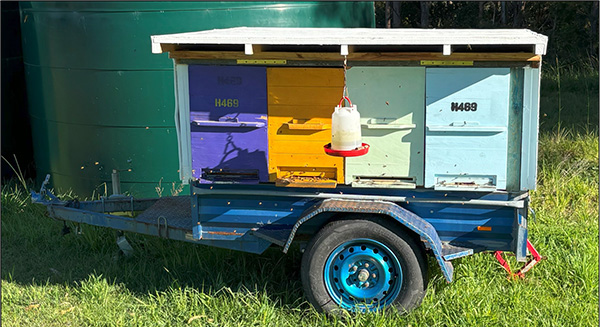
Figure 8 - Authors Bee Trailer
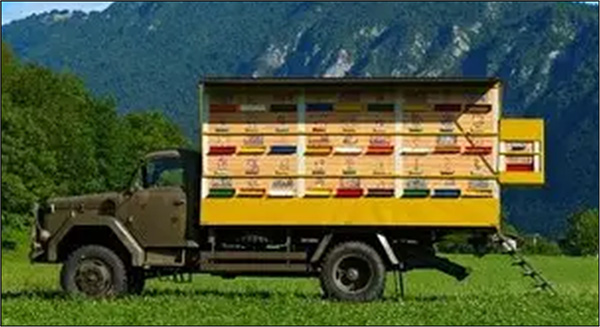
Figure 9 - Slovenian Beekeeper Truck
Not standard size equipment – unfortunately the Slovenian AŽ hives are not the same size as the industry standard Langstroth hive, and neither are the frames. There is the possibility of purchasing all this equipment from overseas, but it is just as easy to build your own equipment if you are handy with woodworking. To date I have built six hives and somewhere in the vicinity of 150 frames. I have also had to build my own wiring board; frame stand and a couple of other handy tools.
Hybrid AŽ – Langstroth Hives
There are many manufactures here in Australia who offer hybrid hives. These hives are usually narrower, shorter but deeper than ‘true’ Slovenian hives. This is to accept either actual Langstroth frames or modified AŽ frames which are the same size as Langstroth frames but without the hanging tab or the wider top section. The hybrids that use standard frames do not use the V-shaped spacers whereas the modified frames do. This does cause an issue when trying to put modified frames in a standard Langstroth hive to start a nuc. To the best of my knowledge there is no outlet in Australia selling the AŽ – Langstroth Frame extenders, which are a plastic clip-on, to extend AŽ frames to fit Langstroth hives.
Conclusion
I have found keeping bees in the AŽ hives to be very rewarding despite the cons. I was recently gifted a three-tier hybrid hive which I plan to install into my apiary for the next season to compare the two systems. If anyone wants more information on the AŽ hives I would be happy to take your queries.
About the author
Steve “Windy’ Hill spent 44 years in the Royal Australian Navy and began researching beekeeping about six years prior to leaving. He joined the Gold Coast Regional Beekeepers in 2018 to gain hands on experience prior to starting his first hive in 2020. Over the years he has learnt how to construct AŽ hives, frames, and associated equipment. He is currently fitting out his new bee shed that was built in 2025.