
Please Note: The APVMA has stated that Beekeepers are not permitted to undertake the test outlined in the article below. TAB is providing this information for beekeeper education purposes only.
Detecting Varroa Mite Resistance To Apistan®, Apitraz® Apivar® And Bayvarol®
by Southern Cross University Bee Research & Extension Lab in partnership with the Australian Centre for International Agricultural Research
Chemical resistance
Resistance to synthetic varroa controls occurs in every country where varroa exists (Jack and Ellis, 2021). Knowing how to conduct resistance tests can help beekeepers detect future resistance issues early and avoid wasting money on a product that is no longer effective.
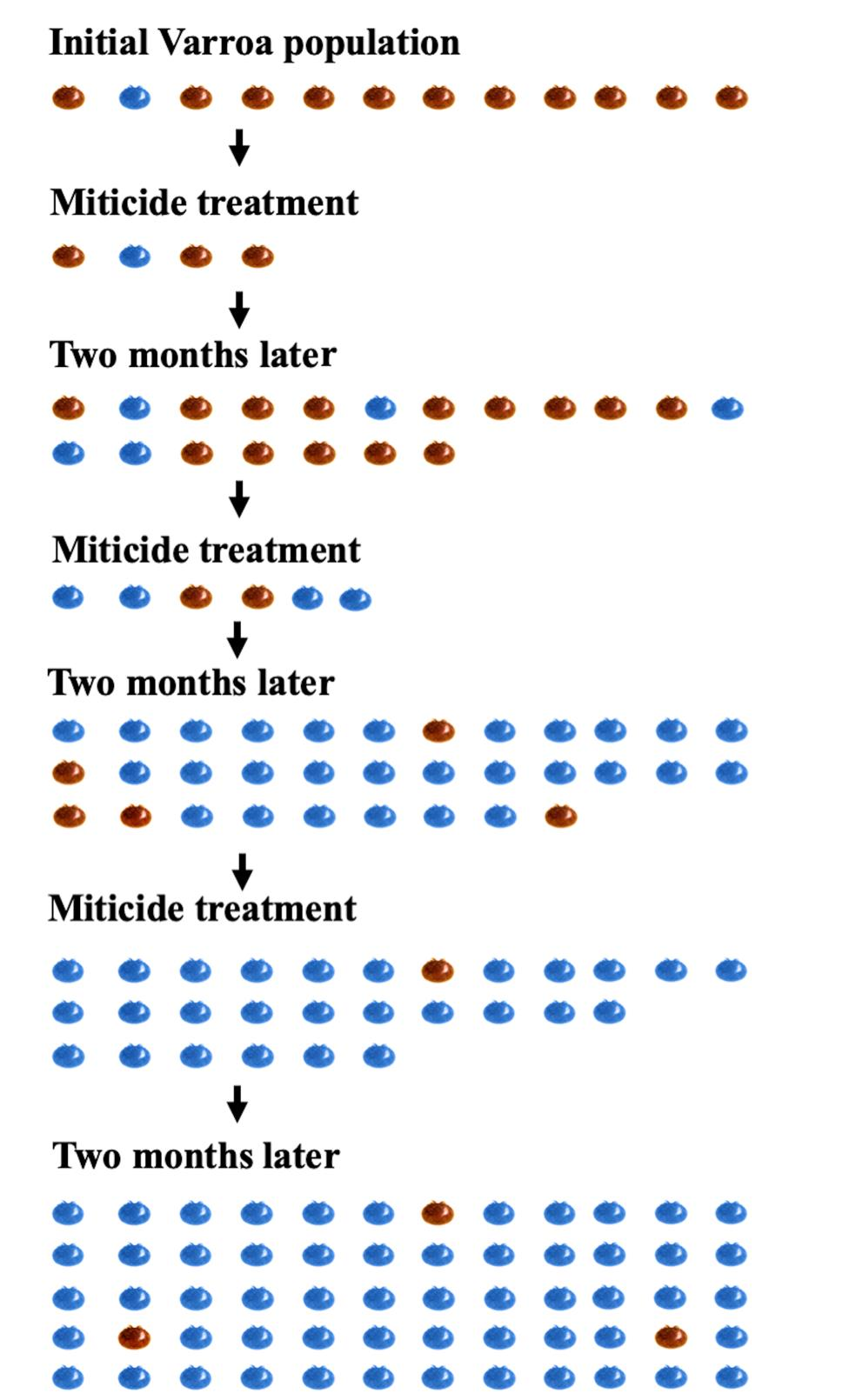
Synthetic varroa controls are efficacious, but they don't kill 100% of mites. The mites that survive are better at tolerating the chemical being used, and these mites go on to reproduce. Over successive treatments, more and more mites exist which are unaffected by the treatment being used, as illustrated below: an initial varroa population is knocked back by a synthetic miticide treatment, but the survivors rebound over the following three months, and each subsequent round of treatment removes a smaller share of an increasingly tolerant population.
By the time a colony does not appear to respond to a synthetic chemical mite control, resistance issues are likely problematic. This crude but useful field test can be used by beekeepers to determine whether varroa are resistant to miticide controls. This test cannot indicate the exact level of resistance; further laboratory work is needed to determine this.
Materials needed
- 500 ml jar with lid – e.g. sugar shake jar
- Metal mesh cover for the jar
- 75 x 125 mm index card or similar
- 9 x 12.5 mm piece of a new miticide strip (e.g. Apistan®)
- ¼ cup (to scoop up 150 bees)
- Methylated spirits
- Nitrile gloves (to handle strips)
- Stapler (to staple the miticide strip to)
- Sugar cubes (so bees don't get hungry)
- Marking pen
- Sheet of white paper
- Paint straining material
Instructions
Step 1
- Cut miticide strips (e.g. Apistan®) and staple the strips to the centre of the index card. The card is used so the strip doesn't lay flat on the bottom of the jar.
- Place the card in the jar with the section of the Apistan® strip facing inwards so it comes into contact with the bees.
- Place a sugar cube in the jar.
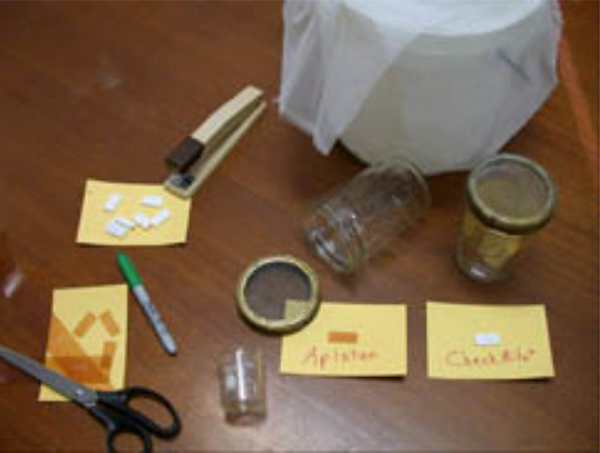
Materials laid out for the test: jars, mesh lids, index cards, a miticide strip, and a stapler.
Step 2
- Shake bees from a brood comb into an upturned hive lid or a tray.
- Scoop up 1/4 of a cup of bees (about 150 bees) and put them in the jar, being careful not to damage the bees.
- Record (e.g. label the jar) the time the test started so you know once 24 hours has passed.
Step 3
- Place the wire mesh lid over the jar to stop the bees from escaping.
- The holes in the mesh should be large enough to easily let varroa through.
- Place the jar in a warm, dark place for 24 hours. Try to look after the bees if in transit (e.g. not in a hot vehicle or in the sun). Make sure the lid is not covered so the bees can breathe.
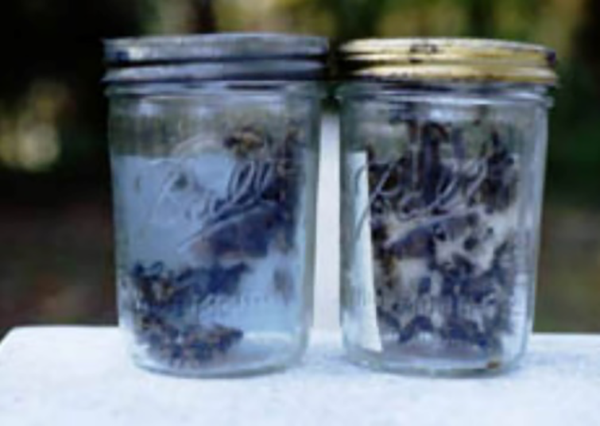
Jars containing bees fitted with mesh lids. (Photo courtesy British Columbia Ministry of Agriculture.)
Step 4
- After 24 hours, hold the jar above a piece of white paper and turn it so the mesh lid is facing downwards.
- Hit the jar with the palm of the hand ten times.
- Ensure no dead mites are stuck on the walls of the jar.
- Count the number of mites that fall on the paper (and include any dead mites on the wall of the jar). This is the 'initial kill' figure used in Step 8. The initial kill represents the varroa that died due to the miticide.
Step 5
- Fill the jar halfway with methylated spirits, then once the bees are dead, remove the card and chemical strip.
- Remove the mesh lid and replace with a solid lid for the jar. Shake the jar vigorously for five minutes.
Step 6
- Remove the solid lid and fit the mesh lid.
- Pour out the methylated spirits with any mites into a small bucket with a paint straining cloth fixed.
- Refill the jar with methylated spirits, swirl the bees around and pour the spirits into the lined funnel or container again.
Step 7
- Count the number of mites recovered in the strainer. This is the 'final kill', which represents mites that did not die from the miticide, but were recovered from the bees using the alcohol wash.
Work out the total number of mites killed:
Total mite kill = the initial kill + the final kill
If the total mite kill is less than 5 mites per sample, you will need to carry out the test again.
Step 8
To calculate the percentage of mites killed, divide the initial kill by the total mite kill. Multiply this number by 100 to get the % of mites killed by the Apistan®:
% kill by Apistan® = initial kill / (initial kill + final kill) x 100
For example:
- Initial kill = 6 mites
- Final kill = 1 mite
- 6 / (6 + 1) x 100 = 85.7% of mites in the hive killed by Apistan®.
If less than 50% of the mites were killed by Apistan®, the mites may be resistant and should be tested with a more sensitive laboratory test.
Critical factors for the success of the above resistance test
- Pre-screen hives using an alcohol wash or sugar shake (300 bees) and only run the resistance test on colonies where you find 5 or more mites.
- Expect levels of resistance to be different among hives.
- This test is not designed to identify individual hives showing resistance. Therefore, use apiary averages to assess the results: select 12 hives per apiary. More hives are better.
- Perform the test exactly as described above; jar size, size of strips, sampling bees from brood frames, the number of bees (use a measuring scoop), and temperature are all important.
- Ensure that bees are mobile in the jars so they contact the strips. Cool temperatures may cause the bees to cluster away from the strips, so ensure fresh air to encourage bee movement.
- Do not reuse strip pieces or index cards. Wash jars between tests.
- Do not expose jars with miticide sections to sunlight.
Slowing resistance
Beekeepers can slow the resistance process by:
- Following the instructions on the label.
- Only using synthetic miticides when they are needed, and not re-using strips.
- Using the recommended dose so that mites are not exposed to low concentrations.
- Removing the miticide when recommended so varroa are not exposed to low concentrations of the chemical. Mark hives with the date of application and the number of strips in the hive so it is obvious when the strips need to be removed.
- Encouraging other beekeepers to use techniques that will delay resistance — any resistant mites they produce will eventually find their way into other beekeepers' hives.
- Not relying on just one product or chemical. Rotate different chemical classes to reduce the chance of cross-resistance (see below).
Chemical class rotation
Examples of chemical class rotation of synthetic miticides for varroa control:
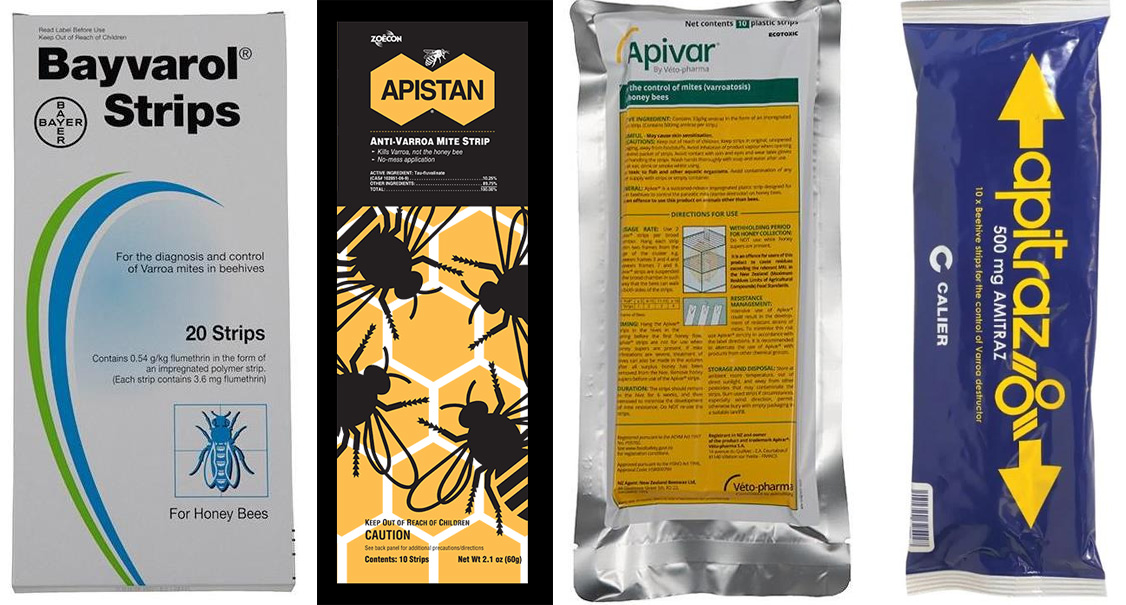
- Bayvarol + Apitraz: Yes
- Bayvarol + Apivar: Yes
- Bayvarol + Apistan: No (both synthetic pyrethroids)
- Apitraz + Bayvarol: Yes
- Apitraz + Apistan: Yes
- Apitraz + Apivar: No (both amitraz)
Further reading and references used to develop this fact sheet
Almecija, Gabrielle, et al. “Inventory of Varroa destructor susceptibility to amitraz and tau-fluvalinate in France.” Experimental and Applied Acarology 82.1 (2020): 1-16.
British Columbia – Ministry of Agriculture. “Pettis Test – Detecting Varroa Mite Resistance to Apistan, Apivar & Coumaphos.” 2015: Apiculture Bulletin #223.
Coles & Dryden, 2014. Insecticide/acaricide resistance in fleas and ticks infesting dogs and cats. Parasites and Vectors: 7:8.
Elzen, Patti J., et al. “Detection of resistance in US Varroa jacobsoni Oud. (Mesostigmata: Varroidae) to the acaricide fluvalinate.” Apidologie 30.1 (1999): 13-17.
Hernández-Rodríguez, C.S., Moreno-Martí, S., Almecija, G. et al. Resistance to amitraz in the parasitic honey bee mite Varroa destructor is associated with mutations in the β-adrenergic-like octopamine receptor. J Pest Sci 95, 1179–1195 (2022).
Higes, M., Martín-Hernández, R., Hernández-Rodríguez, C.S. et al. Assessing the resistance to acaricides in Varroa destructor from several Spanish locations. Parasitol Res 119, 3595–3601 (2020).
Jack, C. J., & Ellis, J. D. (2021). Integrated pest management control of Varroa destructor (Acari: Varroidae), the most damaging pest of (Apis mellifera L. (Hymenoptera: Apidae)) colonies. Journal of Insect Science, 21(5), 6.
Marsky, U. et al. (2020) „Varroa mite sensitivity towards amitraz in France.” COLOSS Conference (October 2020).
Milani, Norberto. “The resistance of Varroa jacobsoni Oud. to acaricides.” Apidologie 30.2-3 (1999): 229-234.
Mozes-Koch, R., et al. “First detection in Israel of fluvalinate resistance in the varroa mite using bioassay and biochemical methods.” Experimental & Applied Acarology 24.1 (2000): 35-43.
Morfin, Nuria, et al. “Surveillance of synthetic acaricide efficacy against Varroa destructor in Ontario, Canada.” The Canadian Entomologist 154 (2022).
Pettis J.S., Shimanuki H., Feldlaufer M.F. (1998) An assay to detect fluvalinate resistance in Varroa mites, Am. Bee J. 138, 538–541.
Pettis, Jeff S. “A scientific note on Varroa destructor resistance to coumaphos in the United States.” Apidologie 35.1 (2004): 91-92.
Rinkevich FD (2020) Detection of amitraz resistance and reduced treatment efficacy in the Varroa Mite, Varroa destructor, within commercial beekeeping operations. PLOS ONE 15(1): e0227264.
Suszkiw, Jan. “Easy-to-use bioassay spots Varroa resistance.” Agricultural Research 53.4 (2005): 19.
