
Honey Fraud- how it happens and what are the options for monitoring/control?
by Clare Winkel
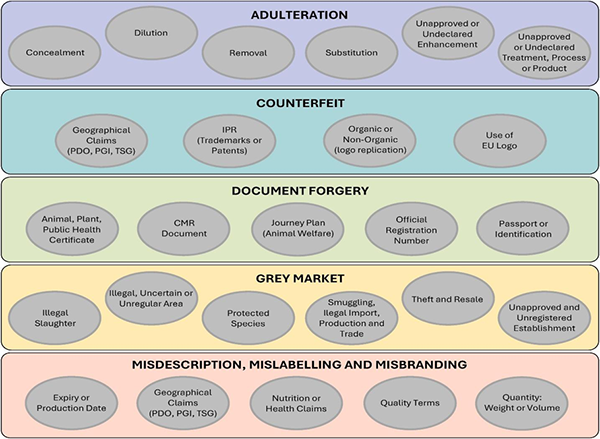
In my previous article I discussed the progress of the Agrifutures funded project National Beehive & Honey Traceability Feasibility Study undertaken by ICS. The majority of that project was investigation the feasibility of hive traceability. But another part of the project was looking at traceability of the honey, which is a related but separate problem requiring different solutions to that of hive traceability. One reason why people would like to be able to trace honey, is related to food fraud.
What is food fraud?
Food fraud is an intentional act for economic gain,
- whereas a Food Safety incident is an unintentional act with unintentional harm (i.e. Salmonella contamination).
- Food Defence incident is an intentional act with intentional harm (i.e. to damage another company’s brand/share price).
But one of the easiest and most effective method of fraud, is to copy a leading brands packaging/artwork/product claims and sell a third-rate product in the leading brands packaging, for a much higher price. The first the leading brand will know about it, is when they receive an avalanche of customer complaints.
This method of fraud is happening to Australian fresh produce and seafood companies regularly- internationally and locally.
Could this happen to your product and brand ?
In my previous article I stated some of the findings of overseas reports on honey fraud. Here are the results of some studies much closer to home:
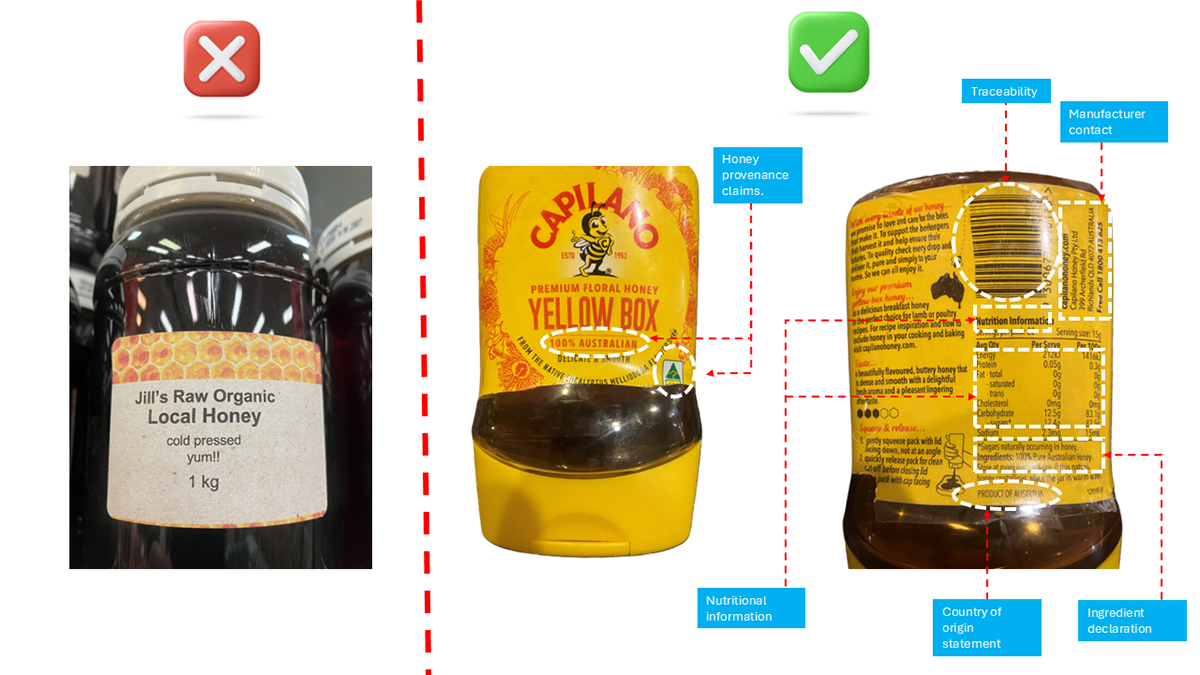
- Australia (2021 B-QUAL survey): More than 40% of honey available in jars did not meet labelling requirements under Australian standards. Retail honey labels were randomly assessed during this project and often identified honey for sale in independent shops that did not comply. But this is likely to be based more on ignorance of the laws and lack of enforcement of Australian food labelling laws in general. Additionally, most independent retailers fail to implement any effective approved supply systems, as the three major retailers do. Refer to figure 2 below.
- AHBIC tested 20 retail SKUs: Every prepackaged Indian honey failed advanced adulteration testing, along with half of prepackaged Chinese honeys. These products are sold through specialty shops, greengrocers and markets. However, these adulterated products were not present at major retail supermarket chains (which require SQF/BRCGS/FSSC 22000 certification with twice annual traceability checks and mass-balance within independent certified audits).
- AHBIC Annual Report 2025 confirms that over 33% of honey produced that should be levied is not being levied. This provides direct evidence of grey market activity and compliance resistance that undermines any voluntary traceability system.
The 2018 Capilano/QSI event resulted in losses exceeding $10 million and a 15-30% decline in honey sales in Australia, demonstrating the market vulnerability of the domestic industry to fraud allegations (substantiated or otherwise). Significantly, subsequent AHBIC testing of approximately 20 SKUs across supermarkets and found that Australian-packed blended honeys tested clean.
Here are some financial incentives for honey fraud to be undertaken in Australia:
- Prepackaged Indian honey retails in Australia at approximately A$4.99/kg, and are below the Australian cost of production of approximately A$4.50/kg for beekeepers alone, before supply chain, packaging and distribution costs. This price point is economically impossible for legitimate Australian honey to match.
- Some Australian honey commands significant price premiums:
- Jarrah honey (15-25% premium for verified product).
- Manuka honey (200-400% premium in key Asian markets over bulk honey).
These premiums create a financial incentive and simultaneously make provenance verification commercially valuable.
In the five years to 2021, Australia imported an average of 7500 tons of honey per annum. Key sources of low-cost honey were China, Brazil and Argentina. High-value honey was imported from New Zealand. The majority in volume is imported from Asia, at the lowest price of all imported products. But we can see from the Australian (FICA) border rejection rates (2020 – 2026) and the international (HorizonScan) recall data (2016- 2026) that very little Asian sourced product has been rejected at the border or recalled from sale since at least 2016 and none from China. C4 testing is routine for only 5% of imported honey consignments, while C3 testing is not typically part of the standard, routine surveillance. As a result of AHBIC lobbying and highlighting the results of their testing of imported honey products, DAFF has recently undertaken their own testing on imported bulk honeys using both C4 and NMR (Nuclear Magnetic Resonance) test methods. As a result of this study, it looks like NMR testing with be undertaken on imported honeys in the future.
Once the honey is within the Australian retail supply chain, we see a lack of consistent enforcement of Australian labelling laws at all retail outlets including farmgate and markets. There is also a lack of random testing of retail honey products to identify countries of origin, by enforcement authorities. In the seafood sector, one or two high profile public ACCC prosecutions routinely see a massive increase in widespread industry compliance.
Recently (June 14 2026) The European Union has introduced a new labelling law: instead of the current wording "blend of EU and non-EU honeys," the packer will be required to state all countries of origin of the honey blend in the main field of vision of the product, along with their respective percentages in descending order. Instead of the current wording "blend of EU and non-EU honeys," the packer will be required to state all countries of origin of the honey blend in the main field of vision of the product, along with their respective percentages in descending order. This is a partial solution but requires significant enforcement resources to ensure compliance.
Product testing is one part of the solution, but to know what test method you need to use, you also need to know what you are testing for. Understanding how adulteration occurs is essential to designing test methods to detect each method. The 266 honey products listed in the HorizonScan (international recall) database were recalled/rejected over the last 10 years were for the following reasons: pollen analysis, low level of enzyme diastase activity, high levels of HMF (hydroxymethylfurfural), ammonia-sulphite caramel dye (E150d), illegal foreign sugars (including maltose, sucrose, corn & cane sugar, amyl syrup & starch syrup), unauthorized added chemicals (DHA, MGO, d13D delta, Vardenafil, 4-methyl-imidazole (4-MEI) & tadalafil), lower conductivity & higher water-insoluble content than allowed. Each fraud type has a specific method for identification of that issue.
So what value are some of these test methods to the Australian honey industry and what is the cost of the testing?
|
Feature |
PCR |
Isotope (IRMS) |
NMR Profiling |
|
Detects bee DNA |
✅ |
❌ |
❌ (chemical) |
|
Detects C4 syrup |
❌ |
✅ |
✅ |
|
Detects C3 syrup |
❌ |
⚠️ limited |
✅ |
|
Detects unknown adulterants |
❌ |
⚠️ limited |
✅ |
|
Best for botanical origin |
Partial |
Partial |
Moderate |
|
Cost per sample |
Low |
Medium |
High |
|
Widely accepted standard |
Low |
High |
Growing but not universal |
Figure 3: Quick Comparison of honey lab testing methods by one Australia testing lab: https://www.agerecology.com.au/
Additionally, not all labs can undertake these tests, and these test methods won’t detect all of the known adulterants. But widespread targeted testing of honey products across the retail spectrum would assist the industry to identify where in the supply chain, honey fraud is occurring. To identify the actual point in the process where (and who) is undertaking the fraud, that would need a national traceability system with batch-level records from hive harvest/importer to processor/packer receival through to retail receival. This system combined with specific country or origin testing methods to verify label status, would provide the supply chain documentation to ensure clarity in honey origin and the blend status to end consumer transparency via label compliance.
Traceability is not only a compliance response. It can support premium provenance claims, export access, private certification standard requirements, EU origin labelling compliance, buyer assurance and protection of Australian honey reputation.
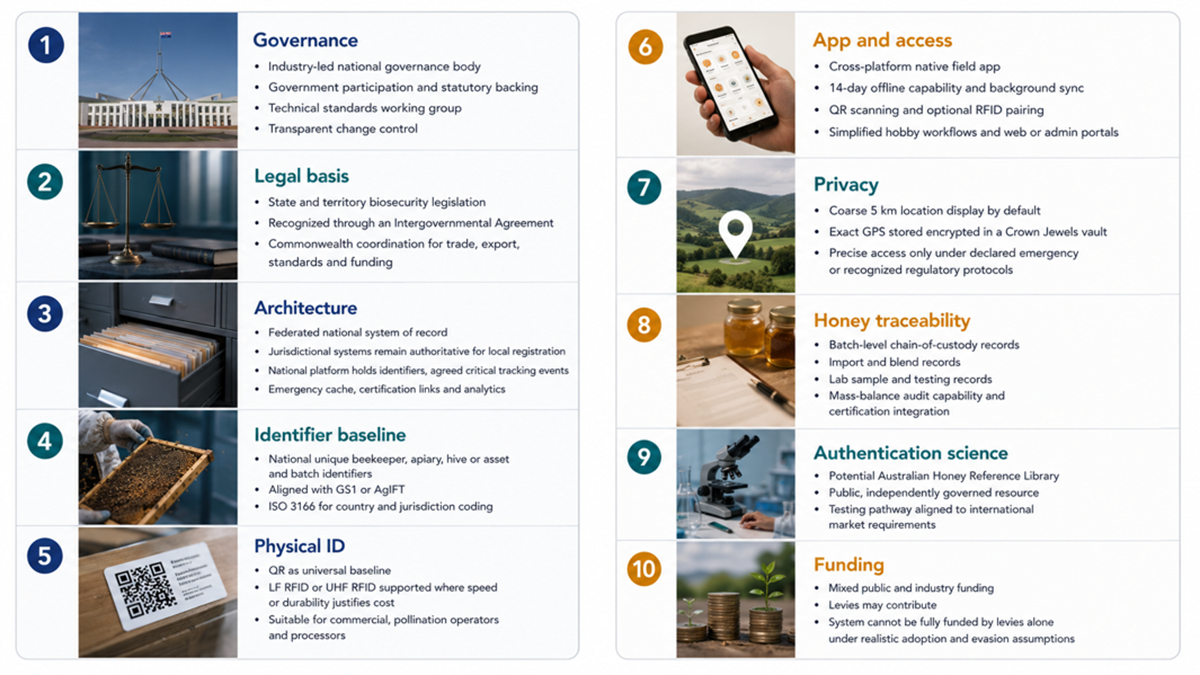
Figure 4: Proposed governance, legal, technical and funding design for a national beehive and honey traceability system.