
The Life of Neville Cutts
For thirty-four years from 1953 to 1987, Neville was a lecturer at Hawkesbury Agricultural College. At that time, it was run by NSW Agriculture and then by the University of Western Sydney, most of that time teaching Apiculture. Neville passed away just prior to his 98th birthday in October. His wife Gwen, 99, is still living in the family home. His children, Marcus lives in Richmond with his family, Dennis and his family in Victoria and Gwyntha and her family at Paddington.
Neville graduated from Hawkesbury Agricultural College in 1947. He enjoyed beekeeping having been taught by Bumble Smith the college lecturer and his father who also kept bees in the Hawkesbury.
Neville had a strong desire to join the NSW Department of Agriculture on leaving college, but with no vacancies, he went to work for Frank Armstrong, who was a large Central West beekeeper famous for migrating hives by truck and train to Western Australia. The return journey was with the Whiting family from Molong, still the largest migration of hives in Australia.
While working for Frank, Neville attended a church service at Yeoval and met Gwen who later became his wife. He had no car so he could only visit by train on weekends from wherever he was, working on the migratory apiaries at the time.
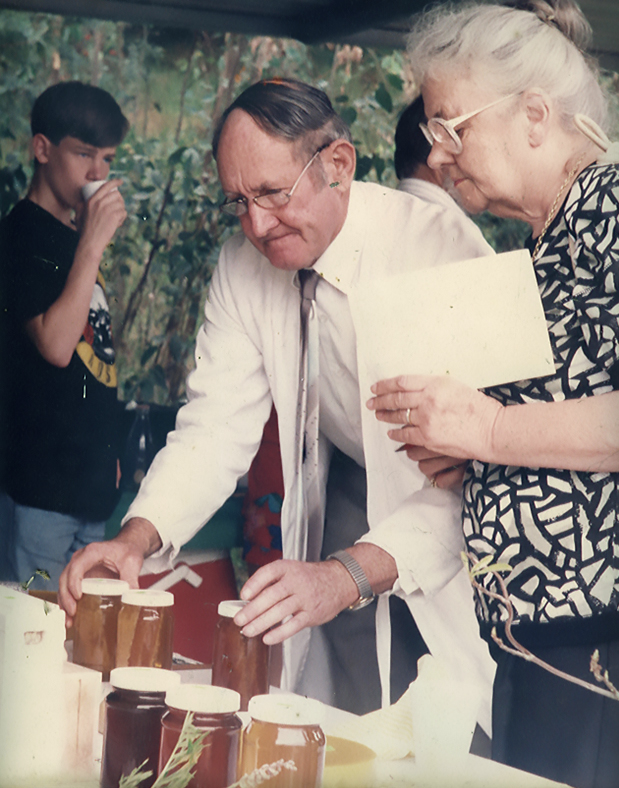
Neville and Gwen married in 1950 and this year celebrated 75 years of marriage. Image: Neville and Gwen Honey Judging
In 1949 a vacancy occurred in the Department and Neville was the successful candidate. He started in Bathurst and after being married, Gwen joined him living in a caravan. He was then transferred to Wagga Wagga and given a month to get to Wagga Wagga working on the way. Gwen remembers a large fire of American Foulbrood hives being destroyed at Young. On reaching Wagga Wagga they moved into a government house.
Then in 1953, when the college Apiculture Lecturer, Graham (Bumble) Smith retired, Neville was transferred to Hawkesbury Agricultural College as the Apiary Lecturer. The college had a very successful apiary run by Neville, without apiaries in the Hills District to take advantage of early pollen and in those days plenty of citrus and the central west round Tarana for honey production.
It is very pleasing that the university still has an apiary of thirty colonies managed by Michael Duncan with the strong support of Professor Robert Spooner - Hart and students, and some of the university courses are still taught beekeeping by Robert and Michael and exposed to colonies, with some research also being conducted.
In Neville’s time at the college beekeeping was a compulsory subject in first year, of a three-year course. Many students loved the course that gave them a career in Apiculture in NSW Agriculture, but others not so keen.
Many students, as the results of Neville’s teaching and enthusiasm, started to keep bees after leaving college. Some of Neville’s students have become commercial beekeepers and/or queen breeders. Over Neville’s thirty-four years of teaching, thousands of students have completed the beekeeping course. Many went back on to the land, others to work for agricultural companies or government Departments.
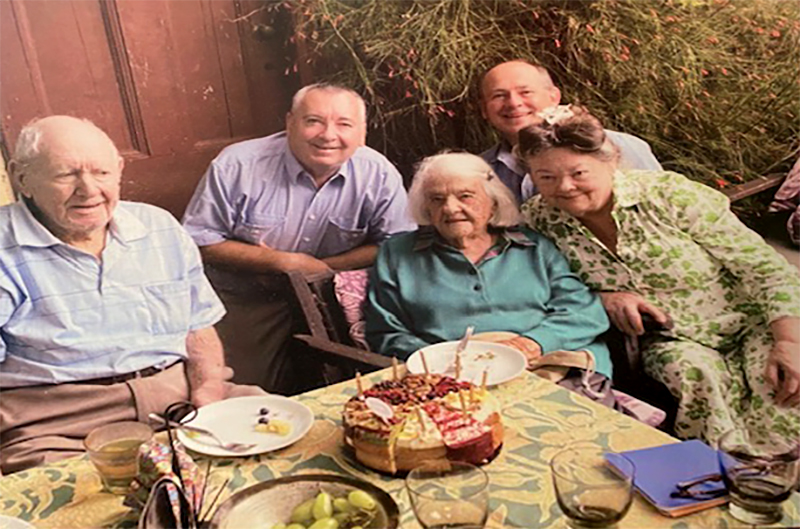
Image above: Neville’s family – Neville, Marcus, Gwen, Dennis and Gwyntha
His worst incident was when he told a student who had long hair, to put on a hair net when extracting. The student refused and his hair caught up in the drive of the extractor and by luck Neville was able to cut the hair to remove the student. This gave him great pleasure as he disliked long hair!
Apiary officers Neville trained when students were Bob Guilford, Bill Smith, Roger Roberts, Warren Jones, Warren Taylor, Debbie Thomas, Peter Stace, Doug Summerville, Bruce Ward, Stan Wilson and me, Bruce White.
The college obtained a truck, a Bedford that greatly assisted in the training of students allowing easy migration of hives. Neville for some reason enjoyed coasting down as many hills as possible, in the bright red Bedford.
The college sold queen bees and Neville pioneered the artificial insemination of queen bees in Australia. The breeding program was very successful and Neville placed a lot of emphasis on honey production docility and “wing hooks”. Of these wing hooks that join the worker bees two wings together in flight on each side, the hook numbers vary between strains.
When the college sold queens and Neville quizzed the beekeeper to ensure they knew how to introduce the queens successfully failure meant no sale
Neville retired in 1987 on his 60th birthday, having spent four years as a district Apiary Officer and thirty four years, as a lecturer. He continued striving to improve honey bee genetics, to sell queen bees and doing pottery.
When the college became a university Agriculture lecturing changed and Neville was asked to teach basic Vet Science. He was lucky as his son was a vet in Victoria, so he was able to supply notes and tutor his father so that he could provide the students with the information for the course.
Neville was very practical having learnt a lot from the commercial beekeepers. He freely passed on what he had learnt to students and especially the apiary officers who were prior students of his and the commercial beekeeping industry
Neville had a keen interest in honey marketing and processing and for many years was the honey and wax judge at the Sydney Royal Easter Show. He was also a honey judge for many country shows. He wrote articles and taught me a lot about honey judging and he taught beekeepers how to prepare exhibits for shows.
Neville was keen on beekeeping associations attending conference and encouraging beekeepers to join associations. His legacy leaves behind countless numbers of beekeepers after passing on his knowledge in his own very special way.
Even when retired Neville continued to offer his help to the industry by allowing hives in his yard to be used for Port Surveillance, as he lived close to the Richmond RAAF base. At the time the council was concerned about his hives and this stopped any more council interest.
Living very close to East Richmond railway station. once a week with his wife, they enjoyed a mystery train trip with his $2.50 Seniors’ card. For many years after retiring, going to Bondi Beach for a swim, was a special destination.
Many an apiary officer, when students, were given extra training. I attended all the three-week long summer schools in Apiculture. A wonderful learning experience because, in those times, aspiring commercial beekeepers from all states attended the live in school and even apiary officers from other states such was the reputation of the training Neville provided.
For one of the students Gretchen Wheen, Neville told her to buy a property at North Richmond. S, he did to become a well-known queen breeder and left the property to the Wheen Bee Foundation, to benefit the industry.
Neville taught Gretchen to artificially inseminate Queen bees and she taught Neville to become a potter.
Banter occurred always during the week-long Summer Schools. Neville always asked if anyone had a BA meaning (Boiler Attendant). One of the beekeepers always seemed to be a boiler attendant, so took the honor of looking after the boiler very seriously. Other beekeepers would block the boiler chimney with a bag as a result you couldn’t see the apiary for smoke. The BAs action was to clean out the boiler tubes till someone said maybe a possum is up the chimney.
At another school after a talk on migration and queens, students placed empty hives borrowed from the college, at night in Neville’s front yard, with a large sign let me supply your queens with skimpy clad female models. His house was on a major road on a corner. The next day Neville had plenty of questions on night migration and the best way to promote queen sales he never let on what had happened.
Neville over his long working career meant so much to so many beekeepers, and he never did retire from his love of beekeeping and educating beekeepers
Neville was deeply religious, and a Baptist lay preacher.
An informal wake is planned for Wednesday 21st January:
An informal wake is planned for Wednesday 21st January at the University of Western Sydney (Hawkesbury} Bourke Street Richmond or enter from Londonderry Road from 1pm to 2.30pm where stories can be shared, and light refreshments will be available
The university has a very strict parking policy and a $6.fee applies with the ticket machine on College Drive The wake will be held at the Apiary Building S17 located off Horticulture Drive (coming from Londonderry Road) or turning right at the end of the main Campus Drive.
If you intend to attend the wake, please advise Bruce White phone 0404462322 or email bruceandlynn@outlook.com, for catering and directions.
A special thanks to the University of Western Sydney (Hawkesbury) for making the facilities available for the wake.