
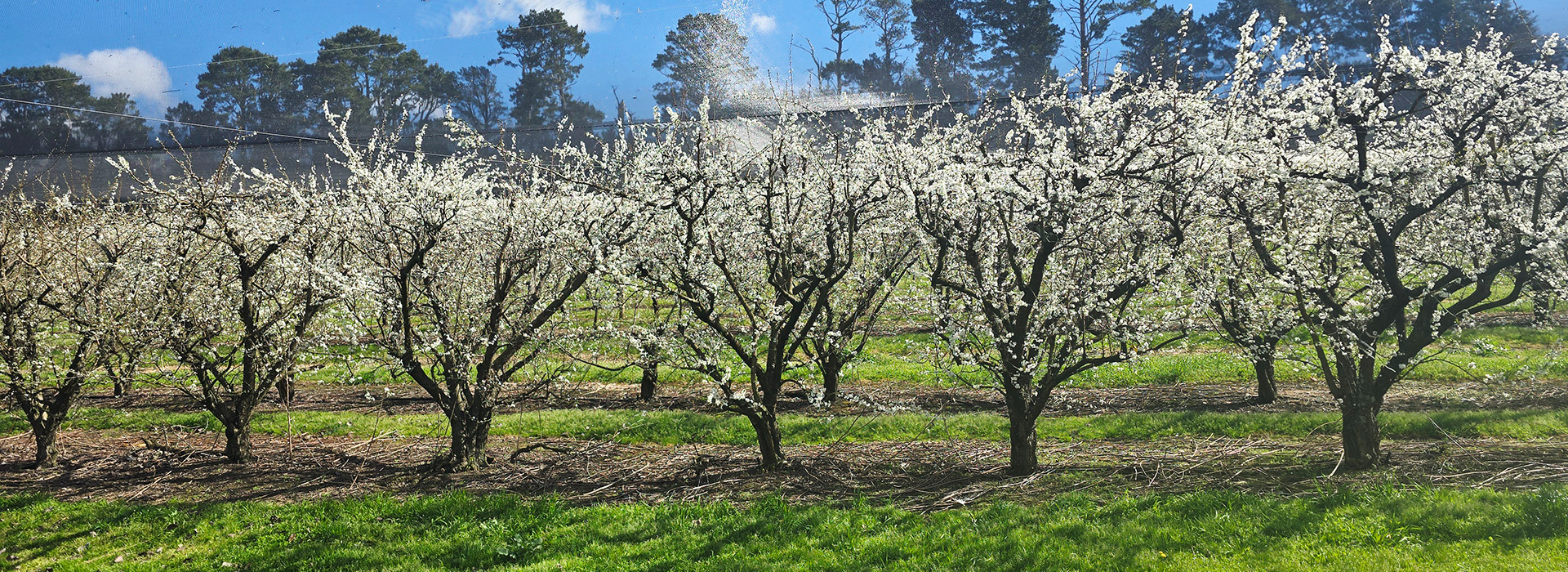
Pollination Failure at Bilpin!
Varroa? Bad Weather? Or Did the Bees Get a Better Offer?
by Ian Spencer
with a lot of assistance
See the panel at the foot of the article.
I sell honey at Bilpin Community Markets and a few weeks ago I heard from other stall holders that something had gone drastically wrong with the fruit pollination this year! Multiple orchards in and around Bilpin have almost no apple crop (Less than 5% of average crop). The situation for stone fruit is mixed. Almost no peaches or cherries, but some plums.
I have heard a few theories as to what happened. Varroa and bad weather are on the top of the list of suspects. As apples and stone fruit are completely pollinator dependent, there is no doubt this is a bee story of some sort.
As beekeepers, we often talk about the importance of pollination to our agricultural production. Much of the fruit we eat relies on bees to pollinate the crop. The economic value of honey product is in the hundreds of millions of dollars per year. According to Agri Futures the value of pollination to agricultural product is in the order of $4.6 billion in 2024. This incident highlights the importance of bee pollination at a local community level.
Where is Bilpin?
The community of Bilpin was one of the first apple growing regions in Australia. Bilpin is situated in the Northern Blue Mountains at 800 m altitude. It’s about one and a half hours drive northwest of Sydney.
The impact of no apples:
The economy of Bilpin is centred on tourism and fruit production (often a combination of both). Most of the orchards offer a seasonal pick your own experience. Depending on the time of year you can pick cherries, plums, peaches, persimmons, strawberries and from January to June apples dominate the orchards.
Day tourists from Sydney come up to Bilpin to buy apples, pick apples, drink apple cider and eat apple pies. A failed apple crop will have a big impact on the local community. Not just the obvious financial impact on the orchardists, but all the other businesses that rely on apple tourism to bring customers to the region.
In the process of putting this article together I visited two orchards and spoke to many people in an attempt to understand what had happened. An outline of the available information is presented below.
What we know for certain:
- Stone Fruit (Peaches, Cherries and Plums) all flowered from mid-August to early September.
- Pome Fruit (Apples with some Quinces and Pears) flowered from mid-September to early October.
- The flowering times were the same for all orchards.
- Both stone and pome fruits flowered profusely.
- The orchardists use paid pollination services from 3rd week of September.
- Ongoing research from Western Sydney University pollination team has shown native stingless bees (Tetragonula carbonaria) are effective orchard pollinators when the temperature is warm enough.
- August weather records indicate only 5 days when it was warm enough (18 ° C) for native stingless bees (Tetragonula carbonaria) to emerge from their hives. Only one day reached over 22 ° C where the native bees are effective pollinators of fruit trees. 2
- September and October weather was much better for native bees. 2
- Varroa is well established in the Bilpin area with some anecdotal evidence from nearby beekeepers that reinfestation rates are now quite low; an indication that feral honeybee colonies may be significantly reduced.
- On 26th September Western Sydney University pollination team reported feral bee pollination visits were down more than 80% in a Bilpin orchard they had been monitoring for 4 years. 3
Image: An apple tree in full blossom at Pine Crest
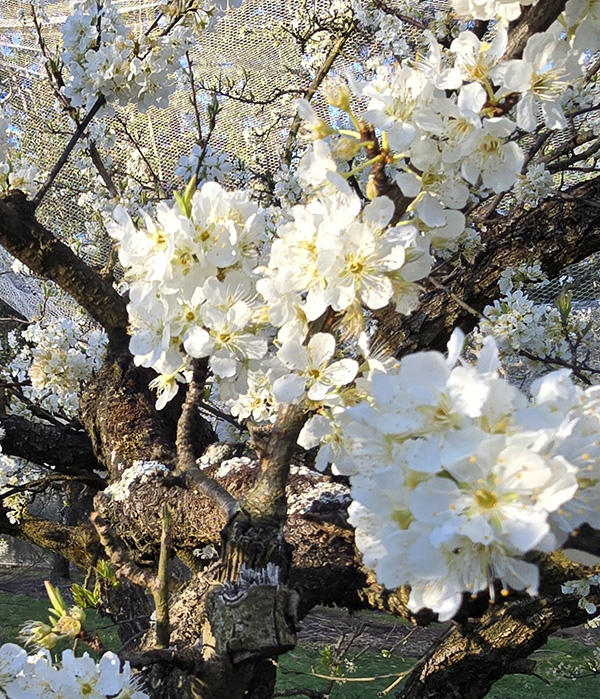
- No pollination service was used in 2023 0r 2024 for either orchard. Average to above average crops were produced both years indicating a high reliance on feral European honey bees and also native bees particularly Tetragonula carbonaria.
- September and October were well below average rainfall, orchards visited were irrigated. Neither John Galbraith nor Bill Shields felt water stress was a likely contributor.2
- September and October were above average temperature. Both John Galbraith and Bill Shields indicated the weather was warm and windy in September / October, but not exceptionally so.2
- The pollination failure was isolated to the Bilpin area. Orchards in Orange, 175 km (as the bee flies) due west and at the same altitude report no pollination problem. 4
- Apples and most stone fruit are not self-pollinating. This means the pollen to fertilize an apple flower must come from a different variety. Apple orchards are planted with alternating variety rows or mixed variety rows.
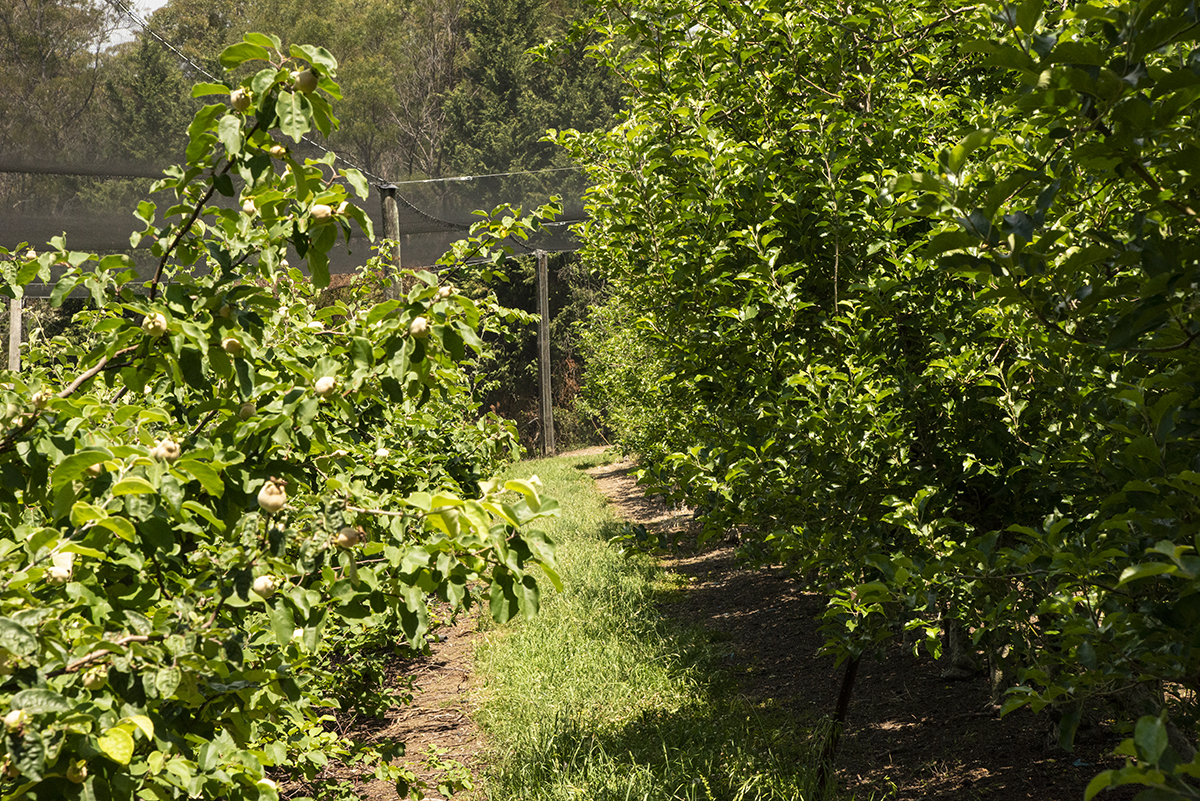
- Quinces which are self-pollinating (i.e. pollen comes from flowers on the same tree) had normal pollination and a normal crop. NB: the quinces at Pine Crest Orchard are surrounded by apples with no fruit set.
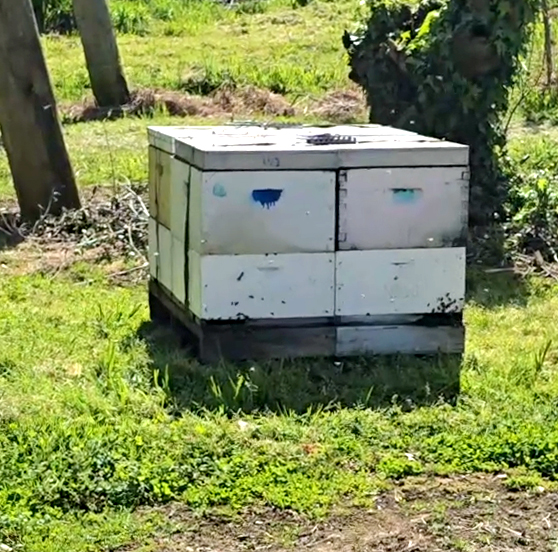
Image Pollinator hives inside the netting at Pine Crest
- Some plum varieties which are self-pollinating (or partially self-pollinating) have produced a moderate crop. 5
- Strawberries and Raspberries (which are also bee pollinated) on the same orchards are producing normal crops.
- Some of the orchards are completely enclosed with hail / bird netting. Some net the trees after pollination is complete. In the netting enclosed orchards, the pollination hives are located under the mesh.
- Bilpin sits on a quite narrow ridge. It is flanked to the north by Wollomi National Park and to the south by Blue Mountains National Park. In places there is National Park on both sides of Bells Line of Road, which connects Bilpin to Richmond to the east and Lithgow to the west. National Park forest is well with in bee foraging range from all nurseries
- There are anecdotal reports that there was a mass flowering of Sydney Peppermint Gum (Eucalyptus piperita) and Mountain Ash (Eucalyptus oreades) in the National Parks surrounding Bilpin during August September and October.
- Orchard fruits like apples and peaches are of low to moderate interest to bees due to average quality of both nectar and pollen 6
Image: Row of quinces with fruit next to a row of apples with no frutit
Pine Crest Orchard:
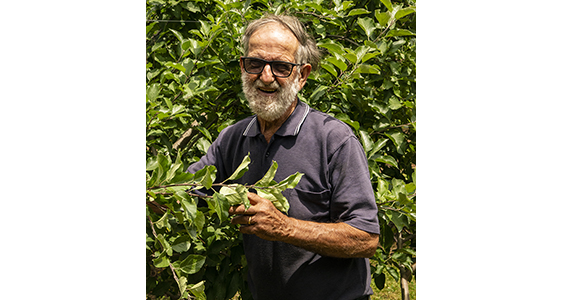
John Galbraith has owned Pine Crest since 1972. The 5 hectare orchard is located at the western edge of Bilpin village. It is a mixture of apples and peaches with some quinces, plumbs, cherries and pears. The fruit orchard is completely enclosed (top and sides) with bird / hail mesh. 23 pollination hives were placed inside the mesh in late September this year. (NB: bees can fly through the mesh.) The orchard is irrigated. There has been an almost complete pollination failure of all fruit with fruit set less than 5% of average yield. There is a reasonable crop of Williams Pride apples and virtually zero crop of other apple varieties. Quinces which are self-pollinating and have a normal crop of fruit. Pine Crest also has strawberries and raspberries.
Shields Orchard:
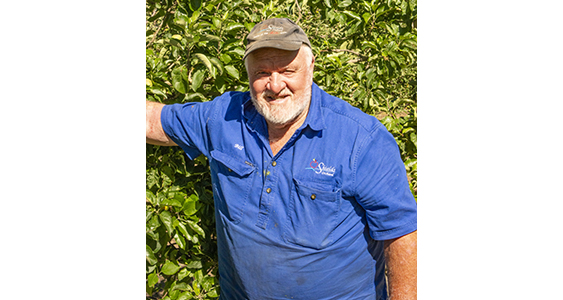
The Shields family has owned the orchard located about 1.5 km east of Bilpin village since 1956. Bill Shields took over the management of the orchard in the 1980s. The orchard is 3 hectares of mixed apple varieties with some peaches and a variety of other fruit. The orchard is fully irrigated. Bill shield nets the trees only after pollination is complete and the fruit is set. He brought in 6 pollinator hives. Bill estimates his stone fruit is about average but Apples vary from 0% to 30% of average depending on variety. As with Pine Crest orchard there are virtually no Pink Lady Apples. Overall, the orchard is somewhere between 5% and 10% of an average crop. Like most orchards in Bilpin it sells all its fruit via the packing room door or a "Pick Your Own" program.
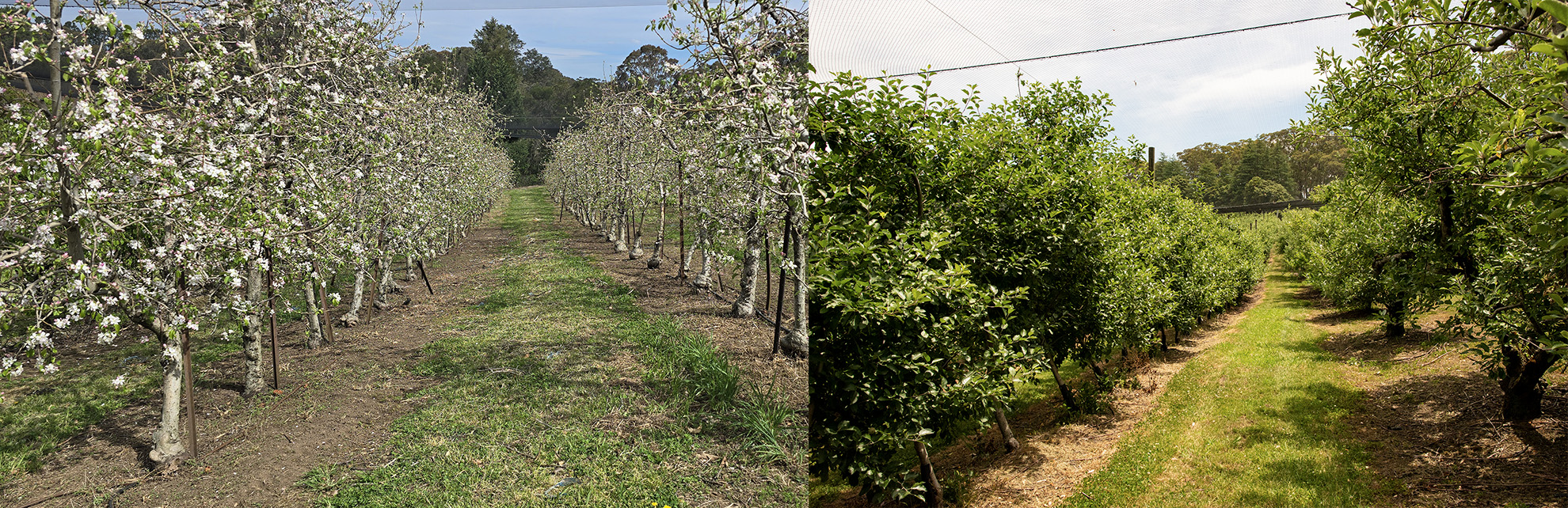
Images above: Image left is rows of apples in flower at Pine Crest orchard. Image right is rows of apples at Pine Crest post flowering, with no fruit. The hail / bird netting is visible in the right image.
What Happened:
There are multiple factors involved in the pollination failure at Bilpin. It is not a simple, single cause and effect problem
- For the last 2 years the Bilpin orchards have completely depended on feral European honeybees and native stingless bees for all pollination. This produced an above average crop in 2024.
- WSU pollination team observations indicate Varroa mite has wiped out most of the feral bee population in the Bilpin area. 3
- Tetragonlula carbonaria activity was limited by low temperature in the August stone fruit flowering period. 2
- These two factors probably account for the extremely low stone fruit set. The low and variable fruit production in stone fruit, is probably indicative of a small residual feral bee population, limited native bee activity and the presence of some other pollinators like hover flies.
- The pome fruit (apples, quinces and pears) pollination failure is more perplexing. Both orchards brought pollination hives into their orchards by about 23rd - 26th September.
- The rate of approximately 5 hives per hectare at Pine Crest should have been adequate. Bill Shields orchard had a lower rate of 2 hives per hectare. Both orchards had similar very poor pome fruit pollination.
- The weather was warm enough in late September and early October for the native bees to be fully productive as apple pollinators. 2
- It has been suggested (but I have no firm evidence) that a major Eucalypt flowering at Bilpin in late September totally distracted both the pollinator honeybees and the native bees, at the peak apple pollination time. Anyone who has seen bees ignore what has been typically good forage for exclusive focus on another nectar flow / pollen source will know this is a reasonable possibility.
- The two flowering species that have been suggested as distracting the bees are Sydney Peppermint (Eucalyptus piperita) and Mountain Ash (Eucalyptus oreades). Both have high quality nectar and pollen.
- Self-pollinating quinces have a full crop in both orchards but non self-pollinating apples in adjacent rows have no fruit. This has everyone scratching their head.
Conclusions:
It looks like Varroa, Cool Weather and the "Bees Got a Better Offer" all contributed.
This incident at Bilpin highlights the impact of the loss of feral bee pollination to Australian agriculture. Bilpin is lucky in that it has a significant population native stingless bee, which may make a big contribution to apple pollination. Stingless bees may not be reliable for stone fruit pollination due to August being too cool. In cooler fruit growing regions like Orange there are no native bees.
The apparent distraction of both European honey bees and Native stingless bees by a major Eucalypt flowering in a neighbouring National Park is probably unique to Bilpin due to its topography. It should be remembered that orchards are only moderately interesting to bees in terms of nectar and pollen quality. So bees will always be open to a better offer! 6.
It would seem, that properly prepared pollination hives will be required at Bilpin from mid August to mid October to cover the pollination of both stone and pome fruit.
This raises a very serious question. Where are these hives going to come from? Bilpin needs probably around 200 dedicated pollination hives from mid August to mid October. In mid August virtually all the available pollination hives are on almonds in southern NSW, Victoria and South Australia. With somewhere between 60% and 80% of the bees in the environment not human managed pre Varroa, there is a huge deficit of bees and pollination to make up. We need more bees and more beekeepers!
The Bilpin orchardists are planning a meeting in early 2026 to discuss a planned approach to pollination for 2026. I have asked to attend and will report in due course.
References:
1 Efficiency and effectiveness of native bees and honey bees as pollinators of apples in New South Wales orchards, Olivia M. Bernauer, Simon M. Tierney and James M. Cook, Agriculture, Ecosystems & Environment, Volume 337, 1 October 2022, 108063
2 Weather records extracted from weather underground station Pup Road - IBILPI6 - Bilpin. NB: This weather station is less than 500 metres from Shields Orchard https://www.wunderground.com/dashboard/pws/IBILPI6
3 Michael Duncan Senior Technical Officer – Apiary Manager, Western Sydny University, Hawkesbury pers. com.
4 Jessica Fernley (DPIRD Development Officer Temperate Fruits) and Cynthia Faulkner President Orange Beekeepers Inc pers. com.
5 Christine Henchman orchardist, Bilpin pers. com.
6 Pollination of apples by honey bees Agnote DAI/132 Doug Somerville 1999 Pollination of apples by honey bees
Thanks to those who helped put this complex story together.
The following people generously provided their time, information and ideas. Orchardists from Bilpin: Christine and Peter Henchman, John and Joanna Galbraith and Bill Shields. DPIRD: Jessica Fearnley-Pattison (Development Officer Temperate Fruits), Orange Beekeepers Inc, Cynthia Faulkner (President) Michael Duncan, Senior Technical Officer – Apiary Manager, WSU Hawkesbury
Joanna Galbraith supplied many of the photos for the article.