
A bee garden by any other name could be an apiary
by Peter Barrett
Caloundra, Queensland

When I first started keeping bees in the mid-1980’s I’d recently relocated from Sydney’s southern suburbs to the lower Blue Mountains. Soon looking for a hobby I came across an advertisement for a hive of bees. As a result I quickly made several new friends: Norm Plenty of Emu Plains who sold me my first hive; Steve Craig, later the owner of Blue Mountains Honey, whom I pipped in acquiring Norm’s hive; and Mark Appleton of Winmalee near Springwood, no finer a man have I ever met.
Thankfully, during my fifteen years of hobby beekeeping I never came across foul brood, and wax moth was controlled with little fuss. Maybe the following story will, for a short time, divert today’s beekeepers’ worries from the challenges of colony loss, braula fly, the threat of exotic bee swarms at Australian ports, the small hive beetle, and particularly, the varroa mite, all of which, thankfully, I never had to face.
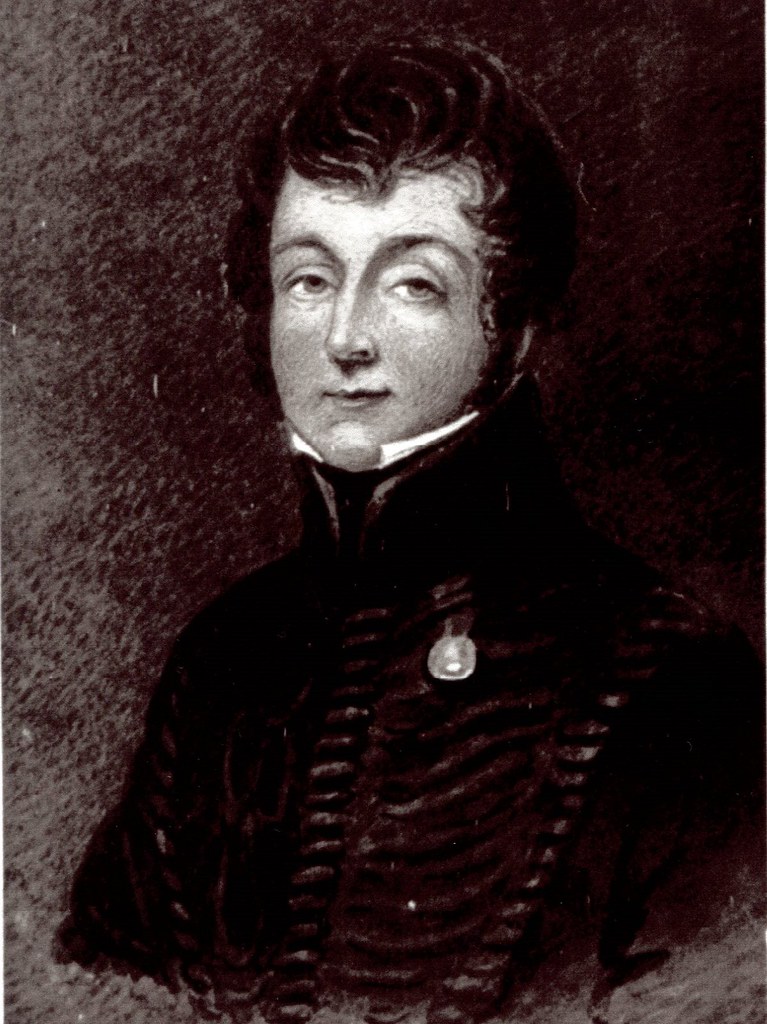
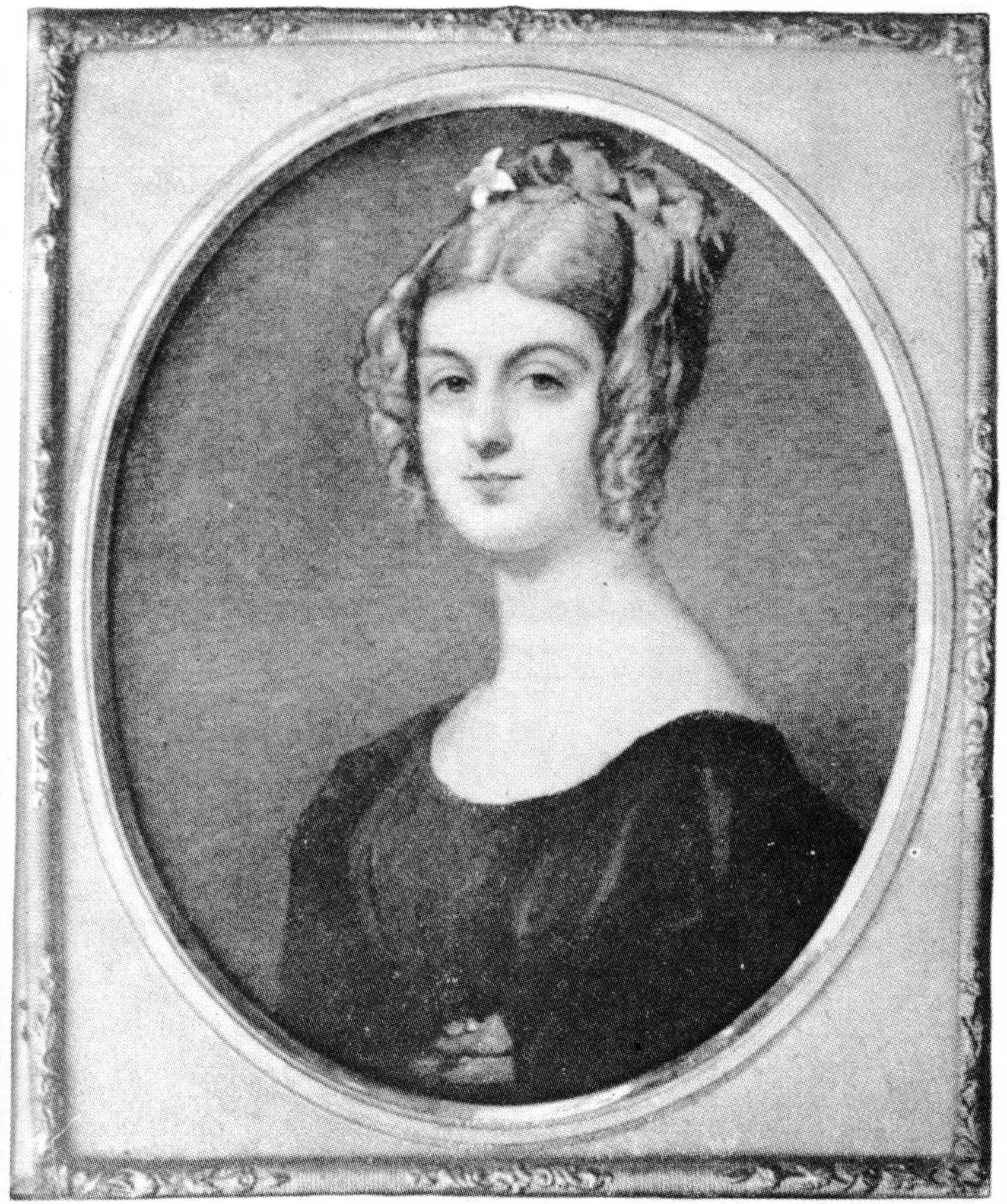
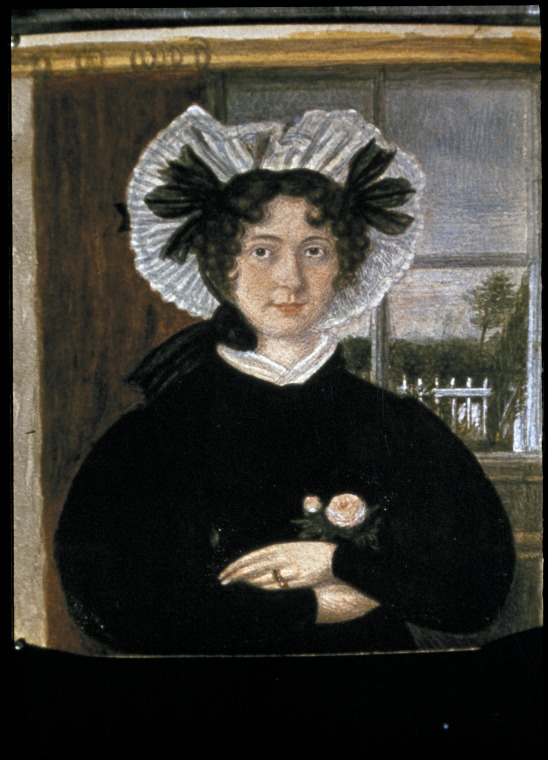
In my 1995 book The Immigrant Bees, I named Captain John Molloy, of whom Marnie Bassett wrote in 1954 “Molloy, over fifty and a veteran of the Peninsular War and of Waterloo, had arrived at Fremantle in the Warrior early in 1830 with his youthful bride [Georgiana] and his sixteen servants, his tools and animals and his hive of bees, all ready to begin life as a gentleman farmer on the grant that he expected on the banks of the Swan.”
Within Molloy’s diary held at the JS Battye Library, Perth, is an entry dated 1st December 1829: “Had the bees upon deck. Inspected them and cleared out the hive and found a great number dead.” I discovered this thanks to R.S. Coleman’s article titled “Beekeeping in Western Australia, Some Historical Notes” which appeared in Western Australia’s 1956 Journal of Agriculture.
Dr. Jessica White, Associate Professor, Creative Writing & Literature at the University of South Australia, recently solved the mystery of the fate of the Molloy bees aboard the Warrior. This she achieved through her research in 2018 at the Carlisle Archives Centre, Cumbria, England, and the J.S. Battye Library, Perth, Western Australia.
Her essay ‘The bees seem alive and make a great buzzing’: Unsettling homes in South-West Western Australia, was reproduced as a chapter in the 2023 book Bees, Science, and Sex in the Literature of the Long Nineteenth Century.
White wrote of the Warrior’s first day out of Portsmouth. "Georgiana observed 'The bees seem alive and make a great buzzing.' On 1 December 1829 she wrote in her diary [1] that she 'opened the bees'. On 2nd December Georgiana checked them again:
'Some bees not out after [my] dinner.' ” Georgiana’s note suggests the hive was transported open entranced and secured within another container, likely a framed woven wire cage, as utilised by Dr. Thomas Braidwood Wilson for his bees during his voyage to Hobart in 1831.
Georgiana noted on the 12th January 1830 in a letter to her mother, [1] written on the day of their arrival in Table Bay at the Cape of Good Hope “several Bees are dead but I don't regret this, as it gives the others more air, [a strange observation] I hope to get them out safe”. Her hive was “a wooden box perforated with holes and a little glass door that lets me see them at work’. After they left the Cape a few weeks later disaster struck the bees: “the Moths got at them and killed the whole hive."
In mid-1830 at Augusta, Georgiana titled one page of her diary "bee garden." White commented "This is followed by a list of plants which included basil, heath and honeywort - plants that produce a great deal of nectar. ... With the assistance of Staples, her gardener, Molloy laid out a flower and vegetable garden which after a year covered nearly two acres. … It was not, however, the honey bee which was pollinating these plants."
Georgiana must have observed the visits to her “bee garden’ by native solitary bees. It's likely she saw Western Australia's yellow and black carpenter bees, or the green variety; reed bees; blue banded, teddy bear, leafcutter, resin, and masked bees, as well as others, Unfortunately, she could not have enjoyed the pleasure of observing native social bees.
From the Museum of Western Australia “Western Australia’s only highly social native bees are the tiny ‘stingless bees’ or 'sugarbag bees’ (Tetragonula and Austroplebeia species) found only in the tropical north. … At least fifty species of bees inhabit the bushlands around Perth and several occur quite commonly in suburban gardens and city parks. Blue-banded bees (Amegilla species) are the most likely to be seen. About the size of a honeybee, they are distinguished by their rotund form and black-and-white-banded abdomen, the white bands often tinged with a bluish iridescence. They visit flowers of many garden ornamentals, both native and exotic, in spring and summer. Their flight is noisy and characterised by alternate hovering and darting.” [5]
Georgiana wrote of her garden "... it is said to be the best … in South West Australia excepting none ... [we] have every sort of British herb & root such as cabbage carrot onion etc., pear apple & peach to the orange tree & vine, tobacco, tamarind & different Cape trees." White discovered Molloy boasted in a letter dated 15th April 1831 to her friend Frances Birkett that her flower and vegetable garden “is more than anyone can say, not even the Governor." A short biography on Trove [6] at the State Library of New South Wales provides: “She thought herself the first person to make a flower garden in Western Australia.”
Despite many attempts in the 1830’s and early 1840’s, the honey bee was not successfully introduced into Western Australia until March 1846. Lt. Helpman R.N. procured some from Launceston aboard the colonial Government schooner Champion. The Sydney Herald, 16 November 1842, noted “It is no long time since that the colony of Western Australia was in convulsions concerning a hive of bees. The Governor wanted bees, the colonists remembered the flavour of honey and desiderated bees, and their children, learning that honey was passing sweet, smacked their lips and incontinently cried for bees also. But not a hive could be got …” (p.3)
Previously to the Molloys, and also from England, George Johnson, and possibly William Hardey, tried in September 1829 aboard the Tranby. John Gregory was another passenger aboard the Warrior in 1830 who was accompanied by his bees. Unfortunately they were drowned in the surf while they were being landed on the South Beach at Fremantle. In 1831 Marshall MacDermott tried on the Stirling; followed by Thomas Henty on the Forth in 1832, whose hive was struck by lightning near the Equator. Mary Bussell on the James Pattison, whose final destination became Augusta in 1834, lost all her in-cabin bees, while another lot of bees aboard her ship abandoned their hive at the London docks before departure.
Charles Innes brought bees to [Albany] King George’s Sound on the Merope from Hobart in March 1834; that same year Mr. Jones, of O'Brien's Bridge near Hobart, took a hive of bees to the Swan River settlement. On at least two occasions Lt. Helpman attempted to bring bees to Fremantle: firstly from Van Diemen’s Land in July 1841, and from Sydney in July 1843.
The bee garden – 17th century
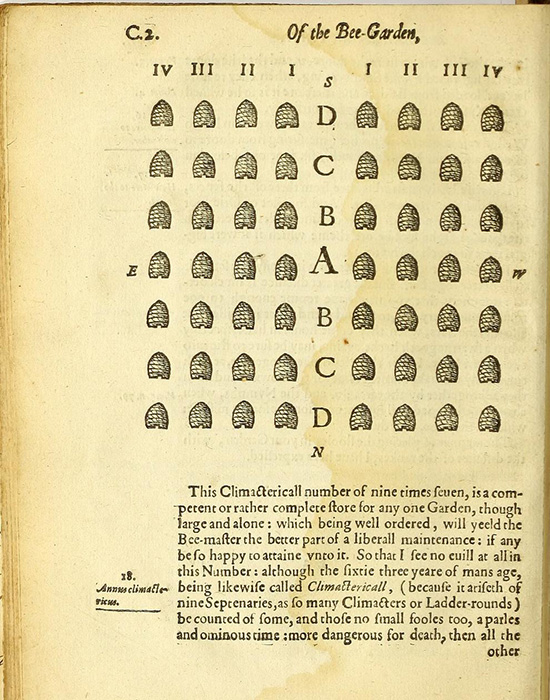
Just over four hundred years ago, Charles Butler's second edition of The Feminine Monarchy, or a Treatise concerning Bees and the due ordering of Bees, was published in 1623. In it Butler drew a plan headed “of the Bee-Garden” where the skep style hives were laid out in a square pattern, nine hives wide by seven hives deep. He wrote “This climactericall [9] number of nine times seven is a competent or rather complete store for any one Garden, though large and alone; which being well ordered, will yeeld [sic.] the Bee-master part of a liberall [sic.] maintenance; [10] if any be so happy to attaine [sic.[ into it.” In context I think “maintenance” refers to “income”
In Roberts Gray's book A good speed to Virginia, published in London in 1609: “The maister of the bee-garden ... reapeth a greater gaine by his waxe and honie."
19th century
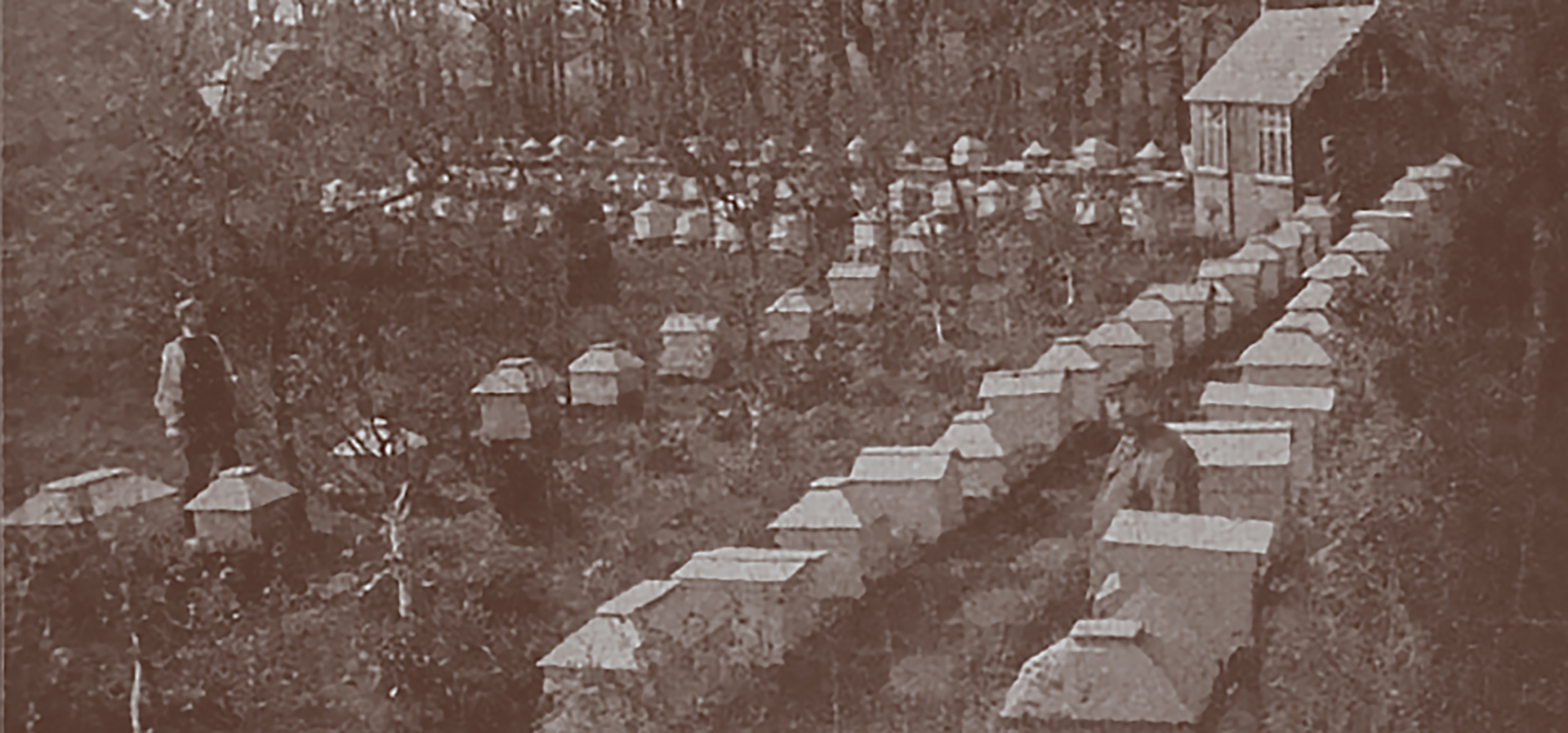
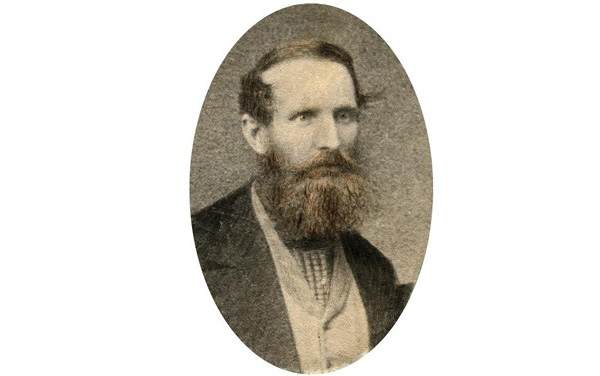
Noah Webster’s 1864 Unabridged Dictionary defines a bee garden as “a garden or inclosure [sic,] to set beehives in; an apiary.” The Royal Dictionary-Cyclopaedia published in London and New York in 1862 provided an identical definition. The Garden magazine, 3 Feb. 1883, gave an emphatic definition of a bee garden, being a "bee stand (apiary)" (p.123). The British Bee Journal, 28 July 1898 (p.295) published a series of "bee-garden" pictures from late 1896 in its “Home of the Honey Bee” series. The smallest number of hives eligible for depiction was arbitrarily set at six. In respect, the following image was presented posthumously.
Gleanings in Bee Culture, 1 July 1898 Mr. Howard stated “So far as the picture of my bee-garden, I may say that … at Holme, not only bees, but flowers, fruits, and vegetables get attention.” (p.509)
Howard’s expanded description seems more appropriate to today’s interpretation where trees, plants and herbs attractive to bees are planted, whether stand alone, or in concert with the presence of bee hives. Chambers's English Dictionary of 1893 published in Edinburgh captures its meaning, simply: “a garden in which bee hives are kept.”
Pettigrew's The Handy Book of Bees, being a practical treatise on their profitable management, published in Edinburgh in 1870, allocated a four page chapter to the subject “The Apiary or Bee-Garden.” He recommended “a warm sheltered corner is recommended for the home of bees” one with “an open space in front.
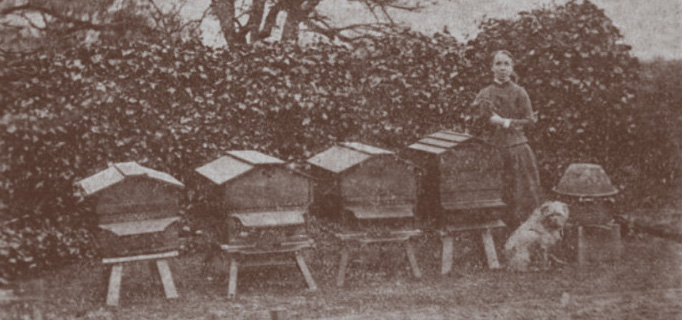
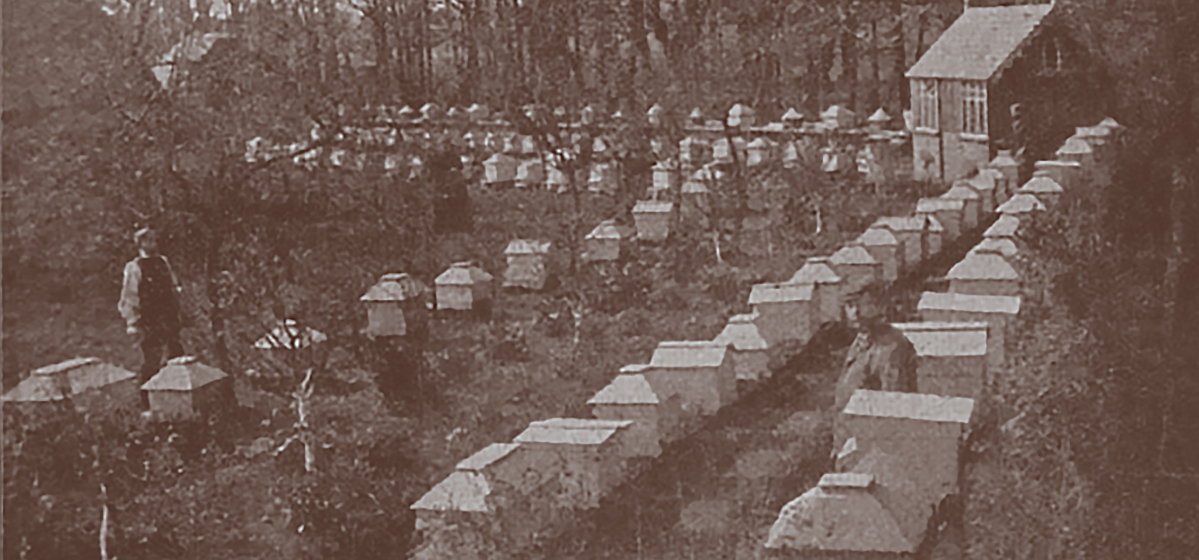
… It is not which garden, but which place in the garden shall the bees occupy? For every bee-keeper consults his own convenience in the choice of a spot on which to place his bee-hives. … So far as honey-gathering goes, one corner of a garden will answer as well as another. And it does not matter much, if anything at all, whether the hives look east or west, north or south.” (pp.62-65)
20th century
Over time the necessity to maintain the presence of honey bee hives in a bee garden to make it such has waned. Books, journals and the web now provide an abundance of information on bee gardens, specifically those containing trees, plants and herbs beneficial to bees, both native and introduced.
Specific to Western Australia I found this site: https://piessefulbeeshoney.com.au/bee-garden/ Posted recently on 26 November 2025, it’s titled “How to Create a Bee Garden in WA – Support Native Bees and Honey Bees All Year Round.” It’s well worth a read. It seems the bee garden concept has come full circle in 200 years. I’ve no doubt Georgiana would have heartily approved.
[1] See Hasluck, Alexandra (1955, 1960) Portrait with Background, a life of Georgiana Molloy, Oxford University Press, Melbourne.
See also https://www.wanowandthen.com/John-Molloy.html
[2] https://en.wikipedia.org/wiki/Georgiana_Molloy
[3] White cited: “Diary of Georgina Molloy, 23rd November 1829, 2877A/1, JS Battye Library
[4] White cited: “Letter from Georgina Molloy to Elizabeth Kennedy, 12th January 1830, DKEN 3/28/9, Carlisle Archives Centre”
[5] https://museum.wa.gov.au/research/collections/terrestrial-zoology/entomology-insect-collection/entomology-factsheets/native-bees
[6] https://trove.nla.gov.au/people/742076
[7] Image at State Library of Western Australia
[8] from Picture Victoria. Original held by Corangamite Regional Library
[9] From the Latin climactericus. Use of this word means “a major turning point or critical stage.” Its use fizzled out around the beginning of the second half of the 19th century. The significance of the number 63 to some in history is a whole other study.
[10] In context I think “maintenance” refers to “income”