
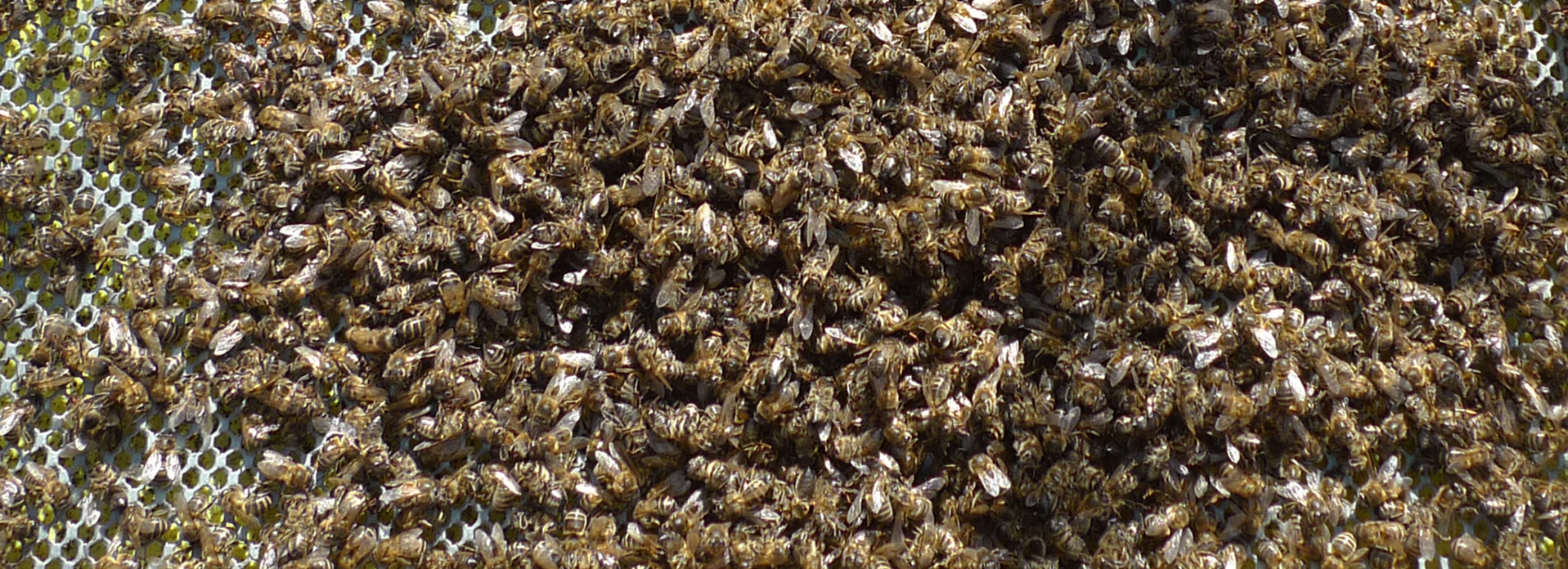
Dead bees on the bottom board of a hive. Courtesy of The Animal and Plant Agency (APHA) Crown Copyright
Alert! Dead Honey Bees Outside the Hive Entrance!
Many beekeepers have been faced with the problem of identifying the cause of the demise of their bees, when dead bees are piled up, at the hive entrance.
The list of possible causes is quite long! Bacteria, viruses, pests, microsporidia, predators or pesticide poisoning? And, there are many different diseases/problems lurking within those broad headlines.
Many infections require microscopy to define the precise problem, but often, pesticide poisoning is the last to be considered. Honey bees, being insects, will be poisoned by any insecticide that has been administered along their forage routes, on plants, in water supply or sprayed into the atmosphere.
Pesticide poisoning is probably more frequent than realized. Experienced beekeepers know that if the colony has been in good health, stores of pollen and honey are plentiful and known pests have been managed, then pesticide poisoning is a very real possibility.
Guide to Understanding Pesticide Exposure Risks for Bees
by Dr. Isabella Lippi, SCU, BREL

The impact of pesticides on bees depends on two main factors: toxicity (how harmful the pesticide is to bees) and exposure (how much a bee encounters it). A less toxic pesticide can be harmful if bees are directly exposed to during application, while small amounts of residues of highly toxic pesticides drifting onto flowers can also cause serious harm (May et al., 2015).
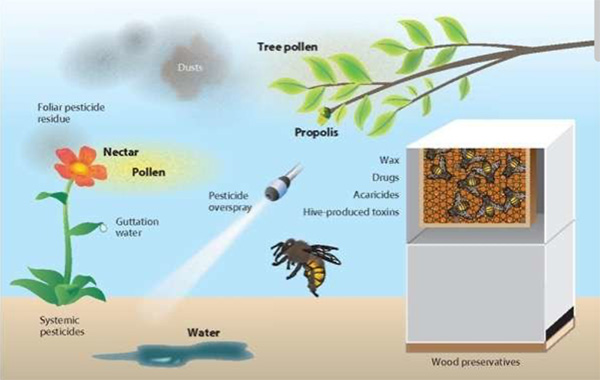
How Bees Are Exposed to Pesticides
There are several ways that bees encounter pesticides:
- Direct Contact During Application: This happens when bees are flying or visiting flowers while pesticides are being sprayed. Direct exposure can kill bees immediately or cause them to carry toxins back to the colony, affecting other bees.
- Indirect Contact from Sprayed Surfaces: Bees can pick up pesticide residues when they land on leaves or flowers that have been sprayed. The risk usually decreases once the pesticide dries or breaks down under sunlight. However, some pesticides create harmful secondary compounds as they degrade. Pesticides that are quickly absorbed by plants may pose a lower risk of indirect exposure to bees.
- Pesticide Drift: Pesticides can be carried by wind onto nearby blooming plants, water sources or bee colonies. Drift can be reduced by using coarser sprays (larger droplet sizes are heavier and so fall faster to the ground) and avoiding application in windy conditions. The type of pesticide formulation also matters—water-based and oil-based sprays behave differently in the air.Another major risk occurs during planting, especially with seeds treated. Many coated seeds release contaminated waste talc as dust when they are planted. This pesticide-laden dust can spread into the environment and expose bees to toxins (Krupke et al., 2012).
- Ingesting Contaminated Pollen or Nectar: Some pesticides, like neonicotinoids, are systemic, meaning they are absorbed by plants and spread through their tissues. These pesticides can be applied as sprays or seed treatments and are then taken up by plant roots. They work well against sucking pests like aphids but can also contaminate nectar, pollen, and secretions via extra floral nectaries. Some systemic pesticides are more toxic to bees than others, and certain chemicals are far more dangerous when ingested than when touched.
- Contaminated Water Sources and Spills: Bees collect water, so they can be exposed to pesticides through contaminated water sources or accidental spills. Keeping clean water sources on the farm and preventing pesticide spills can be important to reducing bee exposure to some crops.
Pesticides can accumulate inside the hive and be found in honey, bee bread, wax, royal jelly, and propolis. When forager bees are not exposed to a lethal dose, which can immediately kill them, they may bring contaminated food or carry pesticide particles on their bodies, leading to the buildup of toxic substances within the hive. This can lead bee colonies to be exposed to sublethal doses. If the dose is not high enough to cause immediate mortality (sublethal dose), it can still have detrimental effects, such as impacts on the bee’s immune system, which makes bees more susceptible to pests and diseases. Additionally, it may cause bees to experience memory loss (Farooqui, 2013; Christen et al., 2016), movement difficulties (Lunardi et al., 2017), impaired colony development, may have negative impacts on the queen’s reproductive success (Williams et al., 2015; Chaimanee et al., 2016) and reduced foraging activity (de Castro Lippi et al., 2024a;2024b).
Synergistic Interactions
In toxicology, synergism refers to the phenomenon where exposure to two or more stressors simultaneously results in health effects greater than the sum of the individual stressor' effects.
- Varroa treatments: Miticides can affect bee health both individually and in combination. Using multiple miticides simultaneously—such as tau-fluvalinate (Apistan) and coumaphos (Checkmite+)—can increase toxicity and lead to bee mortality (Johnson et al., 2009; Tihelka, 2018). Laboratory bioassays have demonstrated that these interactions are not limited to miticides alone; combined exposure to acaricides, antimicrobial drugs, and fungicides can also produce harmful effects on adult worker bees (Johnson et al., 2013). Additionally, hives regularly treated with oxytetracycline and miticides have shown adverse outcomes, especially when these compounds are applied together (Hawthorne & Dively, 2011). Certain pesticide-miticide combinations may also heighten bees’ sensitivity to toxic effects under specific conditions (Rinkevich et al., 2017).
- General interactions: The combination of the neonicotinoid imidacloprid with other pesticides such as tetraconazole, sulfoxaflor, or oxamyl significantly increases toxicity by 20%, 15%, and 26%, respectively (Zhu et al., 2017). In Western Australia, bees exposed to both Nosema apis and the neonicotinoid thiamethoxam exhibited a marked decline in health. Worker bees showed increased mortality and reduced immunocompetence, even when the pesticide concentration was lower than levels typically found in bee bread from colonies near canola crops (Grassl et al., 2018). Furthermore, the use of neonicotinoid-treated seeds followed by the application of additional pesticides later in the crop cycle may result in synergistic toxic effects (Wang et al., 2020).
How to Use This Honey Bee Pesticide Table
The linked table has been developed to support the interpretation of results provided by beekeepers when they have sent samples in for testing suspected pesticide poisoning events. The table describes commonly reported pesticides impacting bees, notes on the type of spray, what crops the sprays are often used on, what the lethal dose of that pesticide is and additional notes. Pesticides that are highlighted in blue are banned in Australia or are not legally registered for use.
Symbols:
< meaning lower
> meaning higher
Oral LD50: The amount of pesticide ingested by a honey bee that gives a 50% chance of mortality
Contact LD50: The amount of pesticide absorbed by a honey bee that gives a 50% chance of mortality
See appendix 1 and 2 to learn more