
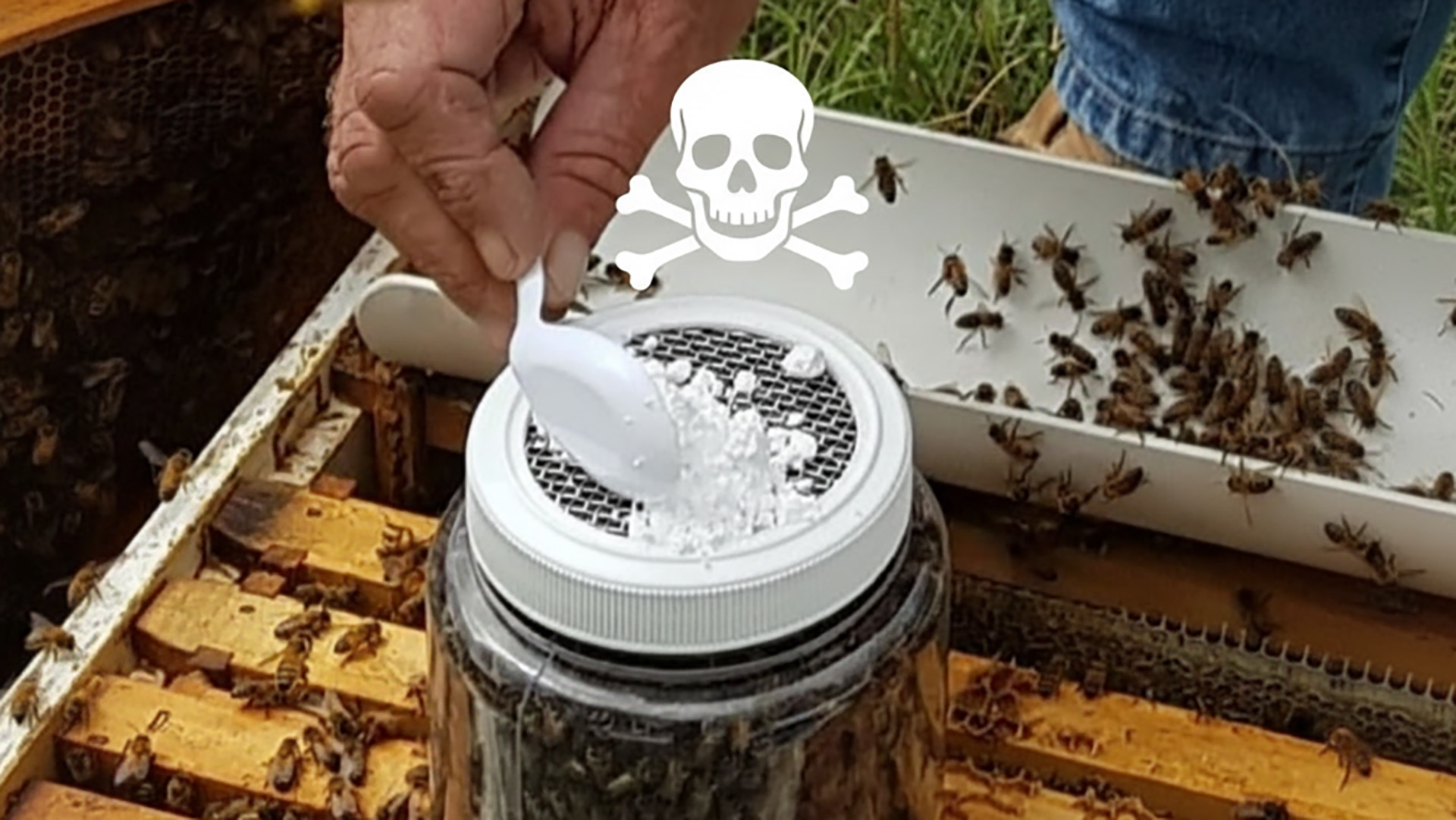
Sugar shake kills bees slowly - image edited NSW DPIRD
Let’s Stop Sugar Coating It:
The Powdered Sugar Shake Is Not Harmless
By Mike Allerton

The powdered sugar shake has been widely promoted as the gentler option for monitoring Varroa destructor, especially among recreational beekeepers who feel uneasy about killing a small sample of bees in an alcohol or soapy water wash. For years, the assumption has been that bees walk away unharmed after being dusted with sugar and shaken in a jar. A newly published scientific paper by Selina Bruckner, Geoffrey R. Williams, Jennifer Tsuruda, and Robyn M. Underwood now provides clear evidence that this assumption is incorrect. Their study, Let’s Not Sugar Coat It, The Powdered Sugar Shake Is Not Harmless for Honey Bee Workers, https://doi.org/10.1080/00218839.2025.2550855 demonstrates that the procedure causes measurable harm and premature mortality in worker bees. This work fills a decades-long gap in bee science, because until now nobody had properly tested whether the bees subjected to this method actually survive and reintegrate into the colony.
I participated in the national Bee Biosecurity Technical Working Group in 2024, where we reviewed recommended monitoring practices, including the sugar shake. At the time, early research drafts and discussions suggested that sugar shaking might be harming bees, and I raised this concern with the group. However, because the paper was not yet published, the evidence was considered preliminary. The release of the peer reviewed study now confirms that those early concerns were justified.
The authors conducted a rigorous mark, release, and recapture experiment that spanned colonies in Alabama, Tennessee, and Pennsylvania. In each colony, 900 worker bees were collected from brood frames using standard Varroa monitoring techniques. These bees were immobilized on ice, individually marked with paint on the thorax, and assigned to one of three groups, the powdered sugar shake group, the powdered sugar coat group, and a control group. The powdered sugar coat group served as an important additional control, because it allowed the authors to determine whether the sugar itself, without shaking, contributed to mortality. Each group contained 300 marked bees. The powdered sugar shake group received two tablespoons of powdered sugar through the screened lid of a jar, and the jar was rolled gently until bees were completely coated. After resting for two minutes, the jar was inverted and shaken vigorously for one full minute, a standard sugar shake procedure used by beekeepers worldwide. The powdered sugar coat group received the same sugar coating but was not shaken. The control bees were marked and released directly.
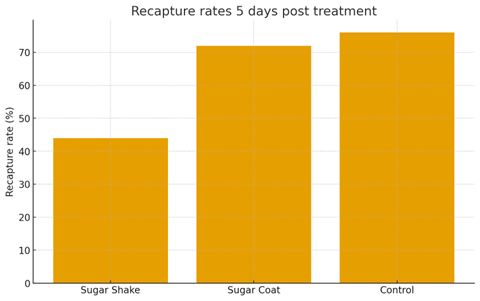
Five days after the bees were released back into their hives, the researchers photographed all comb frames and counted how many marked bees in each treatment group had survived and returned. These recapture rates provide a reliable estimate of short-term survival. The results were striking. Only 44 percent of sugar shaken bees were recaptured. In contrast, 72 percent of the sugar coated but not shaken bees were recaptured, and 76 percent of the control bees were found. The sugar coating alone did not reduce survival. The shaking did. This means the physical agitation involved in the procedure causes harm that shortens the life of the bees. The effect was consistent across all locations and colonies. Shaking bees inside a container, even for only one minute, resulted in injuries and stress strong enough to reduce the likelihood that those bees would be found alive in the hive five days later.
This published evidence supports observations made independently here in Australia. Sam Giggins, Bee Biosecurity Officer with NSW DPIRD, conducted his own monitoring trials and found that bees subjected to sugar shaking failed to reintegrate into the hive at rates similar to those reported by Bruckner and colleagues. These parallel results, produced independently and on different continents, reinforce the conclusion that sugar shaking is not harmless and should not be promoted as a welfare friendly option.
During my time as a contract trainer delivering the national Varroa Workshops, we explained that alcohol wash is, counterintuitively, the more humane method. The alcohol wash kills bees instantly. The sugar shake keeps them alive initially, but many die slowly after stress or injury caused by the shaking. Beekeepers often avoid alcohol wash because they feel uncomfortable intentionally killing bees, but the new research makes it clear that sugar shaking causes far more prolonged suffering. The welfare argument that once justified sugar shake no longer holds.
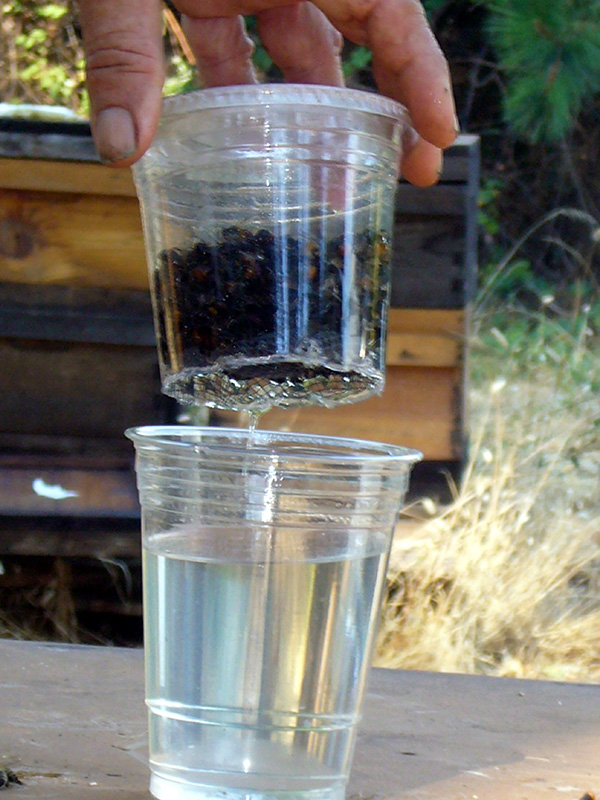
Beyond bee welfare, accuracy matters. The study also compared mite recovery using a powdered sugar shake followed immediately by an alcohol wash on the same sample. This allowed the authors to determine how many mites the sugar shake missed. They found that the sugar shake recovered an average of 89 percent of mites, but the range varied widely from 67 percent to 100 percent depending on colony conditions. This variability is well known by field trainers and is influenced by humidity, nectar flows, and sugar clumping. If a beekeeper is unlucky and the sugar shake recovers only two thirds of mites, they may dramatically underestimate infestation and delay treatment. Accurate monitoring is essential to prevent colony losses, and alcohol wash consistently provides the most reliable results.
A sample size of 300 bees may sound like a lot to new beekeepers, but it represents less than one percent of a healthy colony. Colonies lose far more than that every day through natural attrition, with older foragers dying away from the hive. When weighed against the risk of misinterpreting a low accuracy method or harming bees through physical stress, the alcohol wash becomes the clear ethical and practical choice. The new research reinforces this and should shift community expectations away from sugar shaking altogether.
As the evidence now stands, sugar shake is harmful, less accurate, and highly variable. Alcohol wash and soapy water wash are superior in both welfare and reliability. Thanks to the careful and methodical work of Bruckner, Williams, Tsuruda, and Underwood, beekeepers finally have the scientific clarity needed to update best practice. The beekeeping community should move forward with confidence and adopt alcohol wash as the preferred monitoring method.
Read the paper here: https://doi.org/10.1080/00218839.2025.2550855