Learning About Bee Debris
By Ray Baxter,
BBKA Member, author of “Bottom-Up Beekeeping”
*Originally published in BBKA News, March 2026-reproduced with permission of the author.

This is the first of four seasonal articles for 2026 that explores how honey bee debris can be used to inform everyday beekeeping practice. This article considers what hive debris can tell us about colony activity, shares some recent observations from my ongoing work, and concludes with practical tips for beekeepers interested in using a mobile phone camera to study debris at the hive floor. (NB this is a UK article written as the northern hemisphere spring was just starting)
Modern beekeeping education places strong emphasis on understanding colonies through internal inspection. We remove roofs, separate frames, look for eggs, brood, stores, the queen, and signs of disease. These inspections undoubtedly have an important role in colony management. However, they are also intrusive and deeply disruptive, causing stress to the bees and often providing little more than a brief snapshot of colony condition.
Bottom-up beekeeping proposes a complementary approach: learning to understand the colony through careful observation when it is left undisturbed. When we use a mobile phone camera to record debris patterns, we can begin to ask different questions - what the colony is doing, rather than what it looks like when opened. Over time, these observations may help inform not only whether intervention is required, but also when, why, and how best to act in ways that support the colony.
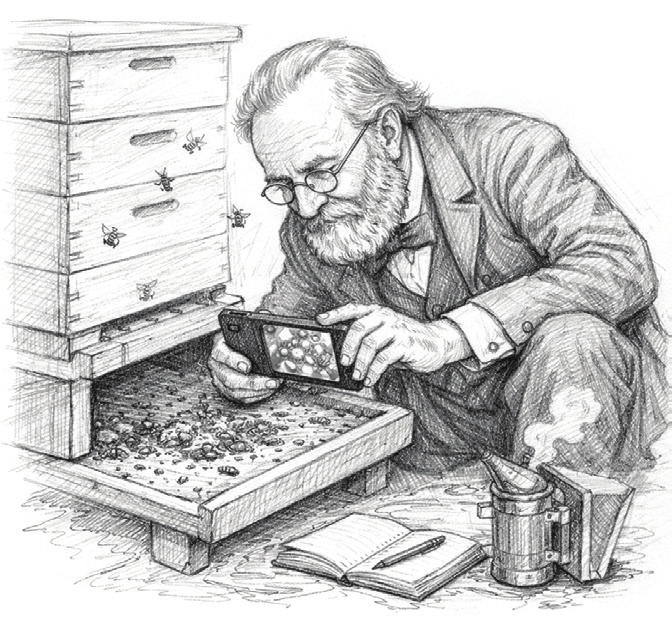
It is difficult to imagine that Langstroth - an exceptionally careful observer and meticulous recorder of detail - would not have embraced such an approach. In *Langstroth on the Hive and the Honey-Bee* (1853), he explicitly draws attention to hive debris, comparing it to the shavings on a carpenter's workshop floor. He notes that bottom boards may be 'covered with parings of comb and with small pieces of bee-bread,' recognising this material as a meaningful by-product of colony activity. Had the magnification and recording capabilities of modern mobile phone cameras been available, it seems feasible that Langstroth would have extended his observations considerably as suggested above in this AI-generated playful exploration of how Langstroth might have used his mobile phone camera to study debris.
Photographing debris - what it tells us about the colony
The debris pattern on an inspection board is not random. It reflects the structure and activity of the living system above and can be thought of as a record of colony function, rather than as waste. Similar to the way that a shadow outlines the form and movement of an object without actual contact, hive debris offers insight into colony dynamics without the need to open the hive.
The pattern we see on the board is a visual representation of the colony's transformation of energy: solar energy captured by plants as nectar and pollen is converted by bees into heat, brood, wax, and
stored food. The material that accumulates on the hive floor is the residue of these processes. Unlike a conventional shadow, debris has depth as well as area. Its area indicates the physical footprint of the cluster, while the height, width (and weight) of each debris seam between individual frames provides a useful proxy for relative activity above them. Broader and deeper accumulations are associated with areas of greater biological work. The constitution of the parts provides insights about the kind of work happening above.
Recent observations
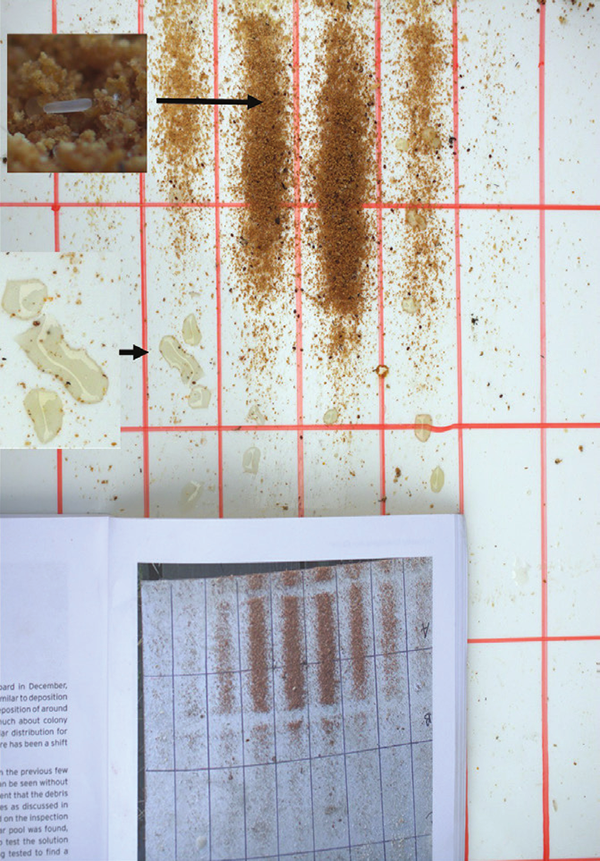
It is the beginning of the third year of this study, and patterns are starting to emerge. Figure 2 shows 28 days of December 2025 debris from a single overwintering colony, alongside debris from the same colony one year earlier. In both years, the winter cluster is positioned towards the southerly aspect of the hive, demonstrating how debris patterns can reveal repeatable spatial behaviour. The image also shows a clear reduction in colony size: in December 2025 the colony occupied four seams, compared with six seams the previous December (later, I will use debris to suggest a plausible explanation for this change).
Across the past three winters, two recurring features have appeared in debris from overwintering colonies: liquid droplets around the periphery of the winter cluster, and the repeated presence of honey bee eggs in the debris (inset, Figure 2). At present, neither observation can be explained with certainty. The eggs may originate from either the queen or worker bees, with each possibility carrying different implications for colony organisation during periods of reduced brood rearing. Their repeated appearance across multiple winters suggests these are less likely to be anomalies and may represent under-recognised aspects of overwintering biology.
Both features have prompted closer investigation - one of the most rewarding aspects of bottom-up beekeeping. The liquid droplets are particularly intriguing. All examined droplets have the taste and appearance of honey (tasting not recommended), and microscopic examination reveals pollen grains of varying types. These observations
suggest the droplets are not simple condensation. One idea could be that they mark the active feeding boundary of the winter cluster.
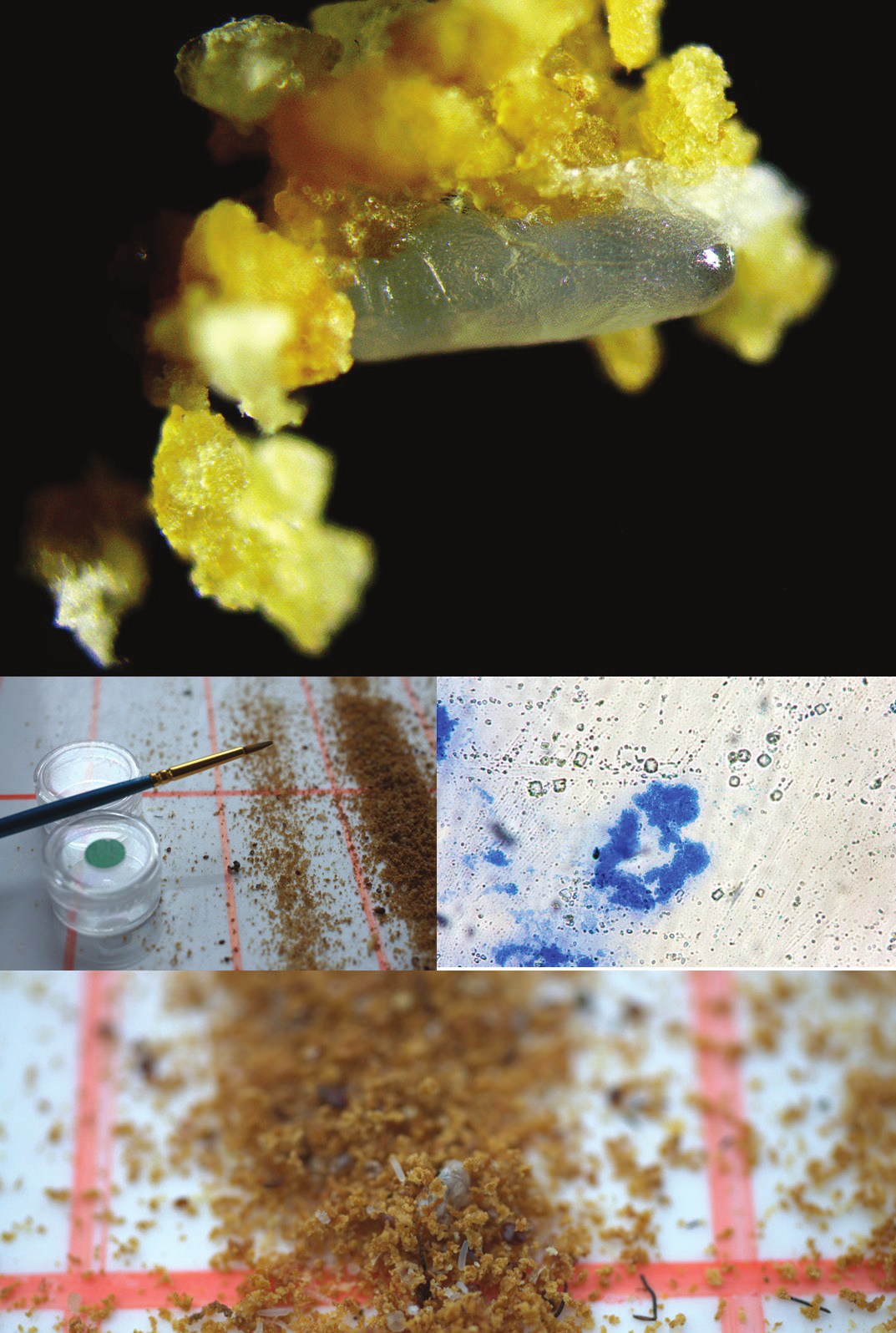
The presence of eggs raised a different set of questions. There are only two possibilities: they were laid by a queen or by a worker. Initial consideration of differences in the egg's outer membrane (the chorion - see Figure 3) proved unhelpful, as although fertilised and unfertilised eggs differ, these distinctions cannot be seen once the egg has been laid.
Attention then turned to microscopy. Fertilised queen eggs have two sets of chromosomes, while worker-laid eggs only have one set, raising the possibility that chromosome staining might help distinguish between them. After dissolving the chorion and staining the egg contents, regions of blue-stained material became visible. While intriguing, this is not yet conclusive, as such stains may bind to other cellular structures. More specific staining would be required to confirm the presence of chromosomes.
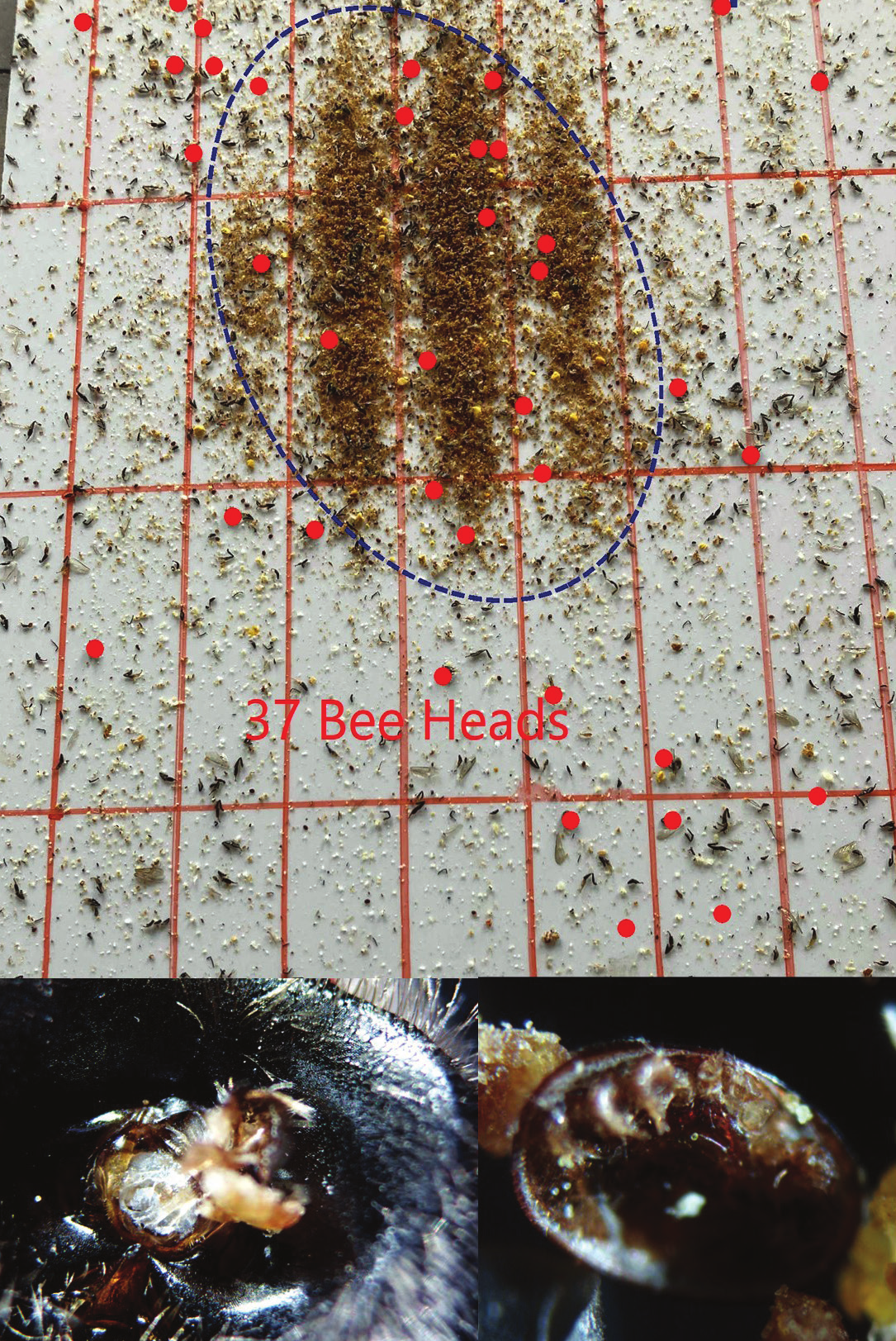
Earlier in this article I said I would offer a plausible explanation for the reduced colony size. Figure 4 shows 37 amputated honey bee heads deposited over 14 days in November, a pattern characteristic of wasp predation. This represents only a fraction of total losses, as only remains falling through the ventilation screen are recorded. Even so, the damage appeared significant for a colony heading into winter and raised concerns about survival. Despite this, there is now cautious optimism - another reminder of the resilience of honey bees. Microscopy of the debris showed the site at which the head was severed and also a few mites with legs amputated. Whether the latter was related to the wasp attack is less clear, but an interesting observation.
These observations represent only a small part of what emerges when debris is recorded systematically over time. Extending this work to a 10-year record would create a colony-specific baseline against which change could be measured. This is the task I have set myself, with the simple aim of improving my own understanding and beekeeping practice - and, hopefully, encouraging others to look more closely beneath their colonies.
From hive floor to phone screen: practical guidance
With nothing more than a phone camera, beekeepers can now create consistent, time-stamped records of hive debris without opening the colony. Bottom-up beekeeping shows how debris photography allows change to be observed as a process, revealing how colonies grow, contract, and everything in between. Many beekeepers find this form of observation not only informative, but genuinely enjoyable - encouraging curiosity, careful attention, and new questions. Recording debris in this way does not require specialist equipment, but it does benefit from a little forward planning. The key principle is consistency, not perfection. Simple, repeatable choices made early on will make records far more meaningful in the long term. I have learned that the following points help.
Select a suitable debris board material
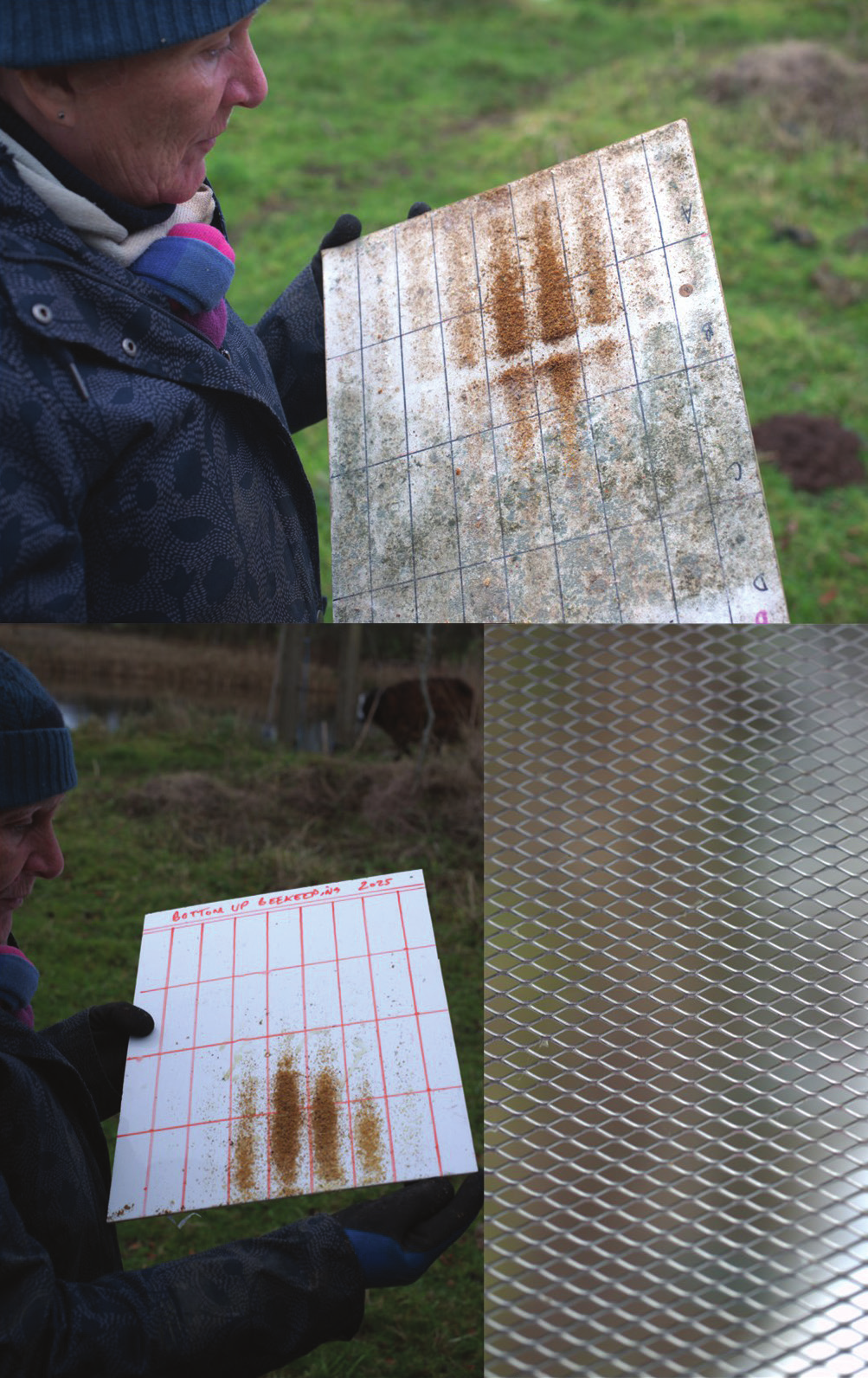
Debris can be collected on many surfaces, but smooth, non-absorbent materials are easiest to work with. White Perspex performs particularly well, as it is easy to clean, simple to photograph, and reveals subtle colour and texture differences (see Figure 5). Whatever material is chosen, use it consistently to allow comparisons over time.
Add structure with marked quadrats
Drawing simple grids on the debris board helps turn scattered debris into something measurable. Quadrats make it easier to compare activity between frames, across months, and between colonies (see Figure 5).
Standardise ventilation screens
The gap size of ventilation screens influence what debris reaches the board. If you are hoping to make fair comparisons between different hives then using the same kind of ventilation screen will be important.
My ventilation screens have 5.5 holes per cm².
Finally, photograph debris using consistent lighting, distance, and angle. Used carefully and regularly, a mobile phone becomes a powerful tool helping beekeepers learn directly from their bees, one photograph at a time.
Choose a sampling period that fits your aims
There is no single 'correct' sampling duration when it comes to recording hive debris. The best approach is the one that fits your questions, your bees, and your routine. Although I describe a 28-day sampling period in my book, I have experimented with different strategies, including daily, weekly, and fortnightly records. All can be useful in the 'right' situation.
Given this article will be published in March, many UK colonies will be in the early stages of spring expansion. There is no need to open the hive to look for growth. Instead, place a debris board beneath the colony and use your mobile phone to photograph it over two consecutive seven-day periods. A simple side-by-side comparison of those images will, hopefully, reveal meaningful changes in colony activity. I am confident that this small step will be enough to spark curiosity and that once beekeepers start to see patterns emerging on the hive floor, they will want to continue. I hope that by turning observations into understanding, beekeepers will gain the confidence to adapt a management approach to suit their own colonies, questions, and beekeeping practice.
Book details
Title: Beekeeping Bottom-Up
Author: Ray Baxter
Publisher: Northern Bee Books (1st ed.)
Year published: 2025
Format: Soft cover
ISBN: 978-1-912271-96-2
Cost: £27 + pp from Northern Bee Books (UK)