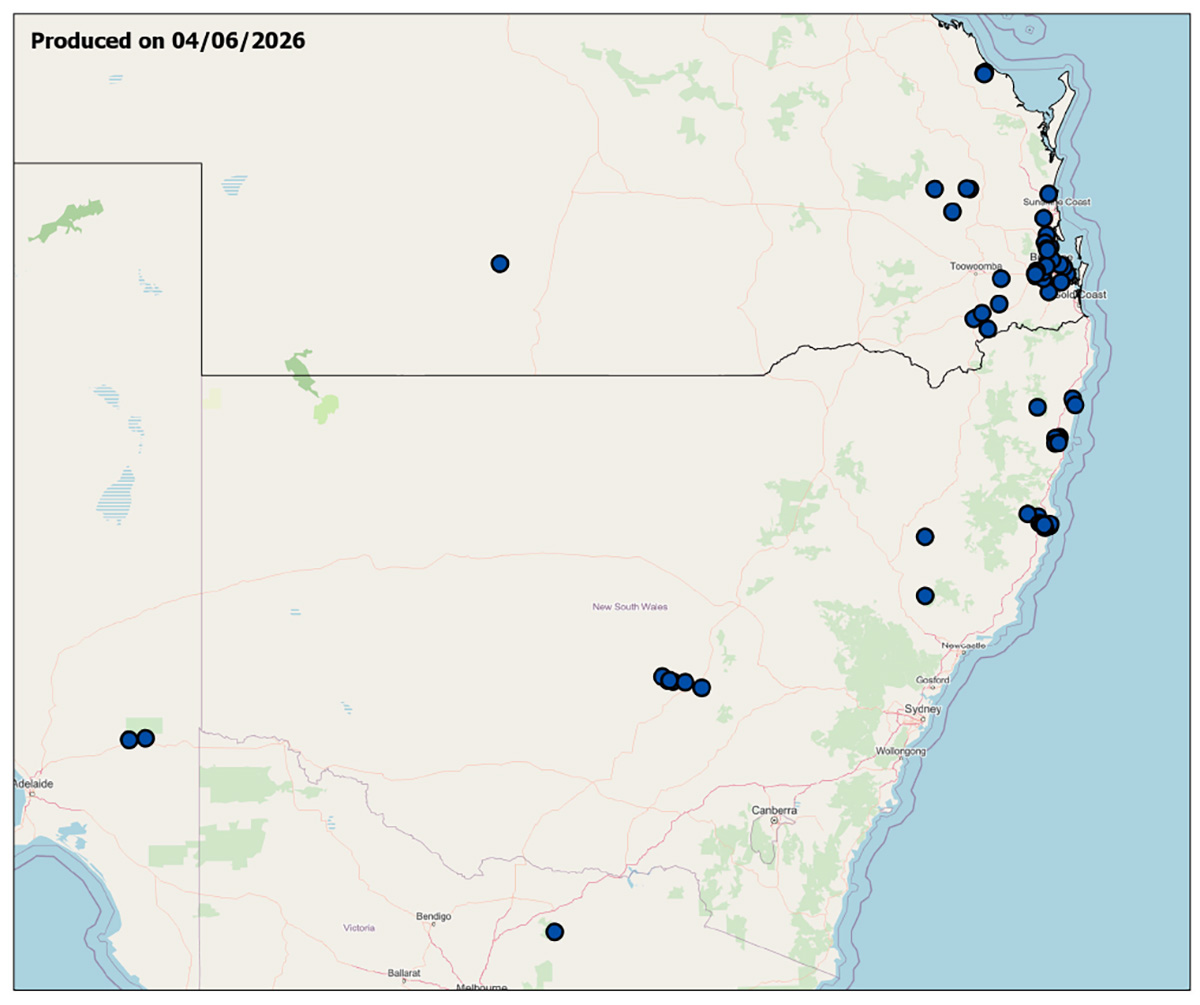
Where are the Miticide Resistant Mites?
The Consultative Committee on Emergency Plant Pests (CCEPP) has approved the publication of a map to guide beekeepers, with a general location of resistant mites. These are not apiaries, but a general locale. The map is a snapshot in time and is already out of date. Do not rely on the map to provide confidence that resistance is not in your area. Beekeepers are nomadic so apiaries are always moving.
As the spring pollination season nears, honey bees will be transported to pollination sites. The spread of resistant mites becomes inevitable. Monitoring will allow the map to be updated to aid beekeepers in their choice of treatment options.
The map shows where we KNOW there are resistant mites. Beekeepers can help to build the map by reporting possible resistant areas. The map will become more accurate the more reports DPI receives.
It becomes imperative that beekeepers monitor their treatments of varroa, in order to ascertain the efficacy of chemical treatments. If there are signs of treatments not knocking down mite numbers, then the possibility exists that your mites are resisting acaricides.
Report to your local DPI and you are likely to be asked to preserve the sample mites in ethanol, after which they can be tested for resistance. Using the full IPM approach to mite management, should buy you time to allow for a variety of strategies.
Good luck with your monitoring!