
National Beehive & Honey Traceability Feasibility Study
by Clare Winkel

AgriFutures Australia commissioned this Feasibility Study under the National Agricultural Traceability Grants Program to determine, whether and how a national beehive and honey traceability system should be implemented in Australia.
The project was delivered by Integrity Compliance Solutions Pty Ltd between October 2025 and May 2026.
The study addressed four primary objectives:
- Assess the technical, economic, legal and operational feasibility of a national beehive and honey traceability system suitable for Australian conditions.
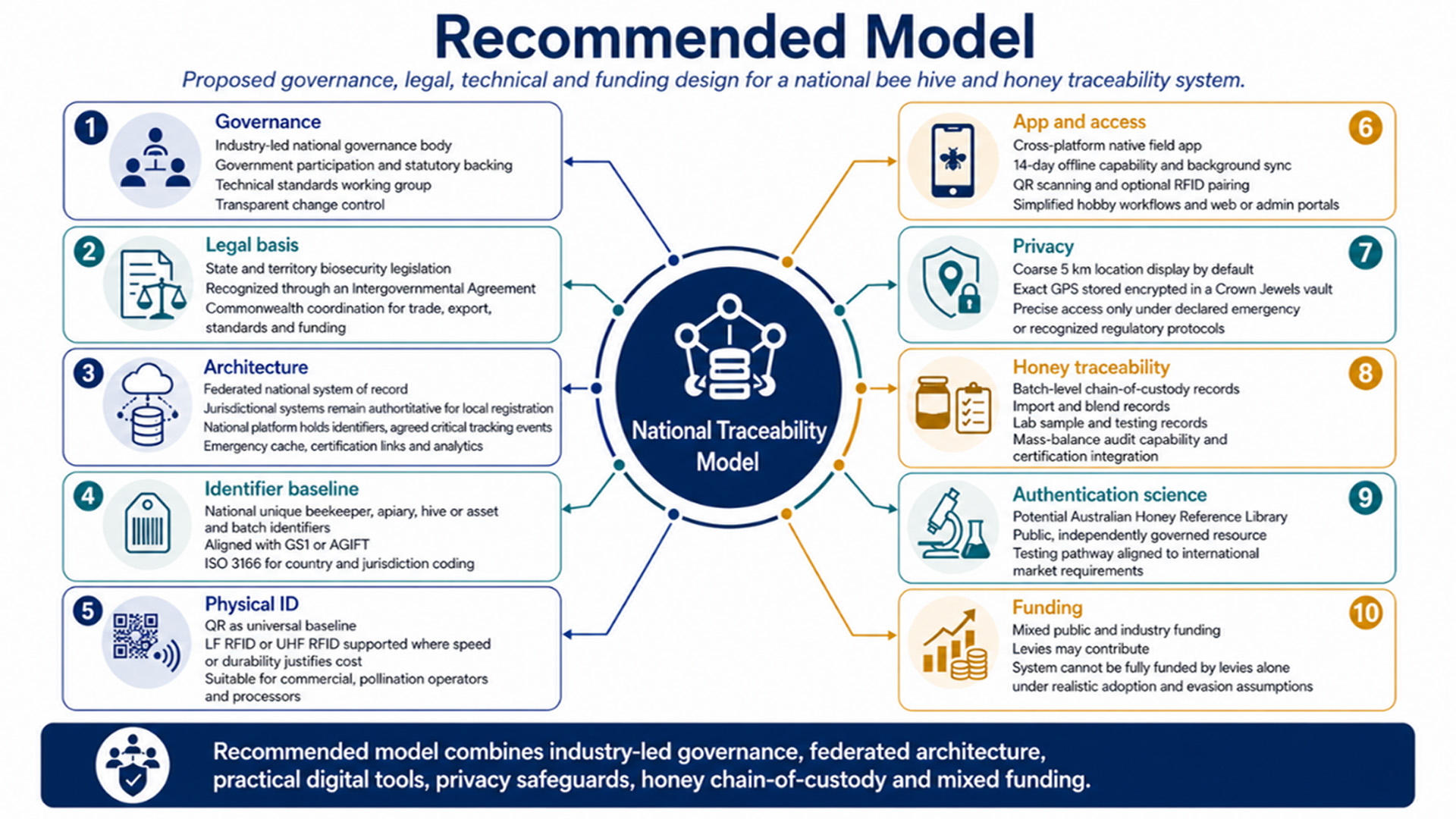
- Identify the most appropriate technology architecture, data standards and governance model based on stakeholder evidence and international precedent.
- Quantify the costs, benefits and funding requirements for implementation, including distributional impact across operator segments and government.
- Recommend an implementation pathway with phased milestones, success criteria and risk mitigations.
What did the project deliver ?
- Literature review and knowledge gap analysis.
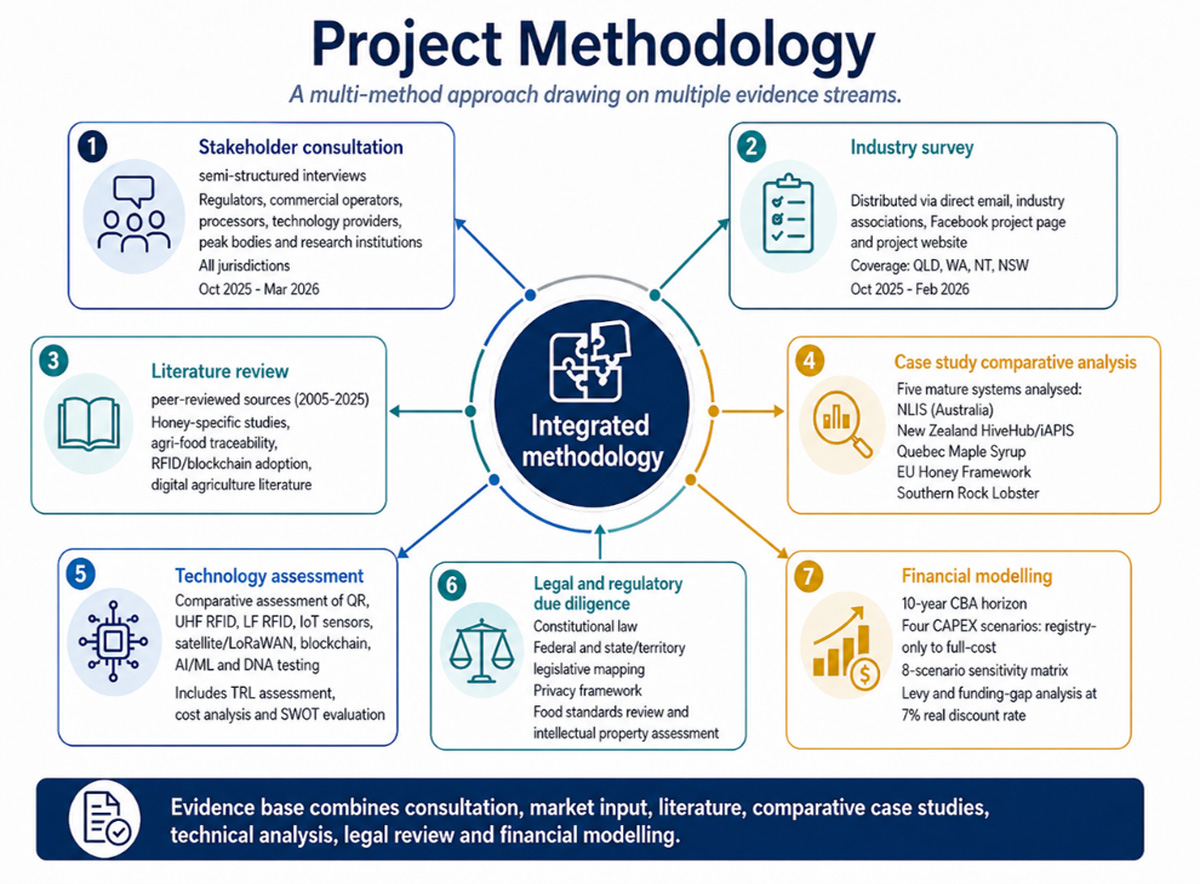
- Stakeholder engagement report: who did we talk to ?.
- Case study comparative analysis: Reviewed 5 national and international case study analysis.
- Technology and implementation review.
- National implementation roadmap.
- Comprehensive feasibility study report.
Australia's registered beekeeping industry has contracted since the project inception. As of December 2024, national registered hive numbers stood around 823 291 (a 5% decrease year-on-year), with 1738 commercial beekeepers and approximately 44 172 recreational beekeepers registered nationally. Interviews with all state and territory regulators for this project, shows the number of registered hives may now have further dropped to 816 243 nationally, with likely further declines in ACT and southeast Qld since this project began, due to Varroa mite impacts.
The spread and management of Varroa mite, combined with ongoing American Foulbrood risks and interstate hive movements for honey and pollination, creates the strongest biosecurity case for a national traceability system.
The existing regulatory model relies heavily on registration and records being available when requested, but emergency experience shows this is insufficient.
A national system should not simply digitise existing paperwork. It should enable rapid traceback, localised biosecurity alerts, movement history reconstruction, proof of compliance and emergency access to precise location data under strict legal triggers.
Hive traceability and honey traceability are related but distinct problems. Honey traceability has two components: a beekeeper-level component that overlaps almost entirely with hive traceability and a supply-chain component that requires laboratory testing and authentication evidence.
Physical hive traceability addresses the following questions:
- Where are these hives?
- Who owns the hives?
- Where have the hives moved from and when?
- And when combined with the correct record keeping: what treatments have been applied to which hives?
To trace honey, the following questions need to be answered:
- Is it actually honey?
- What is the floral source of the honey?
- What is the geographic source of the honey?
- Does the honey contain the specific compounds that the seller is stating it contains?
Not all honey sellers and buyers want answers to all these questions; many would be satisfied with: "Does this jar contain honey created in Australia?" Hive location and movement data directly support key honey traceability functions relating to floral and geographic source confirmation.
Honey is consistently identified as one of the most adulterated food products globally. The US Pharmacopeia ranks honey as the third most adulterated food product.
The HorizonScan database has documented 266 recalls or border rejections worldwide over 20 years, for honey. These recalls/rejections cover at least eight distinct contamination/adulteration types: pollen analysis failures, low diastase activity, elevated HMF (hydroxymethylfurfural), illegal foreign sugars (maltose, sucrose, corn/cane, amyl, starch syrups), unauthorised added chemicals (DHA, MGO, d13D delta, 4-MEI, vardenafil, tadalafil), ammonia-sulphite caramel dye (E150d) and abnormal conductivity/insoluble content. No single test method detects all forms of adulteration.
Evidence from peer-reviewed studies, regulatory testing programmes and industry surveillance establishes that fraud occurs at scale globally:
- European Union “From the Hives” coordinated action (2021–22): 46% of 320 imported honey samples tested were suspected of adulteration through markers of extraneous sugar sources – a substantial increase from 14% in the 2015–17 control plan.
- India 2020 testing: 77% of major-brand samples were adulterated with cane sugar syrup; only 3 of 13 brands passed the internationally accepted Nuclear Magnetic Resonance (NMR) test.
- UK Honey Authenticity Project (2018, 2020): In 2018, 10 of 11 retail products including own-brand honey from the UK’s biggest supermarket failed NMR tests; in 2020, 13 products failed one or more of 18 test methods used.
- HorizonScan database: 266 honey recalls/border rejections worldwide between 2016 and 2026, including 9 in Australia. The honey was sourced from the following countries: Italy (1), Turkey (3), Serbia (3), Malaysia (1) and Greece (1). Australian-origin honey was rejected twice (USA 2022 misbranding and in Cyprus 2017 missing health certificate).
- Australian border rejections figures (FICA): for imported products show the following results: 2024 2 rejections for different Turkish products, 2023 1 rejection for Greek honey, 2022 2 rejections of Malaysian honey and 2020 2 rejections for Turkish products.
- USA FDA testing (2021-22 and 2022-23): approximately 10% of imported honey samples found adulterated. Similar testing undertaken in 2025, the level of fraud was stated as 4% for both product types (domestic: 2 out of 54) & imported products (2 out of 48). The honey was tested using the stable carbon isotope ratio analysis method, which measures carbon isotopes in both the overall honey & its protein content.
- Price-differential incentive: Authentic honey averages EUR 2.32/kg EU import value versus sugar syrups at EUR 0.40–0.60/kg – a 4–6× price gap that makes adulteration commercially attractive.
- Manuka volume anomaly: The global quantity of “Manuka honey” sold in the UK alone reportedly exceeds the combined annual production of Australia and New Zealand – direct evidence of systematic fraud in the premium segment.
Traceability is not only a compliance response. It can support premium provenance claims, export access, private certification standard requirements, EU origin labelling compliance, buyer assurance and protection of Australian honey reputation. Australian floral honeys such as Jarrah and Manuka, command price premiums, creating both fraud incentives and a commercial case for verification.
Effective honey traceability therefore requires both chain-of-custody records and fit-for-purpose testing, interpreted against representative Australian honey reference data. Domestic honey producers are increasingly expected to record and prove origin, while imported honey is tested only at limited rates and primarily using C4 stable carbon isotope screening, which cannot detect important C3 sugar adulterants. Once imported product enters the domestic supply chain, traceability gaps make undocumented blending difficult to detect.
The DAFF Imported Food in the Residues and Food Branch is undertaken a pilot survey to assess the authenticity of imported honey samples and compare the department’s current border tests with the performance of commercially available analytical tests.
- 37 samples were collected from importers and retailers with the assistance of state food regulatory authorities; the focus was on sampling bulk honey.
- Test results are currently being analysed and will inform if further work is required to update our testing capability at the border.
- The department’s current border tests include internationally accepted methods for detecting adulterated honey.
Project Conclusions:
This study finds that a national Australian beehive and honey traceability system is feasible, but only if it is implemented as a governance-first, standards-first and industry-led national system with clear regulatory backing and staged technology deployment.
The Cost benefit Analysis reinforces this dual logic where the system is both insurance against disease and market disruption, and an enabler of export and assurance value.
However, the benefit does not automatically go back to the beekeeper who bears the data entry burden. Adoption depends on transferring value back through easier compliance, market access, pricing, pollination contracts and reduced duplication.
The strongest viable pathway is a low-cost national registry and event-capture backbone, integrated with state and territory systems, supported by a separate honey authenticity workstream covering batch traceability, testing, certification and possibly an Australian Honey Data Library.