
Attack the Varroa mite's Biology not the Symptoms
by Bruce White OAM
Illawarra and Cumberland Clubs

With mite resistance to the miticides Apistan-(Taufluvalinate), Bayvarol-(Flumethrin), Apivar (Amitraz), and Apitraz (Amitraz) becoming more widespread in parts of NSW and Qld., the Miticide resistant mites have been traced back to July 25 in an apiary in South Australia moved in from Queensland.
You can incorporate a brood break as part of your Varroa management to target the mites’ biology.
Varroa can only breed inside capped worker and drone brood, with the mated female mites entering the cells just before they are capped. Each female has one male off-spring and up to two females. The mites damaging the developing bee in the cell and the mites emerging when the bee emerges from the cell. In the case of workers, twenty one days and drones twenty four days .
Beekeepers can cause brood breaks by caging the colony queen or migrating colonies where the queens stop laying causing a brood break.
In the majority of the world’s major beekeeping countries colonies have a brood break due to the harsh cold winters where hives are covered in snow for months. In some tableland and alpine locations in NSW and other harsh conditions, cold, no flora flowering, and especially lack of pollen, the queen stops laying, causing a brood break .
The advantage of a brood break in Varroa management is that it causes all of the mites to migrate on to the bees and other exposed parts of the hive where they are unable to reproduce. They then die of natural causes and are all exposed to miticide treatments when applied. Of the registered miticides in Australia only one penetrates the brood cap to kill the mites - Formic Pro (Formic acid Organic acid)
Brood Break
It is ideal when a natural brood breaks occurs as beekeepers have left colonies with a full box of honey as part of winter management and the colonies go broodless, with the queen running free in the colony but not laying in some cases for months .
Because of the Australian climate, most of the amateur beekeepers will need to force a brood break, unless you live in an area where a brood break occurs in winter, for example, Orange, Cooma and Armidale.
Timing a brood break
It is best to adopt a brood break in Autumn ,Winter and Spring when you find 4 mites and in summer 8 mites, in half a cup of 300 bees. During a soapy water or alcohol wash, the miticide treatment will be 24 or 25 days off. If mite counts are high use a miticide treatment immediately.
Brood breaks can vary from seven to twenty four days; twenty four days is best.
The break is not a good idea during peak colony populations, or when colony numbers are decreasing and should be used with other control strategies.
A brood break is ideal for commercial beekeepers who winter colonies broodless in cold winter locations full of honey and use the oxalic acid vaporization method to control mites as these colonies could be broodless for months. So, no mite reproduction.
In a Varroa infested colony only ten to thirty percent of mites are on the bees with seventy to ninety percent of the mites in the capped brood cells. Forcing a brood break exposes all the mites out of the cells and they can then be exposed to miticides to be effective.
How to force a brood break in a colony.
Catch and cage the queen without escort bees, sealing the cage so the queen can not escape.
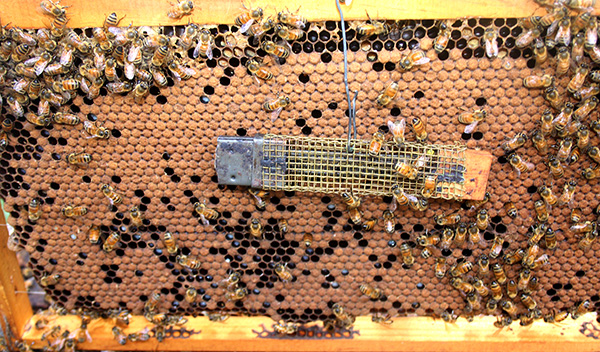
Wire hook to suspend the cage with the colony queen so the colony bees can fed the queen . Brood frame from a hive only previously treated with organic miticides.
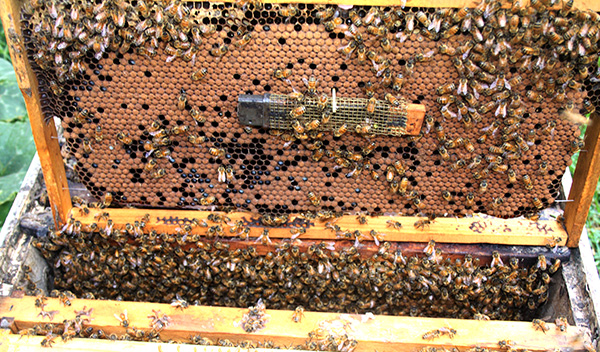
Queen cage attached to a brood frame with a match. Frame inserted between another brood frame for 24 days to cause a brood break.
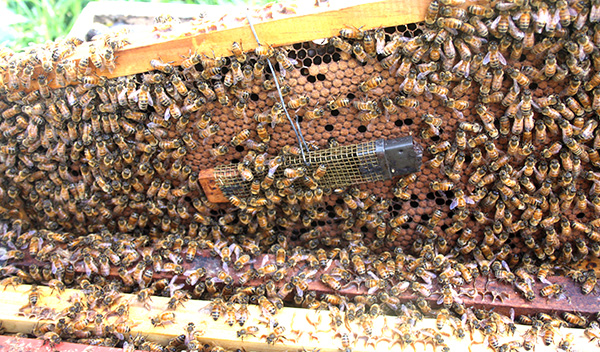
Place the queen cage with the queen in the brood box, between frames well covered with bees so the worker bees in the colony can feed her through the cage.
At about day ten check all the brood combs for any queen cells. This may or may not occur and remove or break down.
Day twenty four or twenty five release the queen and treat the colony with a miticide. This is the time when all the mites are phoretic on the bees.
Treat the colony or colonies with a registered miticide
Options
Synthetic Chemicals
Apistan: resistant risk don’t use
Bayvarol: resistant risk don’t use
Apivar: resistant risk don’t use
Apitraz: resistant risk don’t use
Non Synthetic.
Often referred to as organic. Use safety equipment and follow all permit instructions.
Formic Pro: use when temperatures are between 10 and 29.5C
Smallest pack treats two hives approximate cost to treat one hive $12.00
Apiguard: use when temperature above 15and below 40C remove supers smallest pack treats five hives approximate cost to treat one hive $14.20
Api Bioxal Solution: most efficient when no brood present smallest pack ten hives approximate cost per hive $7.50
Api Bioxal Powder: Vaporization method smallest pack 12 hives approximate cost per hive $3.81 requires special expensive equipment that some clubs loan to members to use. This method is popular for commercial beekeepers.
Aluen Cap: Smallest pack treats fifteen hives approximate cost per hive $8.50
In New Zealand beekeepers have more miticides available and can make for their own use oxalic strips reducing costs for treating colonies. Many beekeeper here would like to see this be made legal in Australia.