
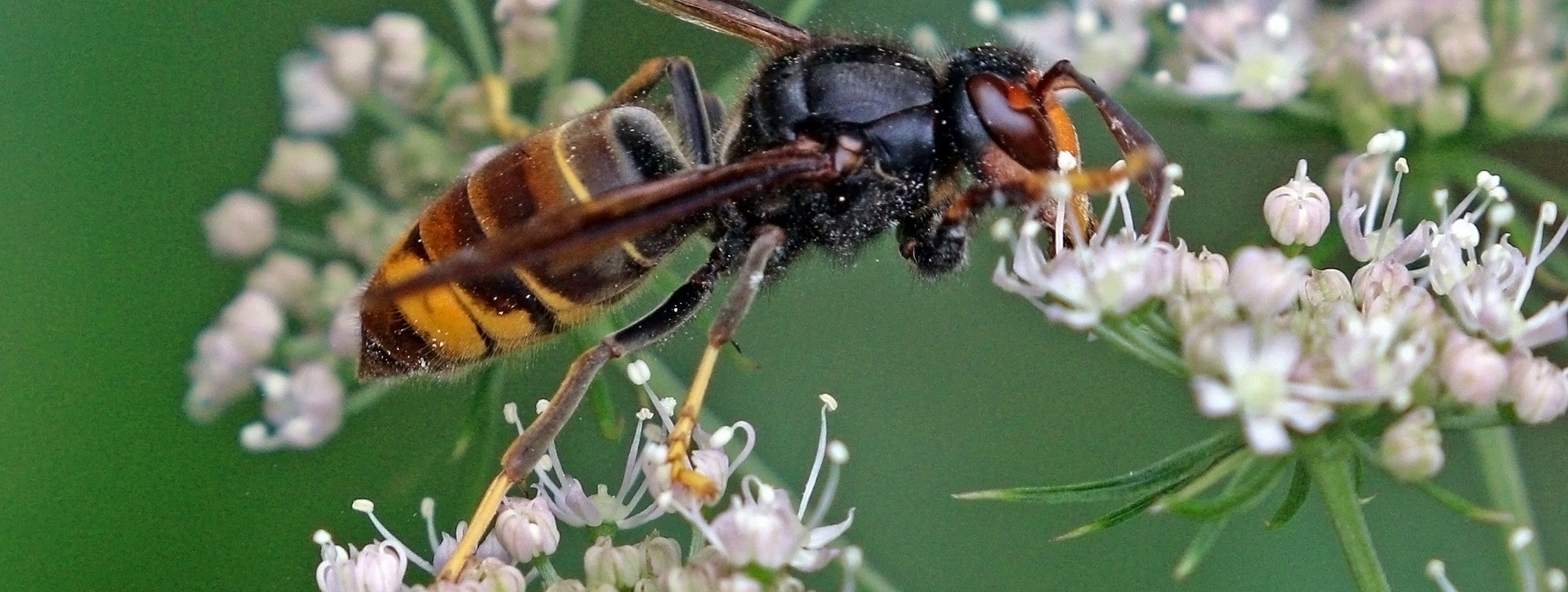
Yellow-legged hornet, Vespa velutina. Note the dark body and yellow-tipped legs.- Photo: Charles J. Sharp / Wikimedia Commons. CC BY-SA 4.0.
Yellow-Legged Hornet: New Zealand's warning to Australia
By Mike Allerton
ABA Biosecurity Officer

In November 2025, New Zealand confirmed the discovery of yellow-legged hornets, Vespa velutina, on Auckland's North Shore. For Australian beekeepers, the news was sobering. New Zealand had until then been free of the pest, and its arrival brought a threat already familiar to beekeepers in Europe and parts of Asia suddenly much closer to Australia. By early May 2026, Biosecurity New Zealand had located and destroyed 77 queen hornets and 132 nests. No hornets or nests had been found since early April, but the eradication operation was continuing, supported by more than 17,400 public notifications of suspected sightings.[1]
The New Zealand response has been rapid, serious and technically impressive. A surveillance zone extending 11 kilometres from detections was established, with protein and carbohydrate traps, bait stations, property searches, more than 50 field staff per day, specialist advice from overseas response teams, radio tracking technology imported from the Netherlands, and a protein bait, Vespex, designed to be taken back to nests and kill the entire colony. More than 575 registered apiaries lie within the surveillance zone, so beekeepers have been drawn closely into the search effort.[1] This is not simply about protecting honey production. New Zealand authorities are clear that the yellow-legged hornet threatens honey bees, wild bees and other insects, with flow-on risks to pollination and biodiversity.[1]
A hornet with a history of invasion
The yellow-legged hornet is native to parts of Asia, particularly regions of China and south-east Asia. The invasive form now spreading internationally is usually identified as Vespa velutina nigrithorax. It was first recorded outside its native range in South Korea in 2003, then in south-west France in 2004, probably after arriving in imported goods from China. From France it spread through much of western Europe, including Spain, Portugal, Italy, Belgium, the Netherlands, Germany, Switzerland and the United Kingdom, and it has also invaded Japan.[2,3] It has the familiar hallmarks of a successful invader: fertile queens, effective dispersal, adaptability, and a talent for using human transport networks.
Its arrival in New Zealand matters to Australia because it proves the pest can cross oceans and establish in a temperate southern hemisphere environment. Australia already lists the yellow-legged hornet as a high-priority exotic environmental pest, alongside Tropilaelaps mites.[4] The biosecurity concern is justified. Once established, this hornet is difficult and expensive to suppress, and eradication becomes harder with every generation of queens that escapes detection.
What it does to bees
To the beekeeper, the yellow-legged hornet is not simply another wasp. It is an aerial predator with a particular talent for hunting honey bees. Workers station themselves in front of hive entrances and hover, or 'hawk', waiting for returning foragers. They seize bees in flight, carry them to a perch, remove the head, wings, legs and abdomen, and take the protein-rich thorax back to feed developing larvae.[5,6]
The visible losses at the entrance are only part of the damage. As predation pressure builds, honey bees become reluctant to fly. Foraging slows or stops, pollen and nectar intake fall, and the colony may enter a state often described as foraging paralysis. That loss of normal flight activity can weaken a colony long before the beekeeper sees a large pile of dead bees. Weakened colonies become more vulnerable to robbing, starvation and collapse, and hornets may enter weak hives to take brood and honey.[5,7]
European honey bees, Apis mellifera, are particularly exposed because they did not evolve alongside this predator. The Asian honey bee, Apis cerana, has defensive behaviours such as shimmering and stronger collective responses to hawking hornets, while European honey bees are much less effective at defending themselves.[6] The damage is not confined to managed colonies. Yellow-legged hornets prey on wild bees, native wasps, flies and other flying insects, so establishment would be a biodiversity problem as well as a beekeeping problem.[1,8]
What the sting means for people
The yellow-legged hornet has a painful sting, and like bees and wasps it can cause dangerous allergic reactions in susceptible people. Unlike a honey bee, a hornet does not leave its sting behind and can sting repeatedly. The sting is generally experienced as more painful than a honey bee sting, because hornets are larger and can inject venom more than once, but the greatest risk comes from disturbing a nest rather than from individual hornets foraging away from it.[1,9]
For beekeepers, the practical point is that a hornet taking bees at a hive entrance is not the same level of danger as a nest. Large secondary nests can contain many hundreds or thousands of workers and may be built high in trees, under eaves, in sheds or in other sheltered places. Disturbing one can provoke a strong defensive response. New Zealand's official advice is blunt: do not attempt to remove or spray a suspected nest yourself. Take a clear photograph from a safe distance and report it.[1]
What beekeepers should look for
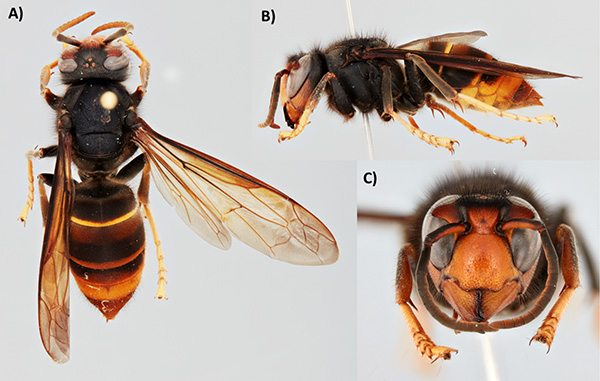
The adult hornet is distinctive once the key features are known. It is larger than a honey bee and larger than the common wasps most Australians are familiar with. The body is mostly dark, with a velvety brown-black thorax, narrow yellow bands on the first abdominal segments, a broader yellow fourth abdominal segment, and, most importantly, dark legs ending in bright yellow feet. The face is orange-yellow when viewed from the front.[1]
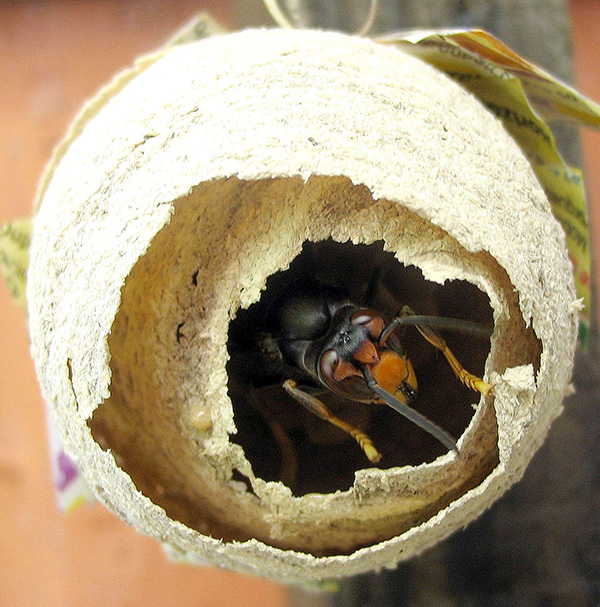
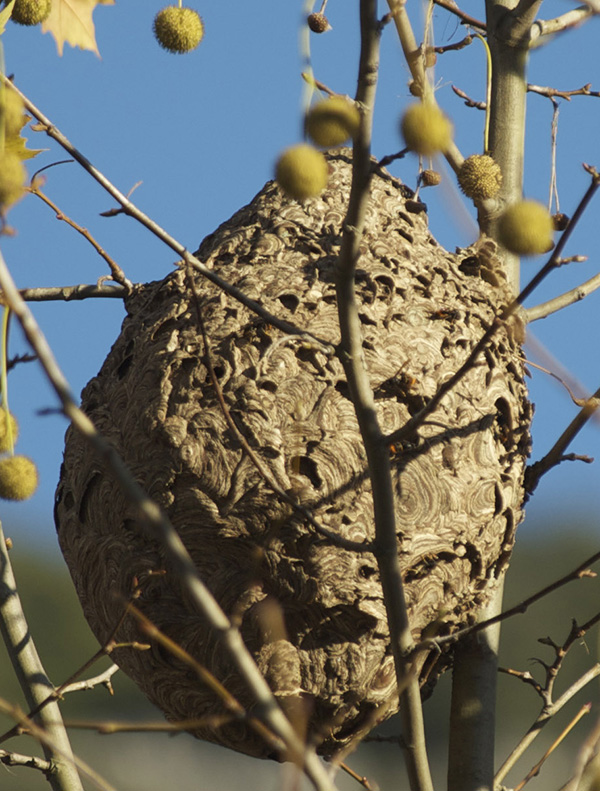
Beekeepers should also notice the behaviour, not just the insect. Repeated hovering in front of hive entrances, bees refusing to fly in otherwise good weather, or a dark hornet carrying off bees are warning signs. In spring, queens build small primary nests, sometimes about the size of a tennis ball, often under eaves, in sheds, carports, outbuildings or other sheltered structures. Later in the season, workers may construct much larger secondary nests, up to about 80 centimetres tall, commonly high in trees.[1]
If a suspect hornet or nest is seen in Australia, the right action is the same as for any possible exotic pest: do not try to solve the problem yourself. Photograph it if that can be done safely, note the location carefully, and report it immediately to the Exotic Plant Pest Hotline on 1800 084 881. A single confirmed queen found early is a biosecurity incident. A queen ignored until she has produced daughter queens is the beginning of a national problem.
Yellow-legged hornet or Tropilaelaps, which is the greater threat?
The discovery in New Zealand naturally raises the question of which exotic pest should worry Australian beekeepers more: yellow-legged hornet or Tropilaelaps mite. Both matter, but they are different kinds of threat.
Yellow-legged hornets are large and visible. They build nests that can be found, they attack from outside the hive, and suspicious sightings can be reported by beekeepers and the public. That visibility gives biosecurity agencies a fighting chance if the incursion is detected early, as New Zealand is now demonstrating. If eradication failed, the pest would be serious for beekeeping and very serious for native insects, particularly in cooler and temperate regions with suitable climate. It would also add a new layer of management to apiary work, especially in late summer and autumn when predation pressure is greatest.
Tropilaelaps is different. These mites reproduce rapidly in brood, feed on developing bees, spread viruses and can drive colonies into severe decline. Australian authorities have long regarded Tropilaelaps as one of the serious exotic mite threats to honey bees, and NSW DPI states that if it entered and established in Australia it would be expected to cause major colony losses.[10,11] Unlike hornets, Tropilaelaps would not announce itself by hovering in front of the entrance. It would be inside the hive, easily moved with bees and brood, and much harder to detect before spread had occurred.
From a strictly beekeeping point of view, Tropilaelaps is probably the greater long-term threat to Australia. That is a judgement based on the biology rather than an official ranking. A hornet incursion may be contained if found early; an established brood mite would become an enduring within-hive parasite requiring ongoing surveillance and treatment, much as varroa now does. Yellow-legged hornet would be a severe pest. Tropilaelaps could become a structural change to Australian beekeeping.
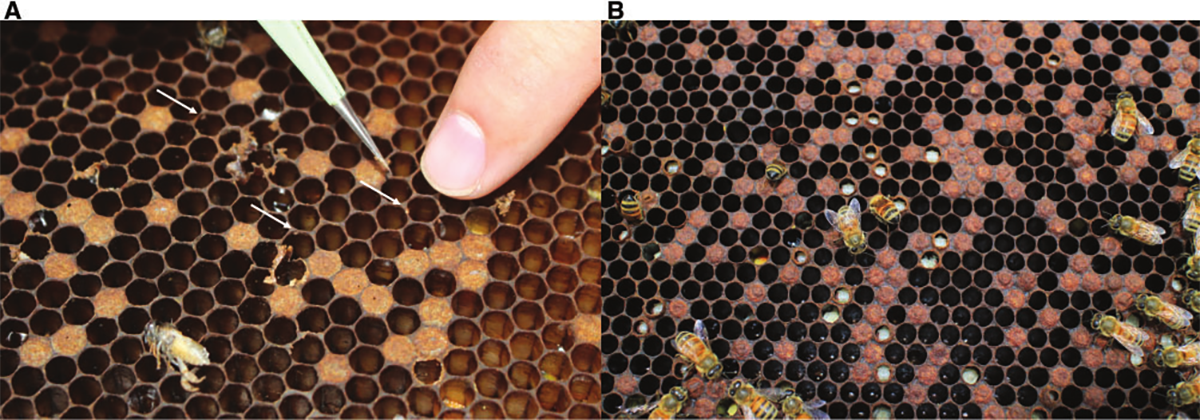
Brood showing damage associated with Tropilaelaps infestation. - de Guzman et al. 2017 / Wikimedia Commons. Public domain in the United States.
The lesson from New Zealand
New Zealand's response deserves close attention from Australian beekeepers. It shows the value of public reporting, decisive action, specialist advice, and using several tools at once rather than waiting for certainty. It also shows how narrow the window can be. By the time the first hornets were found, other queens and nests already existed. Eradication may still succeed, and everyone with an interest in pollinators should hope that it does, but the incursion is a warning.
For Australian beekeepers, the practical message is not panic. It is familiarity. Learn the appearance of the yellow-legged hornet. Learn the sort of nests it builds. Notice unusual predation at hive entrances. Report suspicious sightings immediately. At the same time, keep learning the pests we cannot see from the gate, especially Tropilaelaps. The next major exotic threat to Australian bees may arrive as a conspicuous black-and-yellow hunter, or as a tiny mite hidden under brood cappings. We need to be ready for both.
References
- Biosecurity New Zealand. Yellow-legged hornets in Auckland. Ministry for Primary Industries, last reviewed 5 May 2026.
- Monceau K, Bonnard O, Thiery D. Vespa velutina: a new invasive predator of honeybees in Europe. Journal of Pest Science. 2014;87:1-16.
- Laurino D et al. Vespa velutina: An alien driver of honey bee colony losses. Diversity. 2020;12(1):5.
- Australian Government Department of Agriculture, Fisheries and Forestry. National Priority List of Exotic Environmental Pests, Weeds and Diseases. Updated 7 January 2025.
- Laurino D et al. Vespa velutina: An alien driver of honey bee colony losses. Diversity. 2020;12(1):5.
- Tan K et al. Bee-hawking by the wasp Vespa velutina on the honeybees Apis cerana and A. mellifera. Naturwissenschaften. 2007;94:469-472.
- Requier F et al. Predation of the invasive Asian hornet affects foraging activity and survival probability of honey bees. Journal of Pest Science. 2019;92:567-578.
- Monceau K et al. Native prey and invasive predator patterns of foraging activity: the case of Vespa velutina and honeybees. PLoS ONE. 2013;8(6):e66492.
- Biosecurity New Zealand. Look out for hornets fact sheet. Ministry for Primary Industries, 2025.
- NSW Department of Primary Industries. Tropilaelaps mites. 2011.
- Plant Health Australia. Tropilaelaps mites fact sheet. 2024.