
Two grams good, four grams better1
by Andrew Wootton
originally published in the Australian Bee Journal - reproduced with permission
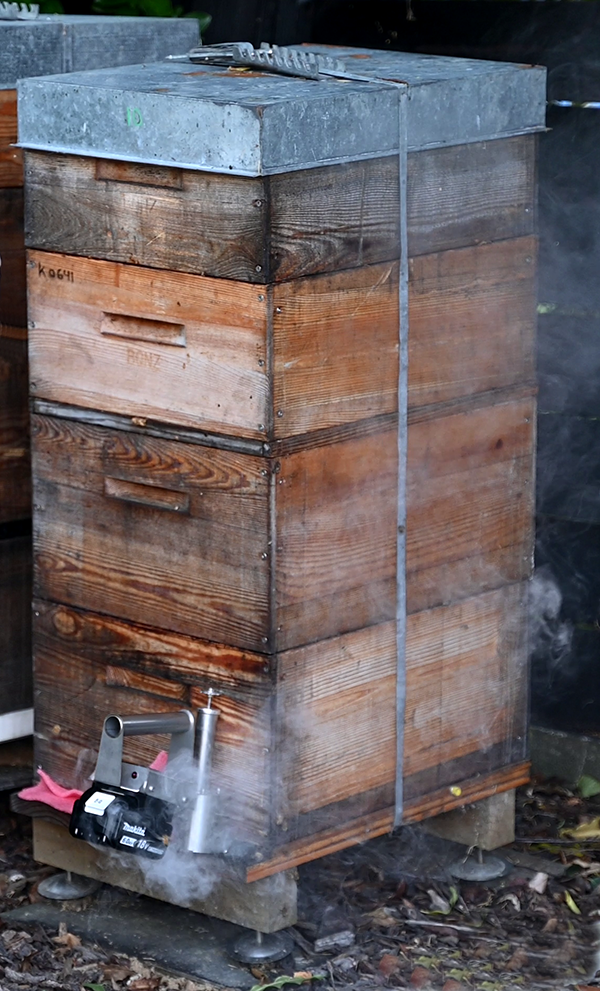
We would all prefer to stick to the organic miticides. However, I’d like to discuss problems with the use of Api-Bioxal that limit its effectiveness. I’m not here to criticise the government (indeed, I’ve been proud to play my own small part in the varroa response and will continue doing everything I can to support it). I’m also not going to encourage anyone to go off-label and break the law (that would put me in a perilous legal position). The issues with the registered product are in both its dose and its administration.
First, the vaporisation dose. Initially in the USA, this was 1g. Cameron Jack2 showed this amount was ineffective, but 2 or 4g (repeated weekly x3) reduced mite infestation by 2-3 fold. Although the 4g dose did not increase mite reduction to the level of statistical significance, examining the numbers shows it to be substantially better. In June this year, the USA’s Environmental Protection Agency authorised the higher (4g) dosage for the vaporisation method.
Next, let’s consider the regime for administration. We know that oxalic acid does not kill mites that are in the reproductive phase under the brood cappings. As a result, a single application of oxalic acid will kill only the mites in the phoretic (dispersal) phase. Over the next 3 weeks, brood emerges and mites re-establish. To be effective, several (ie 3 or 4) repeat applications are required at 5-7 day intervals, to extend the treatment over a complete brood cycle.3
The Australian permit (PERMIT Api-Bioxal -P94609) states that:
Treatment using either method (ie vaporisation or dribbling) may be repeated up to twice annually, with a minimum interval of 5 days between applications.
The label attachments (which are over-ridden by the permit in case of conflict) state:
METHOD BY VAPORISATION: Dosage and administration: Single 2.3g dose administered via vaporisation per beehive. One treatment per year. DO NOT overdose
And the AHBIC Varroa Chemical Treatment Table interprets these regulations as 2.3g of Api-Bioxal (oxalic acid) may be applied by vaporisation twice a year.
Now, if the understanding were that a “treatment” consists of several applications at 5-7 day intervals, all would be well, extending the mite kill throughout a brood cycle (although 4g is more effective than 2.3g). However, I’ve checked with AHBIC and sadly, that is not the case. As a result, if you wish to conform to the law, you are largely wasting your time (and money) if you use Api-Bioxal as a single application in the presence of brood. Use a different miticide.
On the other hand, in a broodless colony, oxalic acid works well. Depending on how cold your local winter gets, you may have a broodless period. Swarms are, of course, brood free, and you can cage the queen to prevent her laying (I’ve a whole article on this in the November ABJ4). Alternatively, killing the queen and either introducing a queen cell or allowing emergency cells to be raised, creates a break.
What can we do to change the unsatisfactory mandating of something less than best practice? AHBIC, the government agriculture departments and the Australian Pesticides and Veterinary Medicines authority (APVMA), are dependent on manufacturers label conditions, resulting in glacial pace for change. AgVic recently proposed a group to develop an Industry Action Plan. We should support this.
Thankfully, Aluen CAP has just been granted (Dec 16th) an emergency permit, so now you can use these slow-release oxalic acid strips when brood is present. And when it is, don’t bother with a single flash treatment.
Andrew Wootton is Vice President of the VAA and a certified master beekeeper with the Eastern Apicultural Society of N America. He first started beekeeping in the 1960s.
References
1. Apologies to George Orwell for mangling the Animal Farm meme
2. Jack, C.J., van Santen, E. and Ellis, J.D., 2021. Determining the dose of oxalic acid applied via vaporization needed for the control of the honey bee (Apis mellifera) pest Varroa destructor. Journal of Apicultural Research, 60(3), pp.414–420.
3. Prouty, C., Abou-Shaara, H.F., Stanford, B., Ellis, J.D. and Jack, C., 2023. Oxalic acid application method and treatment intervals for reduction of Varroa destructor (Mesostigmata: Varroidae) populations in Apis mellifera (Hymenoptera: Apidae) colonies. Journal of Insect Science, 23(6), p.13
4. Wootton, A., 2025. Breaking good. Australian Bee Journal, 106(11), pp.20-21.