
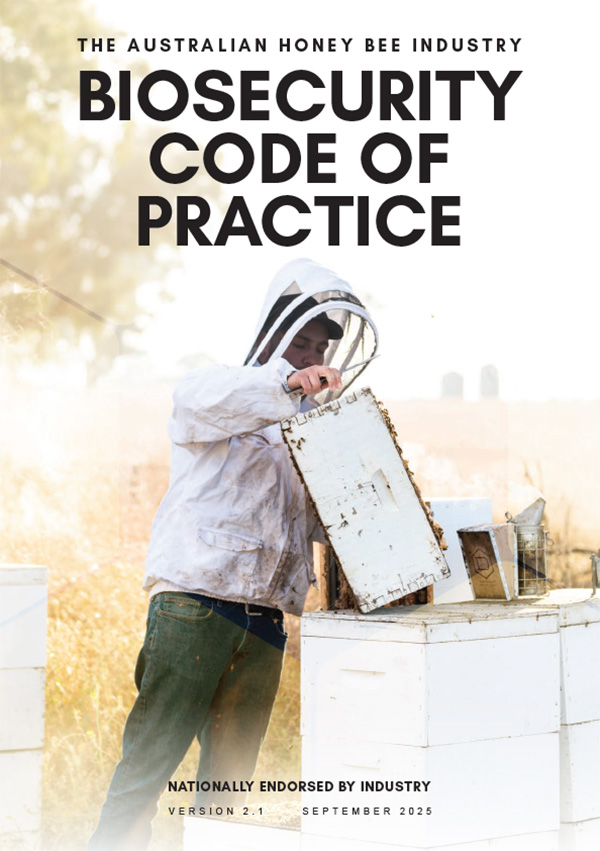
Australian Honey Bee Industry Biosecurity Code of Practice 2025
Vincent Schnyder
President
Amateur Beekeepers Australia
The Australian Honey Bee Industry Biosecurity Code of Practice (the Code) has been developed in consultation with beekeepers and governments to provide a clear framework for Australian beekeepers to engage in best-practice biosecurity.
- Increase productivity in the Australian honey bee industry by improving the general level of pest and disease control by Australian beekeepers.
- Assist beekeepers in recognising exotic pests and diseases of bees and prepare for an exotic or emerging pest / disease response.
- Ensure beekeepers conduct regular surveillance for the presence of exotic and endemic pests and diseases.
- Assist with the management of Varroa mite in Australia.
- Assist in the management of significant endemic diseases of bees, particularly American foulbrood (AFB).
- Facilitate the cross-border movement of bees through adoption of a single national code for biosecurity practice.
- Ensure the future viability and sustainability of the Australian honey bee industry.
Scope of the Code
The Code is the industry’s guiding document and is legislated in full in NSW only, components of it are part of states/territories rules in other states. Part B of the Code is compulsory for ALL beekeepers. Part C is compulsory for beekeepers who manage 20 or more hives.
Part B - What are the Key Requirements for all beekeepers
- Beekeepers must be registered
- Beekeepers must report notifiable pests and diseases
- Beekeepers must regularly inspect their hives for pests and disease
- Beekeepers must control or eradicate pests and disease and must manage weak hives
- Beekeepers must maintain records of Biosecurity-related actions and observations
- Hives must be appropriately construction, maintained and branded
- Beekeepers must not allow hives or appliances to become exposed or neglected
- Beekeepers must allow their operations to be assessed
Part C - Additional requirements for beekeepers who manage 20 or more hives
- Beekeepers must demonstrate a minimum level of knowledge of pest and disease identification and management
- Beekeepers must have honey tested annually for American Foulbrood
- Beekeepers must declare compliance with the code and provide accompanying documentation
Part D - Recommendation for all beekeepers
- Apiary sites should be identified
- Beekeepers should maintain a barrier system of hive management
What Changed from the Previous Version and what is the ABA’s Position?
Initially the review was supposed to cater for the fact that Varroa is now endemic in Australia as well as some minor updates to the previous Code.
However, a draft shared with the ABA in November 2024 proposed to reduce the threshold for the additional requirements in Part C from 50 hives to 5 hives, a change that the ABA would not support and we submitted our response to the drafting committee.
In our view, the requirements under Part C of the code should be addressed as follows:
9 Training – The ABA is of the view that all beekeepers should have a minimum level of knowledge of pest and disease identification and management. Therefore, we recommend that all beekeepers complete a training like the Honey Bee Biosecurity Online Training BOLT. This way the requirement could be moved to Part B of the Code.
10 Honey Testing - The key objection is around the honey testing for AFB as it is easy to cheat by only submitting known clean honey and thus the benefit of this requirement is questionable. However, we understand that for some honest operators the results of the honey testing could be a useful tool to them and thus think this requirement should be moved to the voluntary Part D of the Code.
In addition, random testing of retail honey directly sourced by compliance personnel from supermarkets to capture commercial supplies and food markets, delicatessens etc to capture small operators and provide better results should be considered by state authorities.
11 Certification of Compliance with the Code – Beekeepers who follow the Code would collect the required supporting evidence in their logbooks (paper / electronically / Apps) to be able to complete the certification as part of the registration renewal process and thus we would not object if this part is also moved into Part B of the Code. However, beekeepers who don’t follow the code (e.g. are not registered), would not be captured and thus this requirement has only limited benefits.
By moving the training requirement into Part B, moving Honey Testing to Part D and either moving Certification either to Part B or removing altogether, we would achieve a single Code for ALL beekeepers, regardless of size of operations.
The ABA Executive engaged with AHBIC and various member bodies and raised our concerns at the Bee Industry Biosecurity Consultative Committee (BIBCC) and acknowledge that the threshold for Part C has now been adjusted to 20 and more hives.
Personally, I think the beekeeping community, commercial and recreational, should work together to promote good Bee Biosecurity Practice, promote our industry and our unique honey and hive products. This is one reason why we support the NSWAA Honey Land at the Royal Easter Show.
However, unfortunately, there are some groups, like some representatives of the Tasmanian Beekeepers’ Association, who see it differently and propose changes that have little or no benefit for the wider good but seem to be intended to make life of small-scale beekeepers more difficult.
As a Beekeeping Community we have to ensure that the rules are fit for purpose and not unduly difficult, otherwise beekeepers will disengage and become Biosecurity Risk for us all.
We are pleased that common sense prevailed and honey testing now becomes mandatory for beekeepers with 20 and more hives and not 5 and more hives as originally proposed and thank all who help to achieve this.
Plant Health Australia – Bee Aware https://beeaware.org.au/code-of-practice/