
Using Aluen CAP® to treat for Varroa mite
An American Study
Written by: Dr Madlen Kratz

Beekeepers have been asking for additional varroa treatment options that are safe and effective specifically during summer when temperatures are high, colonies are actively rearing brood and honey production is ongoing. Could Aluen CAP® fill this gap for Australian beekeepers?
Aluen CAP®, produced in Argentina since 2016, is a glycerine based oxalic acid strip that provides a slow-release effect over a period of six weeks (42 days). Because these strips are made of specialised cellulose material and not cardboard, they are not easily chewable by bees and need to be removed six weeks later.
Oxalic acid glycerine strips work by contact, in a similar way to synthetic strips. This can be considered an advantage over oxalic acid vapour and other non-synthetic treatments (eg. formic acid and thymol) that work by vapour and:
- are usually shorter lived
- can damage bees, brood and queens even at moderate temperatures.
The effectiveness of oxalic acid dribble is limited when brood rearing is ongoing.
There are also clear advantages of oxalic acid being able to be used when the bees are actively making honey.
As with any product it is important to test its effectiveness under various conditions, and we will only know its true effectiveness once we try it in our Australian environments. With the first shipment of Aluen CAP® due to arrive next month (April) under APVMA Permits, it is a good time to find out more about what is already known about the product from other countries and how we may best be able to utilise the product.
An American researcher (Aurell, 2024) set out to test Aluen CAP® on colonies at commercial apiaries at three different locations of the United States including the states Alabama (AL), Maryland (MD) and Georgia (GA) as shown on the map below (Figure 1).
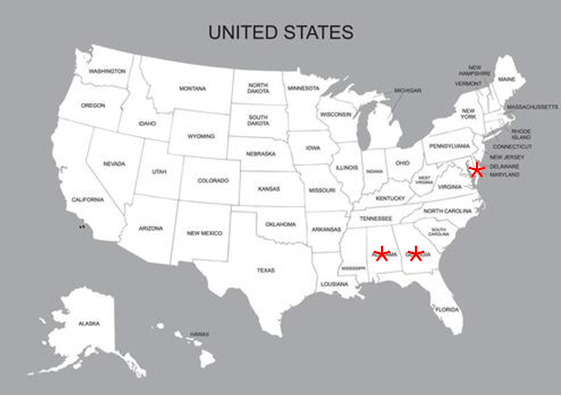
The three apiaries were made up of 45-48 colonies each and Aluen CAP®, Apivar® or no treatment was provided to colonies during summer (July – August) after the end of the main honey flow at each site for 42 days (six weeks). Four Aluen CAP® oxalic acid strips were applied per colony. The colonies were established from splits (AL and MD) or packages (GA) during spring. Queens were of Italian type (AL and MD) or of Carniolan type (GA).
It should be noted that resistance of Varroa destructor to amitraz (active ingredient in Apitraz and Apivar) has emerged in the United States. This could be one reason why Apivar did not have more of a knock-down effect in this study (Figure 3). A reminder for Australian beekeepers to rotate chemical classes and products. DPIRD has a free online tool to help beekeepers figure out how to properly rotate chemical treatments for varroa. Check out the NSW DPIRD online Varroa Management Tool and video explainer at: www.tocal.nsw.edu.au/courses/bees
Figure 3. Varroa destructor infestation rates of adult Apis mellifera honey bees in colonies subjected to different miticide treatments, by site. The horizontal dotted line represents 3% Varroa infestation of adult bees, above which treatment is commonly recommended. Error bars show 95% confidence intervals. Reference: Aurell 2024.
On average, across the different sites, the varroa infestation rate increased substantially from 2.7% to 10.4% from day 0 to day 42 in the untreated control groups, from 3.3% to 4.6% in the Aluen CAP® treated colonies and from 2.6% to 3.7% in the Apivar® treated colonies. This equates to an efficacy of 57.3% for Aluen CAP® and 67.2% for Apivar® compared to untreated control colonies in this study. Note that there was some variation in the relative efficacy of the products at the different sites (Figure 3).
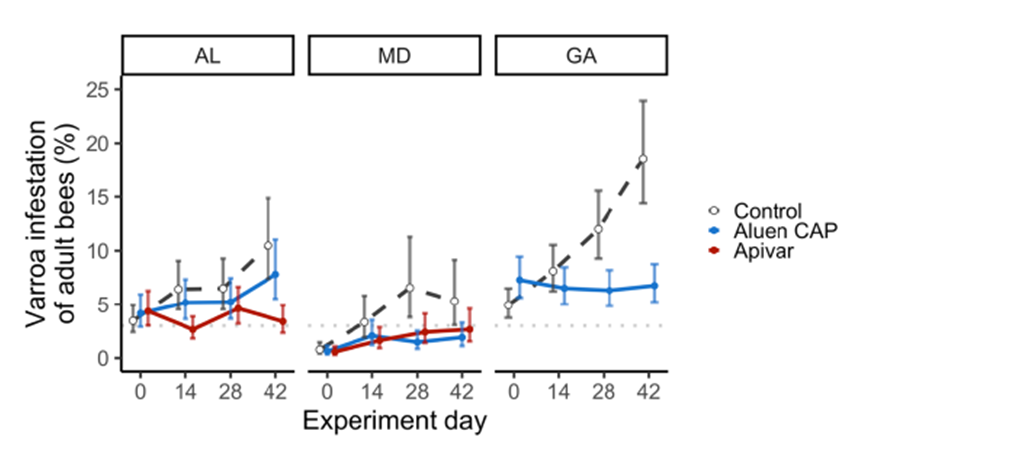
Other studies in Argentina and Mexico have reported higher efficacies for Aluen CAP® of 93.1% and 92.1% respectively (Maggi et al. 2016, Rodríguez et al. 2020). Aurell (2024) points out that unlike for the studies conducted in Argentina and Mexico he differentiated between the efficacy of Aluen CAP® and natural mite mortality which was 24.8%, 5.2% and 13.7% for three trials in Argentina and 36.5% for the trial in Mexico. This makes it a little bit harder to compare efficacies between trials. Other factors such as hive size could also influence Aluen CAP® efficacy (Oliver 2017).
Overall, Aurell (2021) showed a moderate efficacy of Aluen CAP® treatment against varroa. The treatment did not have any negative impacts on the colonies such as frames of bees and brood and led to an increase in oxalate content in brood honey that was still in the normal range for honey. Aurell (2021) concluded that Aluen CAP® could be considered as a preventative strategy to slow mite reproduction but not as a curative intervention to treat for high mite loads and would need to be implemented before varroa infestations reach damaging levels (approximately 2-3% infestation of adult bees).
References
Aurell, S.D., 2024. PhD dissertation: Optimizing Beekeepers’ Strategies for Varroa destructor Management. Auburn, Alabama.
Maggi, M., Tourn, E., Negri, P., Szawarski, N., Marconi, A., Gallez, L., Medici, S., Ruffinengo, S., Brasesco, C., De Feudis, L. and Quintana, S., 2016. A new formulation of oxalic acid for Varroa destructor control applied in Apis mellifera colonies in the presence of brood. Apidologie, 47(4), pp.596-605.
Oliver R (2017) Beyond tactic – beekeeper funded research. American Bee Journal 157:
Rodríguez Dehaibes, S.R., Meroi Arcerito, F.R., Chávez-Hernández, E., Luna-Olivares, G., Marcangeli, J., Eguaras, M. and Maggi, M., 2020. Control of Varroa destructor development in Africanized Apis mellifera honeybees using Aluen Cap (oxalic acid formulation). International Journal of Acarology, 46(6), pp.405-408.