
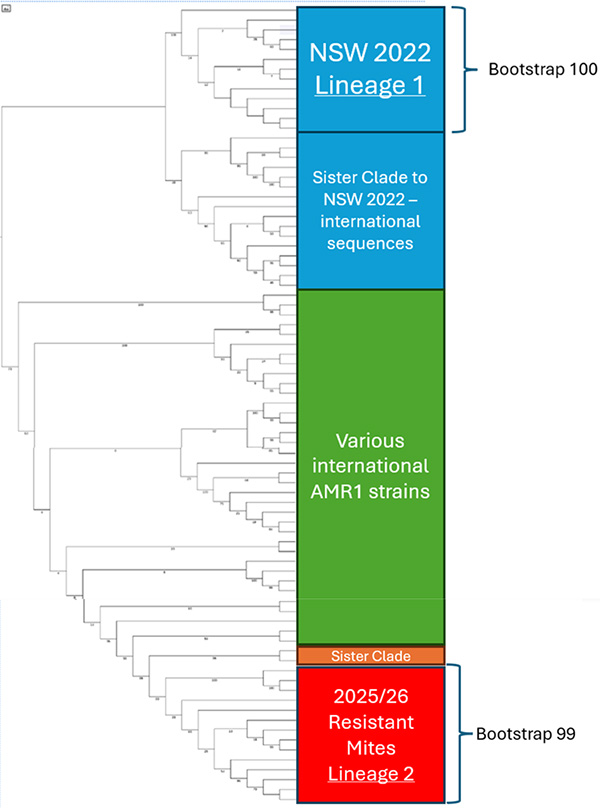
Figure 1. Phylogenetic relationship between global AMR1 virus strains including the NSW 2022 strain that we will refer to as Lineage 1 and the 2025/26 Resistant Mite strain that we will refer to as Lineage 2. The work presented here is ongoing and will be published by the researchers. The distance between different branches of the tree indicates significant genetic distance between Lineages 1 and 2. A ‘bootstrap’ value of 99 and 100 indicates 99% and 100% support for the position of these lineages in the tree reiterating the clear separation of these two lineages.
Resistant mites and Integrated Pest Management – giving yourself the best chance at success
By C Anderson, P Kirkland, D Nguyen, E Remnant, S Mullholland, E Frost, E Noordyke, D Martin, D Purdie, J Kidston, G Herron, R Bourke, M Power
Situation Update
The Consultative Committee on Emergency Plant Pests met on 16 April 2026 to review the detection of varroa mites in Australia that are resistant to commonly used synthetic pyrethroid and amitraz-based miticides.
The committee considered expert advice from New South Wales (NSW) showing that viruses carried by these resistant mites have a unique genetic ancestry (Figure 1). The particular virus studied, called Apis Mellifera Rhabdovirus 1 (AMR1) also referred to as ARV1 in the literature, is a Varroa-associated rhabdovirus with transmission closely linked to the reproductive biology of Varroa destructor. This tight biological association, combined with a relatively low mutation rate, makes AMR1 a useful marker for investigating the population structure and potential geographic origins of Varroa mite incursions (pers. comm. Dr Emily Remnant).
Resistant mites show a unique genetic lineage of AMR1 (‘Lineage 2’; Figure 1), indicating the resistant mites differ in origin from the varroa mites that were first detected in NSW in 2022, which remain susceptible to synthetic miticides. Susceptible mites show a different AMR1 lineage (‘Lineage 1’) that matches to the historical AMR1 lineage from varroa samples that were collected prior to the detection of resistance.
There is a strong correlation between AMR1 Lineage and the presence/absence of resistance, with all resistant mites showing Lineage 2, and all susceptible mites showing Lineage 1.
Based on this evidence, the committee agreed the resistant mites represent a separate incursion into Australia. It also determined that these mites meet the definition of an Emergency Plant Pest under the Emergency Plant Pest Response Deed.
The committee further accepted advice from NSW and Qld that it is not technically feasible to eradicate this resistant mite strain from Australia, with the recommendation to be put to the National Management Group (NMG) for decision. This means that there will be no attempt to eradicate these mites as they are already present in at least two states – Qld and NSW.
Both the Qld and NSW departments are undertaking a significant tracing and testing program to better understand where resistant mites are present and how quickly they are spreading. This article contains advice to beekeepers to help them assess the situation and make effective decisions should they identify resistant mites in their apiaries. Being aware that resistant mites are now present in Australia is the first step towards better mite management.
Introduction
Integrated Pest Management (IPM) is the best management practice for the control of Varroa destructor. Recent detections of a new strain of varroa mite that is carrying resistance to synthetic pyrethroid and amitraz based miticides has caused significant concern across the beekeeping community in Australia with many asking “how do we control varroa if it won’t respond to synthetic treatments”?
If you find yourself in this position, it is important to stay calm and be methodical—assess your risk, then go back to the core principles of effective varroa management. This means unpacking the concept of IPM. You need to develop a plan that might require changes to the way you keep bees so as to give yourself and your bees the best chance at thriving - even in the presence of resistant mites.
An operational definition of IPM developed by the Food and Agriculture Organisation is:
- the presence of pests does not automatically require control measures, as damage may not be significant;
- when pest control measures are deemed necessary, a system of non-chemical pest methodologies should be considered before a decision is taken to use pesticides;
- a suitable pest control strategy should be used in an integrated manner and pesticides should be used appropriately;
- intervention with broad spectrum synthetic pesticides is seen as a last resort when pests exceed thresholds and there are no effective selective management options available.
“Remember that the miticide resistance detected in Australia does not affect organic, mechanical or cultural management options. It only impacts the efficacy of pyrethroid and amitraz miticides”.
Understanding your relative risk
It is important that you as a beekeeper get a clear factual understanding of your relative risk so you can make effective decisions. Don’t rely on hearsay or opinions of other beekeepers. You need to do the work yourself to know where you stand. In NSW, Bee Biosecurity Officers (BBOs) and pesticide resistance experts have been working to understand the extent of the issue. We know from tracing and testing of mites from apiaries across NSW that wherever resistant mites are present, they have been moved into those areas through historically traceable bee movements. Those beekeepers are now facing the challenge of managing synthetic miticide resistance they have not caused. In all cases these beekeepers have purchased bees as they would normally do only to later find out, through careful mite monitoring practices, that the mites in these colonies are not responding to treatment as expected. This observation has then prompted these beekeepers to reach out for assistance and have mites tested for genetic resistance. The actions of these beekeepers exemplify industry best practice through a) careful monitoring, b) seeking assistance, and c) submitting mites for resistance testing. These steps help you understand your relative risk and make effective decisions around mite management. These beekeepers are to be applauded by their peers for bringing attention to this very important issue.
How do I monitor mites to assess treatment efficacy and what options are available to test mites for resistance if resistance is suspected?
There are several tools that you can use to monitor mite numbers in a colony, but the alcohol wash is a quick and accurate method. Further information on the alcohol wash method can be found HERE.
Seasonal thresholds for treatment are outlined in the Varroa Mite Integrated Pest Management factsheet. These thresholds may be updated from time to time as research progresses, so it is important to check back with the Department’s website and apiculture experts for the most up to date numbers. In apiaries with 10 or fewer hives, you should monitor all of the colonies in that apiary to determine whether treatment is required. In apiaries with more than 10 colonies, you should monitor a minimum of 10 colonies in that apiary (consider at least 10% of the load). As soon as you identify a hive that is at or above threshold, you can stop washing and move to treat the entire apiary. If all colonies are below threshold consider re-testing four weeks later. Record all of your alcohol wash numbers for each monitored colony and choose at minimum three colonies including the colony that was at or above threshold to monitor for treatment efficacy during the treatment period. You now have your baseline data for monitoring treatment efficacy.
The next step is a within-treatment efficacy check. Current treatment durations in Australia range from six to 10 weeks for synthetic products. We suggest you go back to at minimum three colonies that you have chosen as your baseline and rewash at two to four weeks after the treatments were first applied. This is not always going to be possible, but it will give you an initial indication as to whether the synthetic miticide you applied is effectively reducing mite numbers.
If you see similar or higher numbers at this point, don’t panic but be alert. Poorly managed nearby colonies or feral colonies can reinfest your treated colonies. There are also other reasons for treatment failure including incorrect use of miticides. However, if at two to four weeks after treatment start you are not seeing a drop in mite numbers, miticide resistance should be suspected. The best step you can take is to reach out to a BBO to discuss your situation.
It is important at this stage that you develop an informed opinion and an appropriate plan of action. Some beekeepers might choose to take a conservative approach, removing synthetic treatments and replacing them with an organic option before mite numbers increase significantly. A BBO can help you determine how to proceed. Early intervention is essential. Action should be taken as soon as resistance is suspected.
Should your two to four week monitoring event appear normal, wait until the completion of the treatment duration, remove the treatments and concurrently retest up to ten colonies in the apiary, including the initial three or more baseline colonies you chose for monitoring purposes. At this point your mite numbers should be controlled and less than the treatment threshold. Any result other than this should prompt you to have mites tested for resistance markers. Don’t wait. Reach out for help.
Where is testing available?
NSW DPIRD through the Elizabeth Macarthur Agricultural Institute offers mite testing Australia-wide under a specially funded project to develop methods for resistance monitoring and tracking of spread. The best way to organise for testing through this project is to reach out to a BBO who will talk you through the process. Commercial resistance testing is also available through local company D’Central for both pyrethroid and amitraz resistance and can be reached on: beehealthy@d-central.au A BBO can help you make the decision around which testing is best for you if you don’t feel confident. You can also contact your state Department of Agriculture diagnostic labs to see whether they offer this service. It is important that you mark the hives from which you collect a sample and that you keep a subsample of those mites for retesting if required.
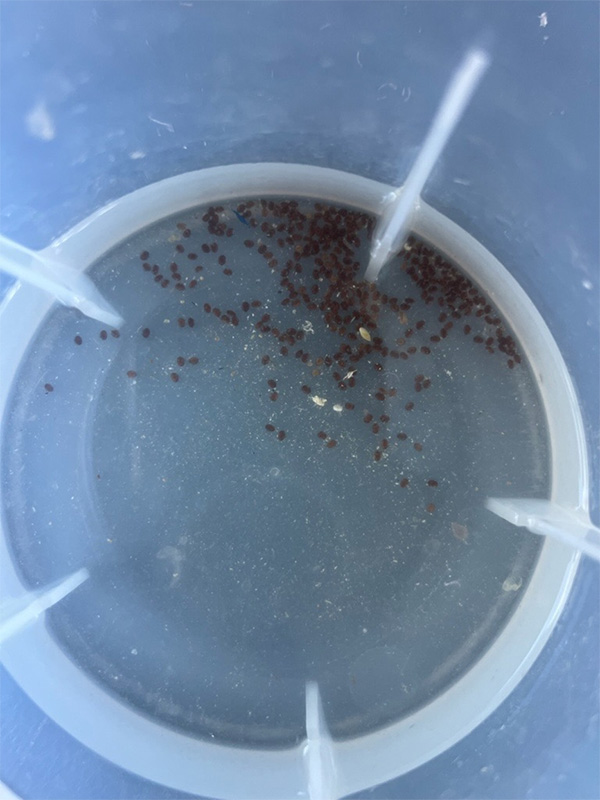
Figure 2. A “low” mite count taken from a commercial load of bees currently mid-treatment with Apivar. These mites are resistant to amitraz and pyrethroid treatments and are therefore not controlled with available synthetic chemistry. In this case the beekeeper did not know that their apiaries were infested with resistant mites. Careful regular monitoring of mite numbers combined with testing for resistance and choice of an appropriate non-synthetic treatment, before mite numbers have climbed, could have reduced the incidence of mites in this load.
If apiarists in Qld suspect their treatment isn’t working, or they’re seeing unusual mite numbers after treatment, they should report it to Biosecurity Qld by calling 13 25 23, using the Bee123 form, or emailing varroa@dpi.qld.gov.au Biosecurity Qld staff will then provide advice on the next steps.
Remember, you don’t need to wait for treatment failure to test for miticide resistance. You can test at any time. The sooner you know the quicker you can plan and act for successful mite control.
What do I do when my results come back positive for resistant mites?
This is where we get down to the basics of IPM. IPM has been standard practice in agricultural industries for decades and many beekeepers already practice IPM without knowing it. Continuing to throw synthetic miticides at resistant mites is a waste of time and money and might ultimately cost you your colonies and your business. You need to look at changes you can apply that reflect IPM principles. So what are some of those changes?
- Cultural controls
By “cultural” we mean everyday bee husbandry practices that set your bees up for success. This includes but is not limited to:
- Monitor, monitor, monitor. Check your hives frequently and take note of any issues that may impact colony strength and health. Take prompt action to address issues and keep records of these actions. This includes strength and brood inspections and varroa mite checks.
- Do not rely on natural attrition of queens. Maintain a queen replacement schedule and monitor queen performance, replacing poor layers before the colony becomes weak.
- Consider running a barrier system by load, pallet or single hive wherever possible. This helps to restrict pest and disease spread across your operation.
- Prioritise access to nectar and pollen that provide sufficient nutrition and where necessary feed supplements to maintain health. Healthy, well-fed bees are more resilient in the presence of varroa.
- Honey bee breed and genetic selection – do your own research. Proven varroa resistant or tolerant stock is not yet available in Australia. With time, queen breeders will select and improve on these traits and eventually this cultural control method may become available for purchase.
- Hive environment. Set up an environment that favours your bees and hinders varroa. Manage hives to maintain strong bee numbers and avoid empty space.
- Consider how you manage brood nest size going into winter. Do you need to add space to the brood chamber for additional honey storage to help ensure adequate over wintering resources to support colonies through winter? Will you overwinter in a cool climate to help shut down laying? Ensuring mites are controlled leading into winter shutdown will help reduce overwintering losses.
- Prevention:
- Try to avoid moving bees within 3km of other beekeepers.
- When purchasing queens and colonies make sure you have a conversation with the seller about miticide resistance. Has the seller noticed issues around treatment efficacy? Has the seller had confirmed results for miticide resistance?
- Do not bring bees of unknown provenance into your apiary.
- Consider isolating new bee introductions from the bulk of your operation until you are sure of the resistance status of the associated mites
- Practice swarm control to reduce the reinfestation rates and further spread of resistant mites.
Many of these recommendations can be found in the Australian Honey Bee Industry Biosecurity Code of Practice and NSW DPIRD factsheets as well as various online resources. Study the available literature so that you are armed with the latest information.
- Non-chemical (mechanical) controls
Non-chemical controls are those controls or interventions that do not rely on organic or synthetic miticides. They include drone brood removal to reduce mite load, and queen caging and splitting to interrupt the brood cycle. Where mites are resistant to synthetic miticides, it is likely that you are going to need to incorporate some form of non-chemical intervention into your beekeeping calendar. This may appear challenging at first, but it is important to weigh up the long-term benefits versus costs that apply to your own specific situation and determine what is feasible for you. This is something that BBOs can assist you with.
- Chemical controls – organics and synthetics
There are two forms of chemical controls available for varroa mites in Australia: organic and synthetic. Organic chemicals are those chemicals that occur naturally, albeit most organic chemicals are the byproduct of industrial processes and are not obtained from natural sources. Organic chemicals are a blunt instrument with a largely unknown mode of action. Synthetic chemicals are synthesised through industrial processes to target known metabolic pathways. Synthetic chemicals are more like a surgeon’s scalpel and are thought to have less of an impact over all on bee health. Having said this, all chemicals that are applied to colonies be they organic or synthetic in origin will have an impact on bee health and this is something that beekeepers should monitor and weigh up when compared to the impacts of varroa mite.
Information on the organic and synthetic treatments that are currently available in Australia can be found at AHBIC Varroa Chemical Treatment Table - Australian Honey Bee Industry Council
Use this table to assist you in identifying the products that will fit your system of beekeeping. Some of these products can be used as effective flash/knockdown treatments such as dribbling and vaporisation with oxalic acid whilst others will provide longer term efficacy. Formic acid treatments can be very effective in controlling mites under brood cappings, but are temperature sensitive and must be used carefully. Be careful to choose treatments that reflect the resistance status of the mites in your colonies. Remember that chemical treatments are not a stand-alone solution in managing mites. You need to look at the entire IPM system and incorporate options that will assist you in managing mites holistically – cultural, non-chemical/mechanical and chemical.
If you are managing an apiary with confirmed resistance, it is important to know which resistance is present. Some apiaries will carry resistance to amitraz, some to pyrethroids and many to both. This reflects the way in which varroa mite populations are moved around and the mixing between resistant and non-resistant mite populations. Your testing results will tell you which form(s) of resistance is present in your apiary. In many cases, you may only have resistance to one synthetic group in which case you can continue to utilise the other as part of your treatment program – but you must continue to monitor and act if you believe efficacy is reducing. In cases where both types of resistance are present, you should avoid the use of pyrethroids and amitraz-based treatments for as long as possible. This means you will need to rely more heavily on organic treatments, cultural and non-chemical/mechanical controls. Consider all options in your IPM armoury and develop a combination that will work within your beekeeping operation. This is not an easy message to digest. Cultural change across the industry will be required to meet this challenge.
In all cases, you must read and comply with the conditions of use for each product, and you must always rotate treatments between chemicals that have different modes of action. Failure to do so can hasten future treatment failures and negatively impact honey bee health.
A word on monitoring
Regular monitoring of mite numbers is non-negotiable. Thanks to the efforts of some diligent beekeepers in reporting their issues, we are all now in a position where we know that resistant mites are out there. Whether managing resistant or susceptible mites, monitoring is key to enable early intervention. BBOs have seen several cases where beekeepers didn’t realise their apiaries had resistant mites. Even with treatments in place, mite numbers rose fast – reaching hundreds of mites in an alcohol wash (Figure 2). By that stage, colonies can be very hard to save, and many have been lost.
You are in a fortunate position because you now have the knowledge and skills to avoid this situation and this starts with regular monitoring and early intervention. The thresholds that have been set by NSW DPIRD apiculture experts provide a science-based guide for when to intervene. If you notice that synthetic treatments are not working as expected, you must take early action and have your mites screened for resistance. Knowing your resistance-status will assist you in making effective management decisions to help bring the situation under control before mite numbers peak.
There is always hope on the horizon
Research is ongoing looking for alternative or complimentary treatments to the current suite of synthetic miticides. Recent work suggests that chemical synergists may help increase the toxicity of amitraz even in resistant strains of mites. The use of Norroa double stranded RNA technology to supress mite reproduction is a new tool recently commercialised overseas. NSW DPIRD has a funded research program looking at the efficacy of miticides in Australian commercial conditions to help inform best varroa management practises – you can sign up to participate in this project through the link. DPIRD research scientists are engaged in preliminary discussions around the novel use of additional synthetic miticides against Varroa destructor. Research and development into new tools to fight varroa is ongoing around the world due to the increasing impacts of synthetic miticide resistance – so watch this space for new developments.
How did Australia end up with resistant mites?
This is another important question that solicits strongly held opinions from beekeepers. We know that the mites that were detected in Australia in 2022 are not related to the mites that are now carrying dual synthetic miticide resistance. We know this because of the very different ancestry of the viruses they are carrying and the tight association between virus ancestry and the presence/absence of resistance in the varroa host. This leaves open the question of how two distinct populations of varroa mite, one that is fully susceptible to synthetic miticides and one that carries resistance, made it all the way to Australia. What we know to date is that these two mite populations likely have very different overseas origins. The Commonwealth Department of Agriculture Fisheries and Forestry (DAFF) has jurisdiction to investigate the incursion of new pests into Australia. A comprehensive investigation into the 2022 varroa mite detection did not reveal a definitive pathway of entry. Information around the latest detection has also been referred to DAFF. What is critically important is for anyone who has information around either of these two incursions to come forward with that information to DAFF. You can do this anonymously by calling Red Line on 1800 803 006. More information on Red Line can be found at https://www.agriculture.gov.au/biosecurity-trade/policy/legislation/compliance/redline
Where to from here?
Whilst it is incredibly disappointing that Australia has suffered two varroa mite incursions in the space of approximately four years, there are some silver linings.
To date, there is no evidence that either of these incursions brought in serious exotic viruses like Slow Bee Paralysis Virus and Deformed Wing Virus – pointing to an extremely small founding population in both cases. This means that whilst mite numbers can build up significantly, the impact on bees is less than what it would be in the presence of these viruses. We must keep it this way for as long as possible. Any subsequent varroa incursion runs the risk of introducing these damaging viruses making it even harder to keep bees alive and healthy.
The absolute necessity to regularly monitor colonies and holistically manage colony health in order to manage varroa will create a more capable beekeeping community. Beekeepers who do not take adequate steps to manage varroa, especially regular monitoring, will lose hives, whilst those who do will remain, and through hard work and diligence rebuild and thrive.
The presence of miticide resistance in your apiary can feel daunting. It is important that you do not go through this alone. Reach out to friends and family. Don’t bottle it up. The BBO program can provide you with technical help and on ground advice. DPIRD’s Apiculture experts can help you work through your options and discuss current research and potential new solutions. Don’t be afraid to contact the good people at the Rural Aid Mental Health & Wellbeing Line (Mon–Fri): 1300 175 594 and the Rural Financial Counselling Service: 1800 344 090 who can support you with mental health and financial counselling respectively. Other similar services include Small Biz Connect: 1300 134 359 and the NSW Mental Health Line (24/7): 1800 011 511.
Contact Details
BBOs can provide you with hands-on practical support in mite management including the collection and submission of mites for testing. Contact the Bee Biosecurity team by email at bee.biosecurity@dpird.nsw.gov.au or give one of the below contacts a call:
- Rod Bourke - 0438 677 195 bourke@dpird.nsw.gov.au
- Sam Giggins - 0438 533 156 giggins@dpird.nsw.gov.au
- Alex Schellenberg - 0419 164 615 schellenberg@dpird.nsw.gov.au
- Harvey Howard - 0475 627 846 howard@dpird.nsw.gov.au
- Doug Purdie - 0475 968 043 purdie@dpird.nsw.gov.au
- Daniel Martin - 0475 947 516 martin@dpird.nsw.gov.au
DPIRD’s apiculture experts can provide you with detailed advice on resistance management and monitoring. Contact:
- Technical Specialist Bees Elizabeth Frost - frost@dpird.nsw.gov.au
- Project Officer Emily Noordyke - noordyke@dpird.nsw.gov.au
Links and resources
Integrated Pest Management — National Varroa Mite Management Program
Managing your hives with Varroa – DPIRD Primefact Collection
AHBIC Varroa Chemical Treatment Table - Australian Honey Bee Industry Council