
The Challenges Facing All Beekeepers
by Trevor Weatherhead AM
President Queensland Beekeepers Association
Beekeepers have always faced challenges over the years but June 2022 presented us a problem that we knew was coming sometime but had hoped it would stay away for a while longer. That was the arrival of the Varroa mite (Varroa destructor). That changed the face of beekeeping in Australia.
Whilst we had been preparing for the arrival of the Varroa mite, the reality of it now being in Australia hit hard.
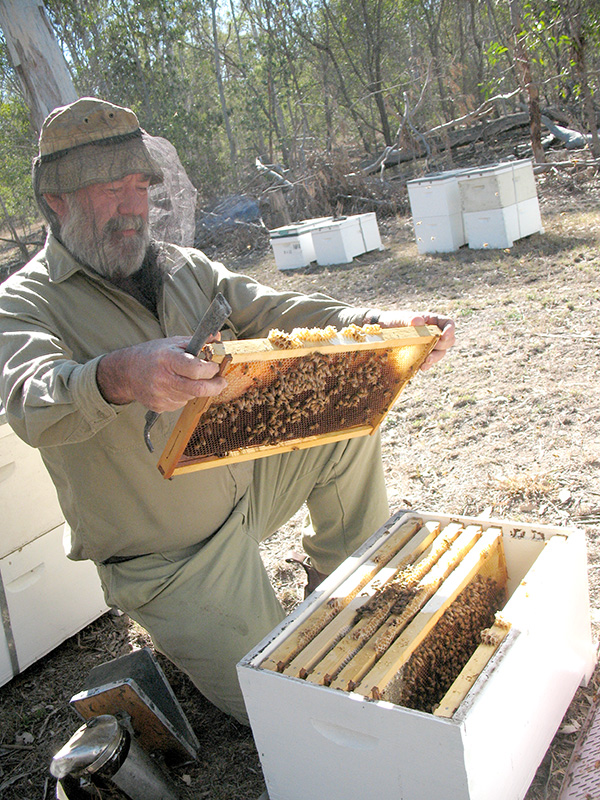
So what have we learnt? Firstly we need to be constantly checking our hives for the presence of Varroa mite. This is usually done via an alcohol wash or a soapy water wash on 300 bees (half a cup full) and count how many mites are present. This has to be done every 4 weeks. Once you get the results you need to see if the counts are over the threshold and, if so, select a suitable treatment.
There are many videos available out there showing how to do these washes but I recommend going to https://www.varroa.org.au/ to get your information. This is a trusted source not like some of the overseas videos which show information that is not pertinent to Australia.
So what do I treat with? The Australian Honey Bee Industry Council has a table on their website which can be found at honeybee.org.au/ahbic-varroa-treatment-table/. This is updated from time to time so you should check back regularly for the latest information.
It is important to note that the colours show the mode of action for the chemical and you should not use the same mode of action sequentially. You need to rotate.
So the mite arrived. What other challenges did it present?
We knew that resistance to the synthetic chemicals would occur sometime but it surprised us when it showed up in just under 4 years. Resistance has shown up in Bayvarol (flumethrin) and Apivar (amitraz). There is another treatment containing amitraz and is called Apitraz and another chemical with the same mode of action as Bayvarol so mites would also be resistant that it. It is Apistan (Tau-fluvalinate). Resistance results in the mite numbers not being killed when the strips are applied. To find out if your treatment has worked it is crucial that you do your washes before considering treatment, to make sure it is over the threshold, mid-way through the treatment and at the end of the treatment. If numbers have not dropped report this to your local Agricultural or Primary Industries Department.
Failure to keep the mite numbers low will result in the hive dying out. Often it is found that the Varroa mite weakens the hive and the small hive beetle (Aethina tumida) finishes off the hive. Other than South Africa, Australia is the only major beekeeping country in the world that had small have beetle before we got Varroa. The other countries had gone through the build-up or invasion phase of the Varroa mite and numbers had settled down because the feral colonies and unmanaged hives were gone. In Australia those dying feral and unmanaged hives are a perfect source for small hive beetles to breed and then infest your hive. So it is crucial that you have practices in place to control small hive beetle.
With Varroa mite affecting our colonies another challenge that faces our industry is the suppling of suitable hives to the agricultural sector for pollination of their crops. Remember our industry pollination value is at last $4.6 billion for crops in Australia. It can be expected that the price per hive for pollination will rise as beekeepers have to spend money on labour for checking hives for Varroa, treating hives plus the cost of the chemicals. The growers will suffer a double whammy as many have been relying on feral and unmanaged hives for pollination. These feral and unmanaged hives will be gone and growers will need to hire hives for pollination. So it is important that beekeepers do the right thing and supply hives of suitable strength for pollination.
So what other challenges does the presence of the Varroa mite present? As Varroa like to breed in drone cells, queen rearers will face challenges in being able to produce drones for mating with the queens they are producing. Feral hives and unmanaged colonies have been out there to supply drones for mating if there was not enough supplied by the queen breeder. With the loss of these feral and unmanaged colonies, the queen breeder will need to have a very good plan in place to produce drones for mating.
As well as Varroa we still have the challenge of the other endemic diseases in Australia that present a challenge to the beekeeper. Among these are American foulbrood (Paenibacillus larvae), European foulbrood (Melissococcus pluton), chalkbrood (Ascosphaera apis), nosema (Nosema apis) and the various viruses. It is important that beekeepers do not drop their guard in looking for these diseases just because Varroa is here. The various Agricultural or Primary Industries Departments have excellent publications on these diseases plus there is Bee Aware, see https://beeaware.org.au/ . Study these to make sure you know what you are looking for.
There is the Biosecurity Online Training (BOLT) course which can be found at https://www.planthealthaustralia.com.au/training/biosecurity-online-training-bolt/ The Biosecurity for beekeepers is the one to take. It is free and you will be issued with a certificate at the end of the course. In some States, this is a requirement for registration.
Other challenges facing beekeepers are drought, floods and fire.
Drought is one that we are being told will be with us as we enter a predicted super El Nino. Whilst the backyard beekeeper will not be affected as much as people will often keep their gardens growing by watering them, out in the bush it is different. Lack of rain will often cause trees to drop their buds, not put on buds and, if the tree does flower, it often will not yield nectar or pollen. Queens go off the lay and the hive strength will weaken. Beekeepers often have to resort to supplementary feeding to keep hives alive.
Flood is one that will affect beekeepers who have hives in low lying areas. When selecting a site it is crucial to make enquiries about previous flood heights. I have seen cases where enquiries were made and the flood took the bee hives out because it was above all previous flood levels. Nothing worse than having to clean out hives that have been inundated with water. Even partial inundation can present a situation where small hive beetle can come and take out the rest of the hive.
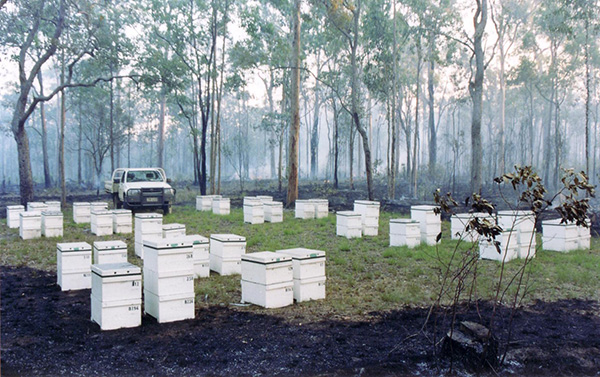
Fire is a big threat as beeswax and hive components easily burn. You need to make sure that you have an adequate fire break around your bees. However in some cases of extreme fires, nothing will stop the hives from being consumed by fire. It is very devastating to come out after a fire and see nothing but ashes, charcoal and pieces of metal e.g. queen excluders and lids, left on the ground.
The last challenge that I can think of is we are all getting older. At some stage we have to make a decision on what we do. Some change full depth honey supers into small sizes such as half depth, ideal or WSP. Beekeepers often jokingly refer to half depth supers as grandparent boxes. At some stage you will decide to stop keeping bees. At that time, it is important to make sure the hives are passed on to someone, who will look after them, either by selling them or giving them away. Do not leave them to die out as they will become a mite bomb which will affect surrounding hives.
So enjoy your beekeeping while you can and go to conferences such as the Queensland Beekeepers Association conference coming up on 11 and 12 June 2026 in Bundaberg or the New South Wales Beekeepers Association conference in Bathurst from 13-15 May 2026. I recommend that you are a member of your local beekeeping club where you will be kept up to date with the latest information and those challenges will not seem insurmountable.