
Where Are All The Drones?
Low Drone Numbers, Post Varroa, Threaten Queen Bee Mating!

By Michael Duncan, Research Apiarist,
Western Sydney University
On warm summer afternoons between 2 and 4 o'clock, something remarkable happens above the paddocks and tree lines of the Hawkesbury region in New South Wales. Thousands of male honeybees (drones) spiral upward, converging on invisible meeting points in the sky known as drone congregation areas (DCAs). They are waiting for queens.
For more than a decade, I have been sending balloons into those DCAs as part of the Animal Behaviour and Invertebrate Biology practicals at the Hawkesbury campus. What I found in last two seasons is concerning.
The Art of Sky Fishing
The technique I use is quite simple, and developed from a paper by Norman Gary in the 1970s. It is known as drone ballooning or, as we call it, sky fishing for drones. (There is a Sky Fishing Video at the end of the article.)
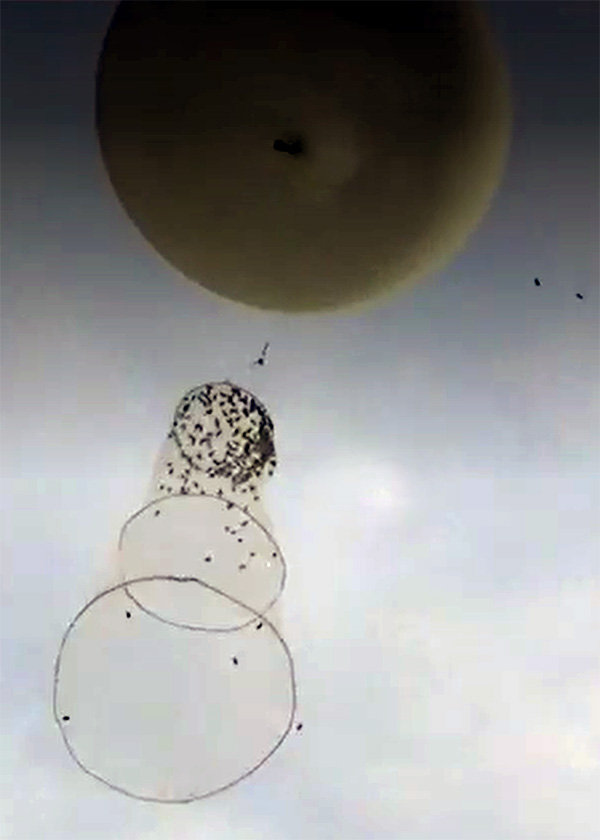
A helium weather balloon lifts a conical net made from bridal tulle into the sky. Suspended inside the net are cigarette filters painted black. Small, dark objects meant to mimic queens drifting on the breeze. Critically, the filters are treated with a synthetic queen attractant pheromone: 9-oxydecanoic acid (9-ODA). The dosage matters enormously. If you put too much on, it has the opposite effect and actually repels the drones. One microlitre represents roughly two queen equivalents. Overdose it, and it simply does not work.
When conditions are right, light winds, temperatures around 28 to 30 degrees Celsius, the result is spectacular. Comets of drones numbering in the thousands stream toward the net, fly up into the conical structure, and become trapped at the top. In past years, three nets deployed across the outskirts of a DCA could yield several thousand drones in a single session. We then genetically analyse the drones to determine how many distinct colonies are contributing to the congregation area, giving us a snapshot of local bee population diversity.
From just 200 drones, you can essentially identify every colony represented in that congregation area. If 50 different genetic lines show up, that tells you there are roughly 50 colonies contributing — whether managed hives or ferals.
Why Drones Matter
Some beekeepers think of drones as freeloaders — all appetite, no purpose. The reality is considerably more important. A virgin queen makes several mating flights, typically between 7 and 14 days after emerging, during which she mates with somewhere between 10 and 15 drones. That is it for her entire reproductive life. The sperm from those encounters is stored in a tiny structure called the spermatheca — she takes in roughly 10 microlitres and retains about one — and that single reservoir must fuel years of egg-laying.
The genetic consequences are far-reaching. A queen mated with 15 drones from 15 different colonies will produce worker offspring from 15 distinct sub-families, each with different traits and disease resistances. That diversity underpins the resilience of the colony. A queen mated with only three or four drones produces a genetically narrow workforce — and is likely to run out of sperm sooner, failing prematurely.
It is worth understanding that drones do not produce any pheromone themselves. The dynamic works the other way around. Queens fly out, and drones come from the congregation area in huge comets to chase them down. One drone mates with the queen, falls back, the endophallus is ripped off, the next one comes, and it is a very rapid process. Then she flies back to the colony, still carrying the last mating sign, and the worker bees remove it.
A Tenth of What It Was
I first noticed diminished drone numbers in 2024. In spring 2025, I set up three drone balloons in what should have been perfect conditions — around 28 to 30 degrees with very light winds. The comets never formed.
Across three nets, we caught six drones. There was a little activity around the area, but nothing was forming into the comets I was used to seeing. Even throwing squash balls and stones into the sky, which normally sends the drones into a frenzy, produced at most one or two bees chasing the ball. What used to be dramatic aerial displays had been reduced to almost nothing.
Thinking it may be a one off event, I repeated the exercise a week later. Same result!
The timing coincided with the first wave of Varroa destructor sweeping through the region, and I believe the connection is direct. Anecdotally, I would say that most of the feral bees within range of those congregation areas had already been wiped out. At that stage, I had about 20 of my own colonies in the area, and they were probably the only ones contributing drones.
Things improved somewhat in early 2026, when I had built my hive numbers up to around 40 colonies. Small comets formed, and we were able to catch 20 to 30 drones per net. But the contrast with pre-Varroa seasons is stark. Previously, we would get several thousand drones across three nets. What we are seeing now is at least a nine-tenths reduction in the drone population in the sky.
That figure — a 90 per cent drop — maps almost exactly onto estimates of how much of Australia's feral honeybee population Varroa destroys as it moves through an area.
Queens That Don't Last
The consequences for queen mating are already showing up in my own apiary. This season, I put out 25 nucleus colonies with virgin queens for mating. Two queens returned as drone layers — they had not mated at all. Eleven superseded within the first month, a pattern I recognise from another context entirely: it is very similar to what happens with single-drone artificial inseminations. They last for a little while, and then they fail. Those queens had almost certainly mated with an inadequate number of drones.
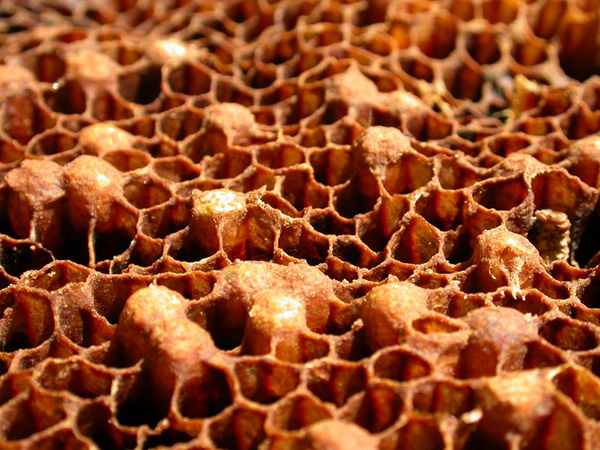
Many of the remaining colonies went on to supersede their queens not once, but two, three, or even four times across the season. I have been doing this for 30 years and I have never seen so many supersedures.The sign to watch for is the queen starting to lay drone brood in worker cells. You will see raised drone cells appearing among normal worker brood, which means she is running out of sperm. That is your early warning sign!
The difference was immediately apparent when I introduced purchased queens from regions less affected by Varroa, where drone populations remain healthy. They hang on in the colony. No repeated supersedures, no premature failures. The contrast is unmistakable.
Much of what I am describing is observational rather than formally measured. It'd be great to be able to document how well they're actually mated and do some hemocytometer work and look at live and dead sperm ratios in the spermatheca.
What Beekeepers Can Do
For queen breeders, the implications are serious. A good breeding operation has traditionally relied on flooding the local DCA with drones from high-quality drone mother hives, ensuring that queens mate predominantly with selected genetics. Post-Varroa, that principle becomes more urgent, but harder to achieve, because the feral drones that once made up the bulk of drone populations are largely gone.
The idea has always been to contribute as many drones of your preferred genetic lineage to the congregation area as possible. It's not just a strategy for genetic control, now it is necessary to simply ensure adequate mating at all. A serious queen breeder should have 50 to 100 drone mother hives producing drones continuously.
For backyard beekeepers, the options are narrower. Maintaining four or five strong colonies as drone mothers is a sensible step, but whether that is enough to sustain the behavioural dynamics of a functioning DCA is an open question. One that, as far as I know, has never been rigorously studied. Some queens will mate well. Others will not. Do not be surprised to see queens failing more regularly if the drone population is not there.
Buying mated queens from reputable breeders in regions where Varroa is not yet established, or where drone populations have recovered, is currently the most reliable workaround. Artificial insemination remains a niche tool, valuable for maintaining breeder queen genetics, but too expensive and labour intensive for routine re-queening at scale. A commercially inseminated queen might cost $500. That is a breeder queen you graft from, not a replacement for your whole apiary.
The Longer View
Drone congregation areas are extraordinarily persistent. The DCA here at the Hawkesbury campus has been in use for as long as anyone working here can remember, well before Varroa arrived in Australia. The one near the Wheen Foundation property at North Richmond was known to the late Gretchen Wheen for 30 to 40 years. I have done ballooning near that site recently, and it is still active. DCAs form around landscape features like open areas near tree lines and at heights shaped by the local canopy. Queens find them reliably, year after year.
In tall forest country like Barrington Tops, the drones can be 30 to 40 metres off the ground, hovering above the canopy. In areas like Grenfell where the trees are more stunted, they sit much lower. They use the canopy as a landmark to orientate themselves. You can find a congregation area by putting up a balloon in likely spots and timing how long it takes for drones to arrive. 10 to 15 minutes means you are some distance from the actual DCA. A fast response means you are close.
The congregation areas will persist. The question is whether enough drones will come to fill them. Drone numbers may prove to be an ongoing challenge for all beekeepers.