
Cues and Clues of the Beehive
By Arthur Garske

Interpretation
To be a good beekeeper and not just a keeper of bees it is necessary to use ALL your senses. Especially your powers of
Observation
There is so much that you can learn from just observing your bees and seeing what they are doing.
- How many bees are flying
- Amount of pollen being brought in
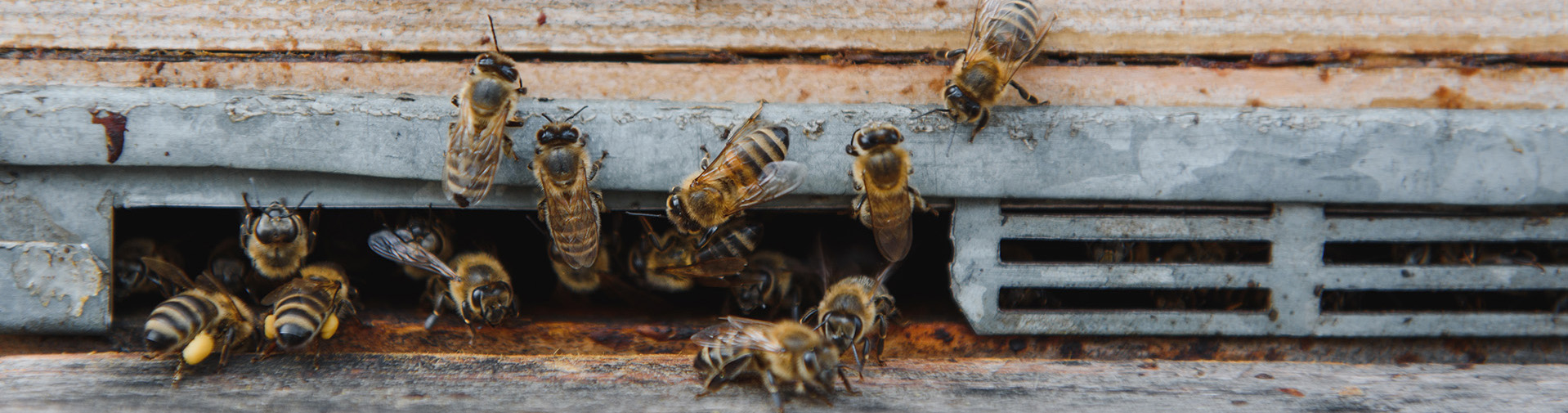
- Are the bees landing light or heavy
- What is on the ground in front of the hive, e.g dead bees
- How many bees are crawling up grass stems trying to fly and falling back to the ground.
- Are their wings distended
- Are they shivering
- Do they look waxy
- Have the front of the hive bodies got orangey looking spots
- Have you listened to the hum of the bees
Whilst you are looking
- Have the bees been checking you out,
- Are you something they feel threatened by
- Are there bees flying around the hive erratically looking into cracks or crevices, the breathing vents on migratory lids landing on the edge of the entrance and taking off again erratically.
You may see a bee trying to run out of the entrance with another bee hanging onto that bee, maybe trying to sting the intruder.
- This could be taking place in several sites across the landing board entrance.
- This tells you that all is not well in the honey gathering stakes, the flow has either been interrupted due to weather conditions or even that the honey flow has finished.
- This means that maybe you have a rethink about looking at your bees. If you had been thinking about robbing them then have a rethink.
- If you decide to go ahead and rob in a suburban situation this could possibly lead to neighbours getting stung as well as family members or anything that moves in the vicinity.
- The answer is to not go past the Observation Stage.
- Are they buzzing around 5cms from your face to get to the hive taking no notice of you
- What is the buzzing sound now
- Is it normal
- Is the pitch much higher
- Are the bees movements jerky and darting
If you dare to windmill with your hands, hey presto! Instant sting.
If you ignore the bee buzzing around 5 cm from your face rather frantically it will leave you for a short time but will return and go through the same process and eventually not come back at all.
Sometimes the first bee that was buzzing with a high pitch sound may return with 2 or 3 other high pitched buzzers. This tells you that all is not happy in the family home and it is time for you to decamp slowly.
On the other hand you might, on first arrival to look at your hives, hear a really high pitch buzz and feel the bee hit you in the back of the neck or ear.
When this happens there is only one thing to do and that is hit the bee as it hits you and scratch the sting out immediately.
If you do not kill the stinger she will keep hitting you and the high pitched sound of her buzzing wings is a call to arms of her sisters who will be devotees of the same Kamikaze school of high speed attack.
It is Time to Leave and Gear Up
If you absolutely have to look into the hives make sure the smoker is belching lots of thick white COOL smoke, preferably from forest She-oak needles.
Now Observe what is happening around you.
- Are there clouds
- Is it windy
- Which direction is the wind coming from
- Are the bees coming in light
- What is the smell or odour in the immediate hive area
- Is it sweet or sour
All this has been Observed and you haven’t even opened up the hive yet.
Opening the Hive
- Go to the hive entrance, a few puffs of smoke at the entrance,
- Lift the corner of the lid, a couple of puffs
- Put the lid back down and wait a minute or so making sure you are standing to the side or back of the hive, NOT in front of the entrance
- Lift the lid off, then the inner cover. Now observe what the bees are doing
- Are they forming rank, if so a couple of puffs of smoke, if not use your hive tool
- Split the frames gently and deliberately
- Withdraw a frame
- Look at it on its edges
- Smell the odour of the hive
- Put your nose down to the gap formed when you withdrew the aforementioned frame and breathe deeply
- Is it sweet or sour (foul)
- Are the bees in the hive buzzing normally
- Are they buzzing nervously
- Are they buzzing, crying, distressed?
Lift off boxes of honey placing them on your upturned hive lid with a puff or two of smoke over boxes before lifting them off.
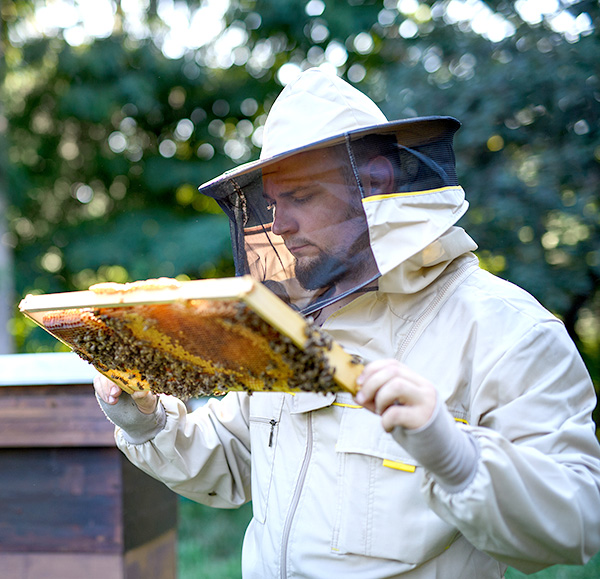
Now you are down to the Brood Box. Lift out the frame of brood nearest the side wall. Look quickly on both sides making sure the queen is not on it and lean it against the side of the hive.
What you are looking for is eggs on end and tiny larvae. When you find these, start observing the bees behaviour, this will help you find the queen.
All the time Listening to the buzz of the hive.
You should also be Smelling at the same time. Gently shake off excess bees back into the hive body then start looking at the frame of brood.
- Give the frame a shake on the flat, this lets you know how good or bad is the honey flow.
- Turn the frame on its axis and position yourself with the sun coming over your shoulder and the frame angles so that the sun lights up the bottom of the cells.
If the queen is young and vigorous there should be even concentric arches of brood larvae.
If conditions are really good there should be a sea of royal jelly in the bottom of cells with the tiny larvae floating in it.
The smell you should be smelling is slightly sour coming from the abundance of royal jelly.
There should be a band of honey around the sides and top bar. All this is done quickly as you want to have the hive opened as little as possible. While you are doing this your ears are Listening to the sound of the bees.
When they start to alter their pitch – anxious, a couple of gentle puffs of smoke over the brood box and frames and also over the top of your honey supers is a good idea.
Quickly go through the brood frames
- How many sealed brood
- How many unsealed brood
- How lavishly are they being fed
- What sort of shake have you got
- Is it consistent with what you have observed in the flora (buds) flowering
- How much more is to crack, i.e., how much that is going to start flowering in another four weeks
- Are the bees really happy and progressive, if so
- Split the brood and, say, put in four well drawn combs alternating between unsealed brood
- Lift up four frames sealed brood and put into middle of honey super
- Take out four frames of sealed honey all the while Listening for changes in buzzing (bee talk) telling you when the judicial use of smoke is needed to start putting the hive back together, take off honey or put on extra box or boxes.
If you do not want to take off honey this time, put the four frames of sealed honey on the outside and four empty frames in the middle of the new box you have given them.
Listening
When you first take off the lid and cover, Listen to the hive sound, bee talk.
- If a hive is queenless the bees sound agitated – unhappy and I call it “crying”
- If a hive has lost its queen – superseded and raised a new queen but she has not long hatched out and has not as yet mated the bees sound “anxious”
- If a hive is “sick” for whatever reason then the sound the bees make is sort of agitated and when your nose takes an active role you can smell that all is not well. The demeanor of the bees is aggressive.
When you take off the lid and cover of a queenright healthy and prosperous hive the sound you will hear is a normal humming sound – “happy bees”.
I have already told you how your sense of smell is so important in helping you to assess conditions in the hive, likewise your eyes are the key to see what is going on outside the hive.
To be a good beekeeper you have to be a student of nature. Look closely at what is happening around about your hives, e.g., your hives may be getting a tremendous shake, the weather is fine and sunny, there is no sign of a change, there is a light breeze, you are working your bees, everything is great then maybe an hour later the breeze stiffens, the tone of the bees changes and they start to get a little toey but you finish your work.
The next day no shake of nectar, bees are as cranky as all hell and prone to rob, but the following day everything is fine, bees are happy getting a tremendous shake. The only thing different is there is no breeze.
Lesson to be learnt that wind stops a number of trees yielding.
Walking through scrub looking at buds and blossoms, pull down a limb to look at the flowers to see how much nectar is in the flowers. Maybe they are full. Go around the other side of the tree that was in the shade, pull down a limb to look at nectar in flowers and guess what could be as dry as a chip.
Look at different trees on the shady side, no nectar; on the sunny side plenty of nectar, Go back in the afternoon the reverse happens.
Lesson to be learnt, if you had looked on the shady side only, you would have thought there was zero flow.
Another example of bees going great. Queen laying profusely, a really large brood nest and bees getting a tremendous shake, plenty of blossoms to break and then another floral source so heavy with bud the limbs were all hanging down like bunches of grapes. Come back to civilization for four weeks, counting the tins of honey that are going to come.
Return to the bees, go down into the brood nest on the first hive after lifting off three boxes of honey but the brood nest is shrinking. First thought: the queen getting past it.
Take off three boxes of honey. On the next hive go down to brood nest, brood nest shrinking, bees packing honey into cells as brood hatches and all the hives the same.
Everything looked great to me, the flow they were working was yielding, the buds on the upcoming flow were full and yellow and just about ready to start cracking.
Came home, went back four weeks later, not a flower in sight. Ground under trees yellow with buds that the trees had thrown off.
Lesson learnt from Observation. Somehow those bees knew what was going to happen weeks before it did happen.
Tips for Beekeepers
Before you start working your bees, thoroughly SMOKE your hands or if you wear gloves SMOKE THEM also.
Observe if bees on landing board are standing with their FRONT LEGS ELEVATED. They will be in STINGING MODE and you will have to use your smoker constantly to avoid the swarms of stinging bees. If you can avoid working them come back another day.
LISTEN to the humming sound and if it subtly changes from normal happy buzzing sound to a more aggressive buzzing, judicial use of smoker needed more regularly.
When washing your bee clothes, use a neutral washing powder with NO added strong perfume.
DO NOT WEAR DARK CLOTHING.
All your movements NEED to be SMOOTH, not Jerky.
DO NOT bang or knock boxes or frames unless you want to get STUNG.
If you know someone in America get them to buy you a Medi haler made by RIKKER it measures out a metered dose of powdered adrenaline you can use if you or other persons exhibit anaphylactic type reactions and if one puff inhaled does not get the required result you can give more puffs.
You used to be able to buy them here without a prescription and they used to be used for people with breathing problems, but they invented more and better relief methods and because they were not used very much they took them off the market, here in Australia. They cost about $20 dollars American. And they last for a year.