
Start Your Own Beekeeping Club
By Kris Fricke
You like beekeeping, and you like where you live. Where you live is a nice, peaceful place out in the countryside. There’s just one problem – you wouldn’t mind having other people around you to talk bees. You could talk over how you’re all mutually dealing with the local conditions, assist each other when someone needs a hand, and share beekeeping knowledge. That would be nice … but the nearest club is over an hour away.
You’ve read the title of this article, and you’re already thinking “no way do I want to be writing up minutes, filing whatever paperwork one needs to do, electing officers, etc!” Well, no worries, I didn’t want to do any of that either, so I didn’t.
Around about 2016 I moved to the little village of Birregurra, population around 800, about an hour west of Geelong, just north of the Otways. Knowing that I was into beekeeping in a big way, people soon started telling me I should start a local club. Probably about two years went by before I started to give in. I posted to the local community Facebook group asking if people would be interested in such a thing, and there were plenty of comments indicating there was.
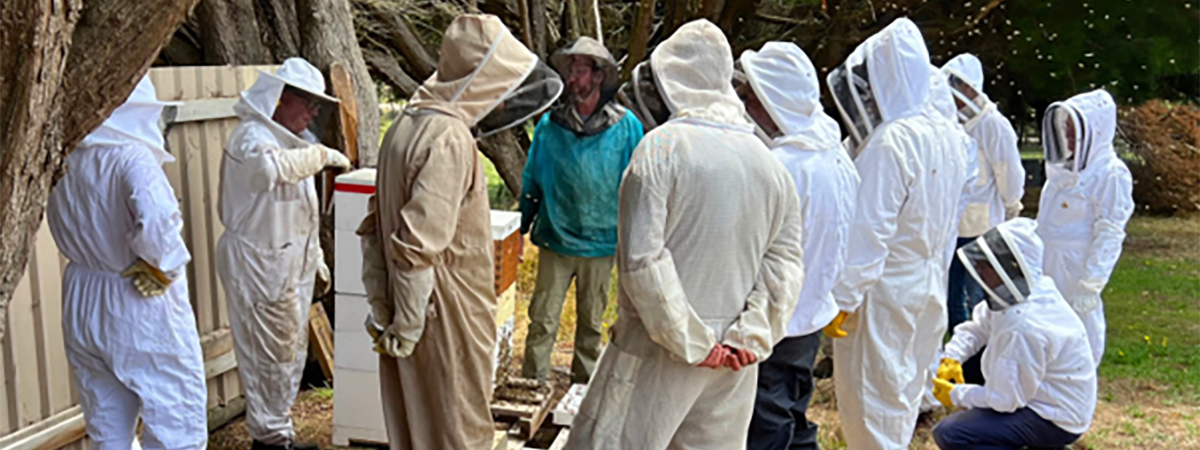
So I booked the local hall and posted to the Facebook group announcing the meeting on a Tuesday evening in spring. About a dozen people showed up, many didn’t have bees yet but were interested; a few already had a hive or two; and one or two genuinely very experienced beekeepers showed up either at that meeting or soon (local legend Alf Wittosch, sadly no longer with us, and a local arborist who had run 400 hives in France before immigrating here!). From there we were off to regular monthly meetings, usually with a “field day” in between as well where we’d meet at someone’s hives. Consistently around 6-8 people showed up at every meeting. Nearly all the interested members who hadn’t had hives soon had them, those who already had hives helping them get their first swarms and mentoring them.
At first I did try to adhere to having a meeting agenda, but with a small friendly group it gets a bit hard and awkward to stick to an agenda. Because nearly all the members were also into hobby farming and serious gardening, sometimes the conversation would address these topics entirely unrelated to bees for significant periods of time and I didn’t see any reason why it shouldn’t, as long as everyone is enjoying themselves, which they did. Two other perennial “agenda items” developed to be hit on every meeting: (1) “What’s the latest with the pub??” – our local pub was in a continuous cycle of being sold to new owners, closed for months of renovations, reopening, closing again after
less time than it had been in renovations, process repeats; (2) as my then-fiancée’s visa took years to wind through the system the members asked me for an update every month. And finally there really was one indispensable serious agenda item: “when and where are we meeting next?”
Covid disrupted us as it did all aspects of life, but when life was finally re-normalising afterwards one of our greatest innovations came out of it. We could meet again, but the hall was still not accepting bookings. So we made plans to meet at one of the members’ houses, we’d look at their hives then throw snags on the barbecue and yarn. By now the only semblance of an agenda item was the one indispensable one, now more important than ever – as people started to get up and say goodbye, “wait, who is hosting next month??” Someone always volunteered and we’d be off to another person’s place the next month and looking at their hives. Long after the hall was open for bookings again we never considered going back to a boring old hall when we were having so much fun meeting at a different member’s place every month.
Even the big city clubs sometimes have trouble getting enough people to step up as officers, and even though running this small local club wasn’t a lot of administration, it did require someone coordinating. Unfortunately, when I moved away to Geelong and got extremely busy with the varroa response the Birregurra group no longer met. Group emails still go out (it was always organized primarily around simply hitting reply-all to the previous group email) about requests for help or local swarm reports, and recently a lot of interest has been expressed in meeting again so maybe we will.
This group wasn’t a unique fluke either. When I was involved in the Varroa Development Officer program I was constantly thinking about how to reach the approximately 90% of beekeepers who DON’T regularly go to beekeeping clubs (!), and one of the ways was contacting Landcare groups (though Certain People in leadership positions preferred to just hit the same official clubs over and over and over again to collect low hanging fruit into a nice KPI pile but let’s not get into that), and I was pleasantly surprised to find in a number of cases the local Landcare coordinators knew of similar informal beekeeping groups in their area (I had correctly surmised that just as our group shared significant interests in Landcare issues, so would others). Unfortunately, I don’t recall a definite list, and it would blur into decreasing levels of formality, but ask your local Landcare network coordinator if there is one around.
I believe some (Many? All?) of the bigger clubs started out this way. When you get to a certain size, incorporation and the administration that comes with it becomes necessary. That may or may not be the ultimate trajectory of your group; I’d say neither fight it nor rush to it, just do what is best at any given time for your group. I’ve seen some groups reach a crisis in growth when they reach a certain size and the
founder is unwilling to let others take leadership positions in their group – don’t be that guy. Embrace anyone else who wants to take up leadership – their ideas might not be exactly the same as yours, but have faith that ultimately any big idea when discussed with the group will result in what’s best and fighting against change or infighting can only be bad.
In summary, without having to file paperwork, elect officers, record minutes, or any of that other busywork, we for many years ran a local group that was very rewarding for many people involved. Friendships were made, many new beekeepers were supported in their journey, knowledge was exchanged all around, fond memories of those sunny days of getting together and looking at hives and then having a barbie will live on for decades to come.
In conclusion I recommend:
- Meeting at different members’ properties to have a BBQ and look at their hives
- Don’t try to replicate the rigid formality of big clubs, lean into the casual informality
- Do encourage anyone who wants to to step up as a leader
- Don’t be afraid to go on hiatus through the winter when you can’t do any beekeeping anyway, rather than force meetings where people twiddle their thumbs (though you can talk about mead or wax products or something).
Happy beekeeping!