
Are We Making Our Bees Work Too Hard?
The Importance of Hive Insulation
By Mike Allerton

For millions of years, honey bees did not live in boxes made from 22 mm or 19 mm pine.
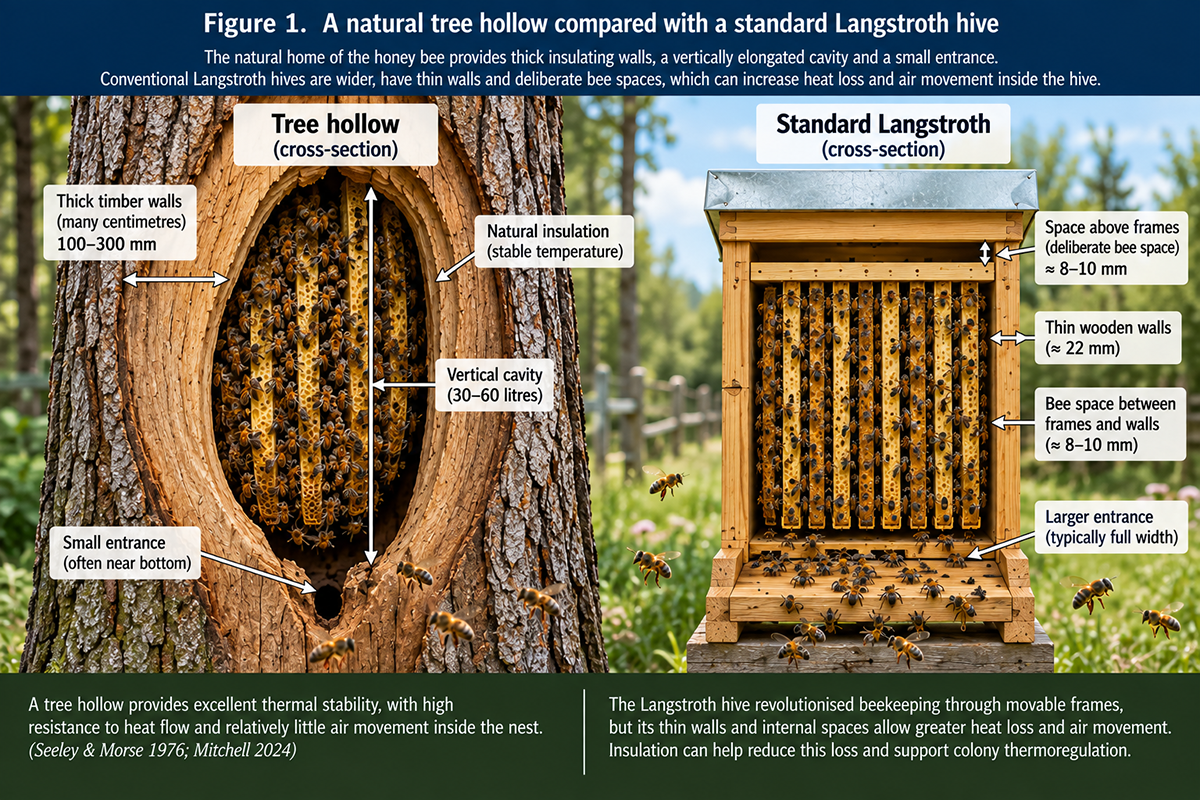
Their preferred home was a hollow tree. That distinction may seem obvious, but it has important consequences. A tree hollow is not simply a convenient cavity in which bees build comb. It forms part of the colony's thermal environment. Thick timber surrounds the nest, buffering it from cold nights, hot days and rapid temperature changes.
Then along came the beekeeper.
The Langstroth hive revolutionised beekeeping because it gave us movable frames, interchangeable components and a practical system for managing colonies and harvesting honey. It was brilliant beekeeping engineering. But it was primarily designed around access and management, not insulation.
As we learn more about how colonies regulate their environment, perhaps it is time to ask whether the thin wooden box we regard as "normal" is making our bees work unnecessarily hard.
What does a natural bee home look like
Thomas Seeley and Roger Morse's classic study of wild honey bee nests examined colonies living naturally in hollow trees. They found cavities were generally vertically elongated, commonly around 30 to 60 litres in volume, with relatively small entrances, often near the bottom.[1]
Those characteristics differ considerably from many managed hives. More importantly, a colony inside a mature tree can be surrounded by many centimetres of timber. That mass provides substantial resistance to heat moving either into or out of the nest.
Researcher Derek Mitchell investigated the difference between natural tree cavities and conventional hives and calculated that heat transfer through commonly used man-made hives could be approximately four to seven times greater than through typical tree cavities.[2] That is an extraordinary difference.
We therefore should not think of a tree hollow simply as nature's version of a wooden hive box. Thermally, the two environments can be very different.
Bees run their own climate-control system
Honey bees are remarkable thermoregulators. When brood is present, workers maintain the brood nest within a remarkably narrow temperature range, generally around 34.5°C to 35.5°C. [3,7]
When conditions become cold, bees generate heat metabolically. They consume carbohydrates, principally honey, and activate their flight muscles to produce heat. The winter cluster also changes its density and configuration to conserve that heat. This has an energy cost.
Research into winter clusters has demonstrated that colony metabolism changes substantially as environmental temperature changes.[4]
Put more simply: Heat costs honey.
Honey is not merely stored food. It is the colony's fuel supply. If heat escapes rapidly through the walls and roof of a hive, bees must replace that lost energy. The poorer the thermal performance of the hive, the greater the burden placed upon the colony to maintain suitable conditions.
That is where insulation becomes interesting to the beekeeper.
Insulation can mean less food consumed
A useful experiment by St. Clair, Beach and Dolezal examined 43 colonies across eight apiaries in Illinois, USA. Colonies were divided between hives receiving insulating covers and untreated controls.[5]
The covered colonies consumed significantly fewer food stores. Control colonies lost mass at almost twice the rate of covered colonies during the experimental period. Even more strikingly, winter survival was 22.5 percentage points higher among the covered colonies.[5]
Obviously, an Illinois winter cannot be directly compared with much of Australia. Our climates, colony cycles and management are different. But the underlying physics does not change. A calorie used to replace heat escaping through a hive wall is a calorie unavailable for something else.
Insulation is not just about cold
This point is particularly important in Australia. Mention hive insulation and many Australian beekeepers immediately picture Canadian hives wrapped against snow. That misses half the story. Insulation works in both directions.
Just as insulation slows heat escaping from a hive on a cold night, it slows external heat entering the hive on a 40°C summer afternoon.
Honey bees actively cool their colonies. Workers collect water, distribute it through the nest and fan their wings to create evaporative cooling.[6]
Again, this is not free. Water foragers are workers diverted from collecting nectar or pollen. Flying costs energy. Fanning costs energy. Evaporative cooling requires water.
Recent research makes this increasingly relevant. A 2026 study followed colonies through desert summer conditions where maximum shaded air temperatures periodically exceeded 40°C.[13]
Average brood-centre and brood-edge temperatures remained remarkably stable and within the preferred 34°C to 36°C range. But averages conceal what the bees were dealing with.
During daily temperature fluctuations, brood in the centre spent about 14 per cent of the monitored time outside the optimal range, while brood near the edge spent approximately 33 per cent outside it. Higher maximum air temperatures and greater temperature fluctuations within the hive were associated with declining colony populations.[13]
Australian beekeepers experiencing increasingly frequent periods above 40°C should take notice.
Brood temperature matters
Temperature regulation is not simply about keeping adult bees comfortable. Julia Jones and Australian colleagues investigated bees reared at different temperatures and found that developmental temperature affected subsequent learning and memory in adult workers.[3]
The brood nest is effectively an incubator containing thousands of developing animals. Every bee that is involved in heating, fanning, water collection and cooling is therefore participating in a colony-level life-support system.
Good insulation does not eliminate those behaviours. It reduces the environmental load against which the bees must work.
How inefficient is the traditional Langstroth?
An Australian study published in the Journal of Economic Entomology provides a notable comparison.[7]
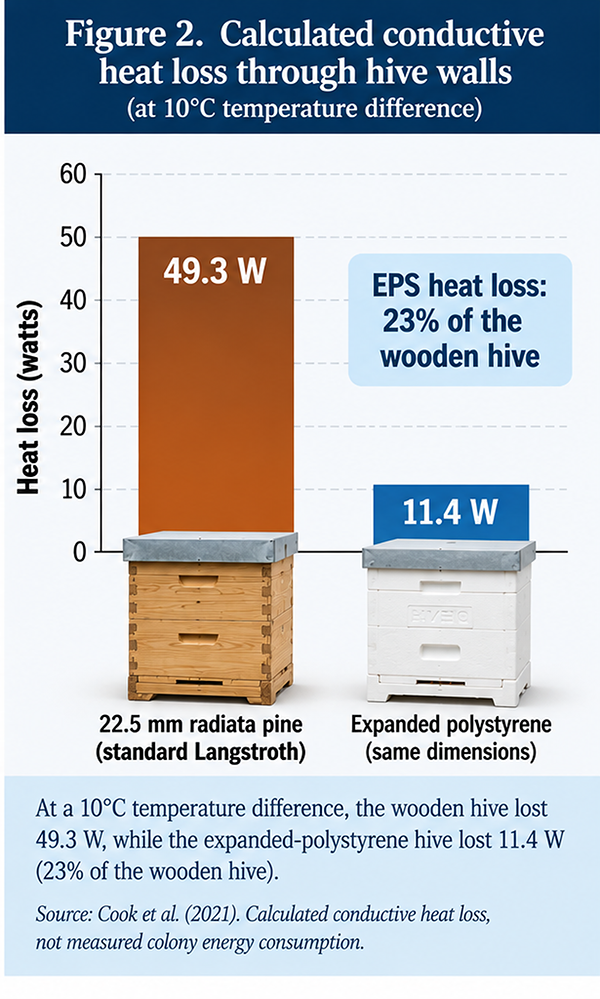
Researchers modelled conductive heat loss from a standard Australian full-depth ten-frame Langstroth brood box constructed from approximately 22.5 mm radiata pine.
With a 10°C difference between internal and external temperature, calculated heat loss from the wooden hive was 49.3 watts.
For an equivalent expanded-polystyrene hive of the same thickness, calculated loss was only 11.4 watts.
The polystyrene hive therefore experienced only about 23 per cent of the conductive heat loss calculated for the wooden hive.[7]
That is not a small improvement.
The same research highlights another consideration rarely discussed among beekeepers. Honey itself provides thermal mass. Frames containing honey can help buffer temperature changes.
When we remove large quantities of honey, rearrange boxes or suddenly add empty supers, we are altering not only the colony's food supply and available space but also the thermal characteristics of its home.[7]
Something to consider next time we completely dismantle a hive on a cold morning.
Is the problem more than thin walls?
Mitchell's more recent research suggests that it is.
In 2024 he used computational fluid dynamics to compare complete honey bee nests in trees with conventional man-made hives.[11]
The differences extend beyond insulation.
Honey bees naturally favour tall, relatively narrow tree cavities. Their combs are attached to the cavity walls, apart from relatively small gaps.
Conventional movable-frame hives are generally wider and thinner-walled, with deliberate bee spaces around and above the frames. That arrangement is excellent for us because we can remove the frames. Thermally, however, there appears to be a price. Mitchell's modelling found that the continuous bee space above the combs could increase heat loss by as much as 70 per cent. Conventional hives also required at least 150 per cent of the density of bees required in tree nests to arrest convection across the brood area.[11]
In other words, the difference between a tree hollow and a Langstroth is not simply wall thickness. The internal geometry is fundamentally different. This does not mean Lorenzo Langstroth got it wrong. Movable frames transformed beekeeping.
It simply means that characteristics making a hive convenient for the beekeeper do not necessarily make it thermally ideal for the bees.
Modern insulated Langstroths
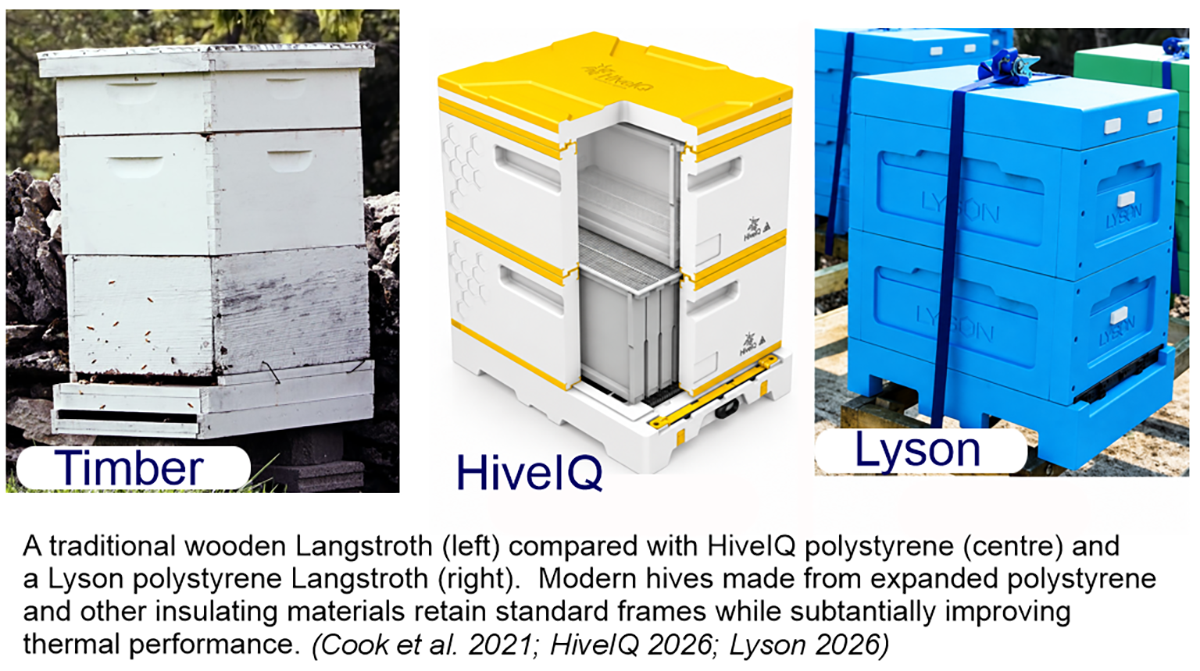
Fortunately, improving insulation does not mean abandoning Langstroth equipment. Modern moulded hives made from expanded polystyrene and other insulating materials retain familiar frames while dramatically increasing thermal resistance.
One Australian example is HiveIQ, which manufactures high-density expanded-polystyrene hive bodies. The manufacturer states that its 40 mm walls provide an insulation value around R7.9 using the US R-value convention, compared with approximately R1.21 for a typical 22 mm dry softwood wall.[8]
Another example comes from Europe. Polish manufacturer Lyson, whose equipment is available in Australia, produces a complete Langstroth hive from expanded polystyrene.[12] Lyson identifies high thermal insulation as one of the principal advantages of the material and promotes improved thermal conditions and spring colony development among its benefits. Its Langstroth system retains familiar modular hive bodies rather than requiring the beekeeper to adopt a fundamentally different management system.[12]
Manufacturer claims should not be confused with independent trials, but the underlying thermal advantage of insulating polymer materials is supported by independent research, including the Australian modelling above.[7]Lyson also raises an important qualification: an impermeable hive material can contribute to moisture accumulation if ventilation is poorly managed.[12]
That is worth emphasising. Insulation, ventilation and humidity need to be considered together. The answer is not simply to make a hive airtight.
The interesting development is that manufacturers are beginning to treat thermal performance as a hive-design criterion, rather than accepting thin timber simply because that is what we have traditionally used.
We can also build better wooden hives
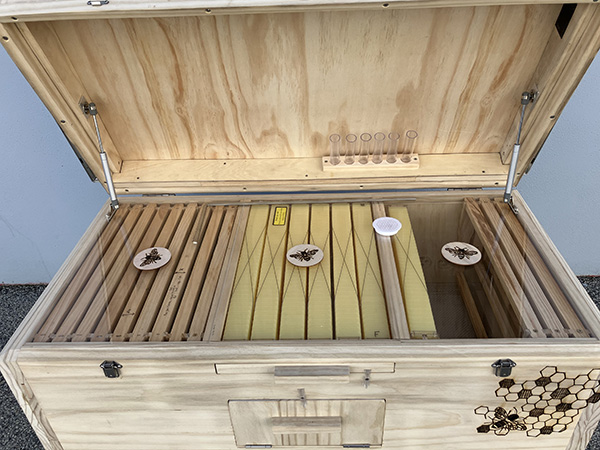
Wood certainly does not need to be abandoned. We can simply use it more intelligently. Thicker timber, double walls containing insulation, insulated roofs and removable external insulation can all improve thermal performance while retaining traditional materials.
Horizontal hives make this particularly practical. A Long Langstroth can use standard Langstroth frames and extraction equipment while the permanent hive body is constructed from substantially thicker material or as a double-wall insulated structure.
Because the hive does not consist of supers constantly being stacked, removed and transported, the outer shell can effectively become a small, insulated building around the colony.
For recreational beekeepers, where compatibility with forklifts, pallets and commercial migratory systems is generally irrelevant, we have considerable freedom to rethink the box.
Taking the idea further: the Bee House
Europe provides another fascinating solution. Instead of requiring every hive to withstand the weather independently, why not put the hives inside a building?
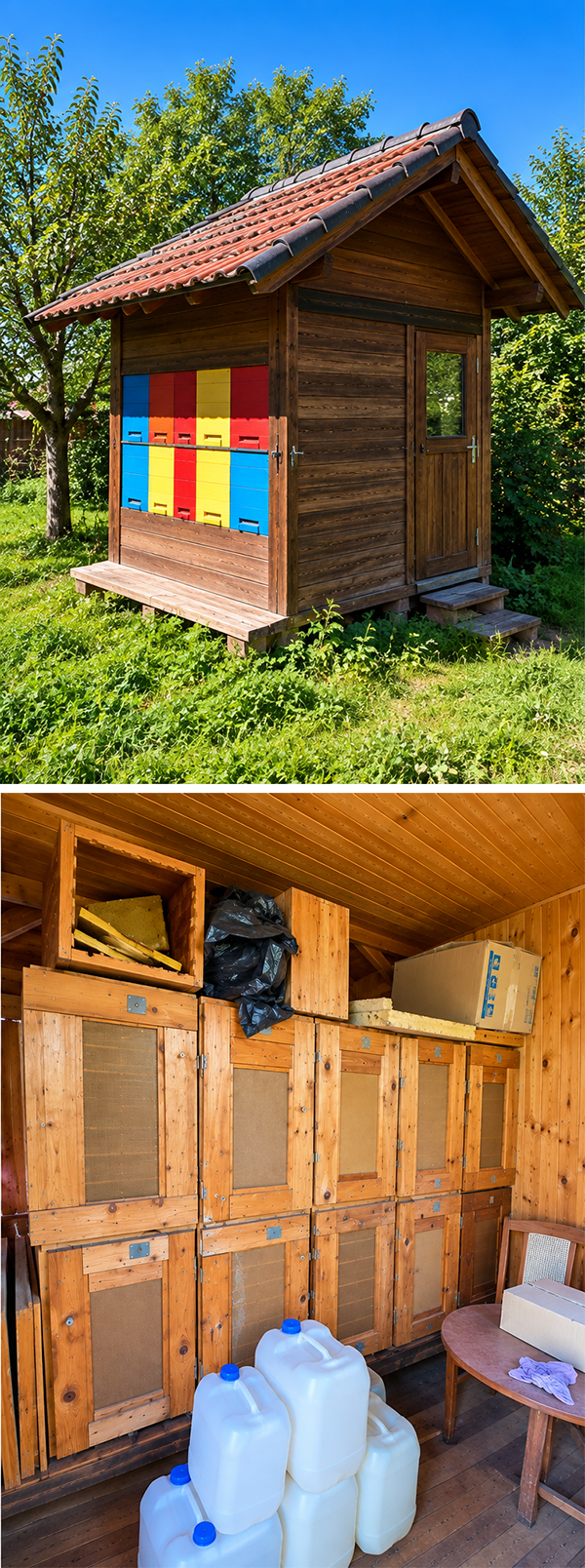
The Slovenian Čebelnjak, or bee house, does exactly that. Traditional Slovenian AŽ hives are installed side-by-side within a bee house. Entrances face through the external wall while the beekeeper works from the protected room behind them. The advantages extend well beyond beekeeper comfort.
The hives are protected from direct rain and wind. Deep eaves can shield entrances and hive fronts from high summer sun while allowing lower winter sun to reach them. The roof and walls of the building provide another thermal barrier between the colony and the outside environment.
For Australian recreational beekeepers, I think this concept deserves considerably more attention. A modern Australian bee house could have insulated walls and ceiling, carefully designed ventilation, generous eaves and orientation appropriate to our climate. The building becomes the first line of environmental protection, with the hive providing the second. And there is something rather attractive about inspecting bees standing upright, in the shade, out of the rain, without lifting boxes.
Perhaps the Slovenians have been trying to tell us something.
We insulate almost everything else
There is a curious contradiction here. We would not build a modern Australian house from 22 mm pine boards with no insulation and expect the occupants simply to burn more fuel when cold and run fans when hot.
We insulate our houses. We insulate cool rooms, water heaters, refrigerated trucks and even our lunch boxes. We do it for a simple reason. Maintaining a temperature difference requires energy, and insulation reduces the rate at which that energy is lost or gained.
Yet one of the most thermally regulated biological systems in nature is routinely housed in a thin wooden box. The bees compensate because they are extraordinarily good at doing so.
But perhaps we are asking the wrong question. It should no longer be:
"Can bees survive in an uninsulated wooden Langstroth?"
Clearly they can.
A more useful question is: "How much of the colony's energy are we unnecessarily asking them to spend because of the box we put them in?"
With Varroa now imposing an additional physiological burden on Australian honey bee colonies, reducing avoidable stresses becomes increasingly worthwhile.
Insulation will not solve Varroa, poor nutrition, queen problems or disease.
But if better hive design means less honey burned maintaining temperature, fewer workers diverted to heating and cooling, less water required during extreme heat and a more stable environment for developing brood, then thermal performance deserves a place alongside bee space, frame dimensions and ease of management when we judge what makes a good hive.
We have spent more than 170 years optimising the Langstroth hive for movable-frame beekeeping. Perhaps it is time we spent some effort optimising the environment inside it for the bees. After all, the hollow tree had several million years of product development behind it.
Our beehives may still have some catching up to do.
References
- Seeley, T.D. & Morse, R.A. (1976). The nest of the honey bee (Apis mellifera L.). Insectes Sociaux, 23, 495–512. DOI: 10.1007/BF02223477.
- Mitchell, D. (2016). Ratios of colony mass to thermal conductance of tree and man-made nest enclosures of Apis mellifera: implications for survival, clustering, humidity regulation and Varroa destructor. International Journal of Biometeorology, 60, 629–638. DOI: 10.1007/s00484-015-1057-z.
- Jones, J.C., Helliwell, P., Beekman, M., Maleszka, R. & Oldroyd, B.P. (2005). The effects of rearing temperature on developmental stability and learning and memory in the honey bee, Apis mellifera. Journal of Comparative Physiology A, 191, 1121–1129. DOI: 10.1007/s00359-005-0035-z.
- Southwick, E.E. (1983). The honey bee cluster as a homeothermic superorganism. Comparative Biochemistry and Physiology Part A, 75(4), 641–645. DOI: 10.1016/0300-9629(83)90434-6.
- St. Clair, A.L., Beach, N.J. & Dolezal, A.G. (2022). Honey bee hive covers reduce food consumption and colony mortality during overwintering. PLOS ONE, 17(4), e0266219. DOI: 10.1371/journal.pone.0266219.
- Kovac, H., Käfer, H. & Stabentheiner, A. (2018). The energetics and thermoregulation of water collecting honeybees. Journal of Comparative Physiology A, 204, 783–790. DOI: 10.1007/s00359-018-1278-9.
- Cook, D., Blackler, A., McGree, J. & Hauxwell, C. (2021). Thermal Impacts of Apicultural Practice and Products on the Honey Bee Colony. Journal of Economic Entomology, 114(2), 538–546. DOI: 10.1093/jee/toab023.
- HiveIQ Australia. Frequently Asked Questions: EPS hive insulation and R-values. Manufacturer information. Accessed September 2026.
- Alburaki, M. & Corona, M. (2022). Polyurethane honey bee hives provide better winter insulation than wooden hives. Journal of Apicultural Research. DOI: 10.1080/00218839.2021.1999578.
- HorizontalHive.com. Insulated Layens Hive and Long Langstroth construction resources. Accessed September 2026.
- Mitchell, D.M. (2024). Are man-made hives valid thermal surrogates for natural honey bee nests (Apis mellifera)? Journal of Thermal Biology, 122, 103882. DOI: 10.1016/j.jtherbio.2024.103882.
- Lyson. American Langstroth Beehive, painted, Ref. W1107. Manufacturer specifications and information on expanded-polystyrene hive construction. Accessed September 2026.
- Chen, J. et al. (2026). Negative Effects of Excessive Heat on Colony Thermoregulation and Population Dynamics in Honeybees. Ecological and Evolutionary Physiology, 99(1), 1–18. DOI: 10.1086/739493.