
NSW DPIRD varroa research
Duong Nguyen, Saleh Adnan, Melinda Simpson, Meena Thakur, Emily Noordyke, Elizabeth Frost, Nadine Chapman
A $9.5 million NSW Varroa Mite Management program commenced in January 2026 and included honey bee compliance officers, a major R&D program and tailored education and resources:
- $1.6m for an enhanced honey bee compliance program, including four new dedicated Honey Bee Compliance Surveillance Officers to ensure beekeepers comply with their obligations under the Australian Honey Bee Industry Biosecurity Code of Practice
- $2.4m for a honey bee biosecurity extension program including the continuation of three Bee Biosecurity Officers – adding to the existing team to help beekeepers in NSW implement effective Varroa management and meet their obligations under the Australian Honey Bee Industry Biosecurity Code of Practice. The bee biosecurity program will continue a surveillance network to monitor the impacts of Varroa mite across NSW.
- $1.1m for a comprehensive program of education and training resources for commercial and recreational beekeepers through DPIRD’s Tocal College. These new initiatives will include a traineeship program to attract new workers to the beekeeping industry, chemical user training that is tailored for beekeepers and a short course on honeybee nutrition and seasonal management to support both honey production and pollination services.
- $4.4m for a program of research and development to address key threats and risks to beekeepers and pollination reliant industries in NSW, developed in consultation with industry.
The research and development program will focus on developing tools to help queen breeders breed varroa resistant bees, monitoring miticide resistance, assessing the diversity and activity of wild and managed pollinators in key crops, and identifying best practice hive placement in orchards to maximise pollination success.
Varroa destructor: Early detection of miticide resistance and management in Australia
Dr Duong Nguyen, Research Scientist – Insecticide Resistance and Genomics,
NSW DPIRD
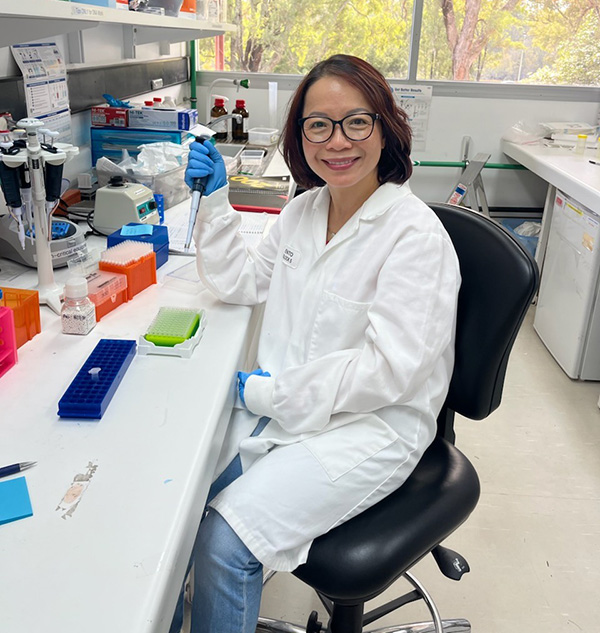
NSW DPIRD has established a miticide resistance monitoring program to support evidence-based management of Varroa destructor (varroa) in Australia. To date, molecular surveillance has detected genetic markers associated with reduced susceptibility to both pyrethroid- and amitraz-based treatments in varroa populations from multiple regions of New South Wales and Queensland, with additional detections recently reported from other states. Importantly, susceptible populations have also been identified, indicating an opportunity to protect the effectiveness of existing treatments through proactive management.
The project combines expertise from the NSW DPIRD Insecticide Resistance Laboratory, Bee Biosecurity Officers and epidemiologists to undertake surveillance, molecular diagnostics and interpretation of resistance data. Current testing focuses on known resistance markers associated with pyrethroids and amitraz.
The next phase of the project will expand resistance testing to investigate all currently reported genetic markers associated with major miticide groups used internationally, including Group 1 organophosphates, Group 3 pyrethroids and amitraz-associated resistance mechanisms. Bioassays using resistant and susceptible varroa populations will be undertaken to validate whether detected markers affect treatment performance under Australian conditions and to guide future treatment recommendations. Additional work will evaluate alternative control options, including coumaphos and other synthetic chemistries, to determine their potential role in Australia’s varroa management toolbox.
Continued investment in resistance surveillance and validation studies will help preserve the effectiveness of existing treatments and support sustainable varroa management for Australian beekeepers.
Developing resilient pollination in subtropical horticultural cropping systems
Saleh Adnan, Research Horticulturist Entomology, NSW DPIRD
The spread of varroa presents a major risk to pollination-dependent horticultural industries in eastern Australia, including blueberries, Rubus, avocados and macadamias. This 12-month project commencing July 2026 will strengthen pollination resilience by improving understanding of wild pollinator communities in north-eastern NSW subtropical horticultural cropping systems, validating habitat enhancement strategies to support pollinators, assessing the impacts of pest management practices on beneficial species, and providing practical tools to assist growers in adapting to changing pollination dynamics. Through an improved knowledge of wild pollinator communities in subtropical horticulture systems, evidence of the contribution of wild pollinators to crop pollination in these systems, and improved understanding of the risks posed by pest management practices to beneficial pollinators the project will contribute to increased resilience of pollination services in a post-varroa environment.
Berry pollination for a resilient future
Melinda Simpson, Berry Development Officer, NSW DPIRD
This 12-month project commencing July 2026 aims to improve pollination in horticulture with a particular focus on the berry industry in northern NSW. Berries have the highest value of production of all fruit in NSW, indicating their importance to the NSW economy. This project has three components. The first is to catalogue existing pollination research related to the horticulture/berry industry to identify existing knowledge that can already be extended and knowledge gaps in pollination, farm practices and pollinator activity that still need to be addressed. The second aims to demonstrate and validate alternative pollination approaches in real-world commercial berry production by translating national and global research into practical recommendations. By engaging growers and advisors directly through on-farm demonstrations, field days, and shared data, the program will build confidence in diverse pollination systems. The third component aims to improve grower understanding of hive health and management by educating growers on how to identify healthy hives and evaluate pollination service providers, ensuring greater accountability and resilience in pollination practices. Activities will include trialling the use of BeeSTAR and workshops with growers and beekeepers to support stronger pollination outcomes.
Enhancing pollination resilience in southern horticultural cropping systems: a post-varroa strategy for NSW
Meena Thakur, Research Horticulturist, Entomology, NSW DPIRD
The spread of varroa presents a major risk to pollination-dependent horticultural industries in NSW, increasing uncertainty around the availability, cost and reliability of managed pollination services. This project, commencing in July 2026, aims to strengthen pollination resilience in apple and melon production systems by improving understanding of pollinator communities, evaluating pollination services under post-varroa conditions, and identifying farm management practices that may influence pollinator activity and pollination services.
In apple orchards in Bilpin and Orange, the project will build on unique pre- and post-varroa datasets to assess changes in pollinator visitation and managed honey bee foraging behaviour through pollinator surveys, floral assessments and honey bee mark–recapture studies. In commercial Riverina melon production systems, the project will assess pollinator communities and flower visitation, evaluate pollination outcomes through flowering, fruit set and crop performance assessments, document commercial pollination management practices, and conduct grower and commercial beekeeper surveys to improve understanding of factors that may influence pollination services under commercial production.
By generating crop- and region-specific information on pollinator communities, pollination services and pollination management, the project will provide evidence to support informed pollination and crop management decisions, strengthen pollination resilience, and support the long-term sustainability and productivity of pollination-dependent horticultural industries in a post-varroa environment.
Miticide efficacy under commercial conditions
Emily Noordyke, Varroa Project Officer, NSW DPIRD
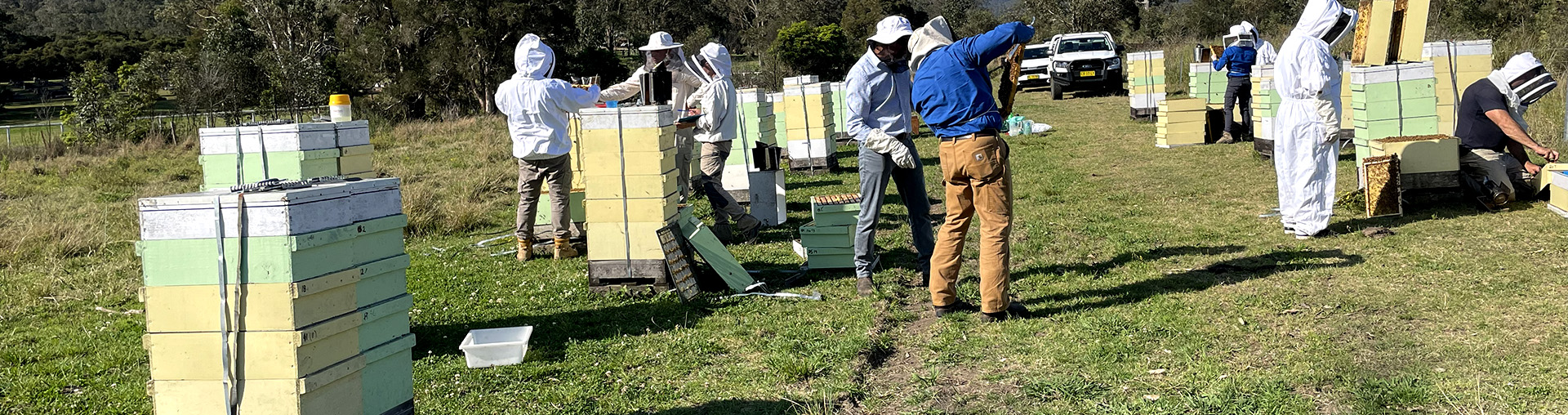
This project is a joint effort of NSW commercial beekeepers and DPIRD researchers to collect data on miticide efficacy in different environments from June 2026 to June 2027. The aim is to look for patterns in the efficacy of both synthetic and non-synthetic treatments to inform best practice varroa management in Australian conditions. Collaborators will share their experience through an online data entry form. Some participants optionally will receive sensors to collect in-hive temperature/humidity and external weather data during treatment. Beekeepers will receive a progress report mid-way through the study and a final report describing project findings at the end. All personal information will be kept anonymous for reporting purposes. All data collected will be for research only—never compliance.
Data to be collected:
- Anonymised participant code
- GPS location of apiary (exact location will never be shared publicly)
- Pre- and post-treatment mite loads of 8 hives/apiary
- Treatment type and duration
- Average frames of brood and equipment type
- Colony health impacts of treatments
Honey bee genetic evaluation program – varroa resistance traits
Elizabeth Frost, Technical Specialist Honey Bees, NSW DPIRD
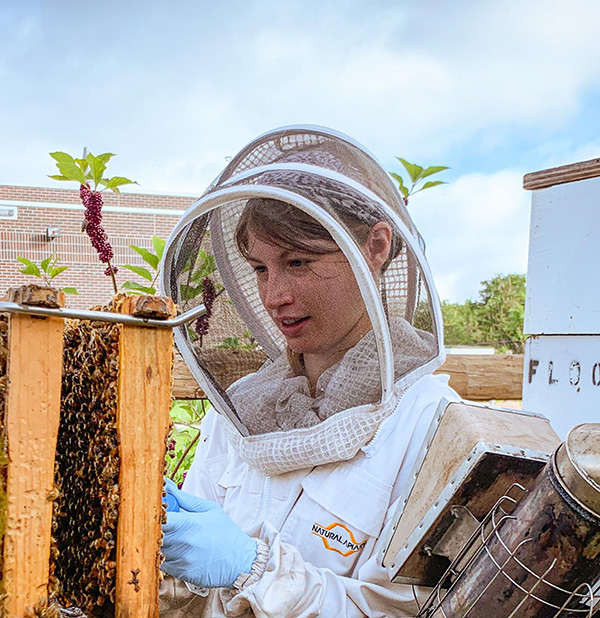
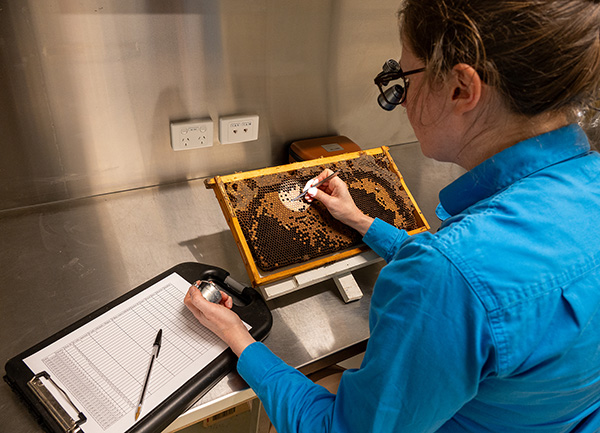
A honey bee genetic evaluation program, working directly with NSW queen breeders, is proposed using modern trait recording and genomic analytical methods for Australia’s top commercial trait honey and varroa traits to breed varroa resistant honey bees. Varroa resistance traits which will be recorded are mite population growth and mite non-reproduction traits. NSW DPIRD and the Animal Genetics & Breeding Unit at University of New England pioneered the development of heritability estimates and estimated breeding values for Australian honey bees in the National Honey Bee Genetic Improvement Project.
DPIRD and AGBU are ideally placed to implement varroa trait recording and selection with NSW queen breeders.
This project seeks to build on the work undertaken in the Plan Bee project by phenotyping honey production and two novel varroa resistance traits and genotyping the recorded colonies in collaboration with key NSW-based queen breeders. Collaborating queen breeders must be open to results such as any heritabilities estimated for varroa traits being published in publicly available extension and research materials. Standardised pedigree and phenotypic data collected from collaborating NSW queen breeders will be housed in the UNE AGBU honey bee database. If sufficient quality and quantity of trait record and genotype data is generated, collaborating queen breeders will receive a phenotypic report and estimated breeding values to inform selection decisions in their breeding program. The program will run from June 2026 to June 2027 and an extension is being sought.
Summary
European Honey Bees are vital to crop pollination across New South Wales, underpinning the productivity of many agricultural industries, including apple, berry and almond industries. Varroa mite poses a significant threat, with international experience suggesting that pollination-dependent industries are likely to become increasingly reliant on paid pollination services. These six research projects aim to support the honey bee and pollination dependent industries in the immediate and long-term through greater understanding of the suitability of different treatments in Australia, improvements to bee breeding, and improvements in on-farm best practice to support bees.