

A bit about the resistant varroa mite

By Rod Bourke
Bee Biosecurity Officer NSW DPIRD
Who’s fault is varroa reinfestation and miticide resistance?
Early this year a small number of commercial beekeepers started advising DPIRD that they were having some increasing problems in managing their varroa mite numbers. NSW DPIRD and QLD DAFF worked together with beekeepers to trace nuc purchases and hive movements to identify other beekeepers that might be experiencing the same issue, they just didn’t know it yet. Before the issue was identified, impacted hives had already moved around NSW and in/out of QLD and SA, spreading what we now know as resistant mites everywhere they went.
Generally, the purchased colonies started out with low mite numbers, expanded and performed well and produced honey, and as mite numbers rose they were treated as per normal with various synthetic and non-synthetic miticides. For one beekeeper the first real warning signs that anything was amiss was when mite numbers remained persistently high around 4-weeks into a Bayvarol treatment in Jan-Feb 2026. The beekeeper initially surmised this could have been heavy reinfestation from other hives nearby but soon suspected it was something worse such as the treatment not working properly. For another operator they were starting to experience significant hive mortality near the end of Bayvarol treatments. Was it reinfestation, was it an issue with multiple batches of miticide not being formulated or stored correctly, or heaven forbid was it miticide resistance???
Bayvarol has been a spectacular miticide, and to date all of my experiences with it have remained positive, and at the beginning of 2026 that was also the opinion amongst most other NSW beekeepers that have used it. Even those beekeepers whom against all advice just continued using Bayvarol treatments one after the other and not switching the Mode of Action (MOA) were still loving the stuff. It really worked wonders!
The “soft landing” phase was going nicely, the dreaded mite had only been here for a short while, and even when beekeepers were misusing Bayvarol (using an insufficient number of strips, extended treatment time well past 6-8 weeks application time as stated on the label) it still seemed to be doing a great job of keeping mites under control. Many were absolutely confident in their ability to control varroa, it seemed to die pretty easily no matter what you used, and as long as you actually kept on top of treatments it was not actually much of an issue. With beekeepers actually needing to go under the queen excluder to add strips or wash for mites, extra effort down there was enabling beekeepers to become more in tune with their bees and see problems earlier. As an added bonus, once the feral bees were wiped out, all the managed bees seemed to get far more honey (even in poorer times).
But when we looked just north of the border into SE QLD in the second half of 2025, the beekeepers there were having a harder time controlling their mites, with many horror stories claiming that they were losing all of their hives. One commercial beekeeper from that area was sceptical when a NSW guy told him that Bayvarol worked really well, as it “has not been any good for ages” in his QLD bees. Lots of questions about how vastly different the varroa experience in QLD has been to that in NSW…hmmmmmm!
But as well as the regular varroa mite, we now know that Queensland also hosted the newer resistant mite. What we have learned as the resistant mite has had more research and testing done on it (and it’s viruses) is that this is actually confirmed as being from a second separate introduction to Australia, with the mite exhibiting some different genetic traits to the nice varroa from NSW that we first enjoyed treating. This second incursion likely came from “North America”, with the most probable arrival options being either through a hitchhiker colony of overseas bees through an international port, or the intentional smuggling of a high value breeder queen (eg. one showing good traits against varroa mite). Sadder still would be if it was just somebody smuggling back an average commercially available production queen in their pocket.
Whatever the case, this second incursion has ruined all of the good work that was being done by beekeepers to learn about managing their varroa at a steady pace. This new version is a highly advanced mite that has already seen a lot more stuff thrown at it than our first one would have seen over the next 15-20 years had our varroa journey progressed without another incursion. The new mite shows full resistance to Bayvarol (that we probably would not have naturally seen here until after misuse of that product over another 5, 10 or even 15 years) and also Apistan (the other synthetic pyrethroid miticide exhibiting the same MOA but using a different pyrethroid chemical). The new mite also expresses a gene which generally indicates a high tolerance or full resistance to amitraz (as found in Apivar and Apitraz). Many NSW beekeepers have already advised me that they believe it has not been effective against the resistant mite.
As resistance develops it initially requires higher doses of a chemical to kill an adequate percentage of the target population. Any susceptible targets (such as the first varroa we found in NSW) will die, but then the remaining population of resistant mites will survive and breed up, and your hive will contain mainly mites exhibiting resistance (unless other mites enter on field bees). Selective breeding (by removing any susceptible/weak organisms) breeds up tougher individuals, which may then become more tolerant as that same chemical continues to be used against them. If you simply increase the concentration of chemical applied to achieve a higher kill rate on resistant mites then you immediately increase chemical residue issues and will at some point also start to affect “off target” organisms such as the honeybees, and still not kill all the mites. Therefore, when resistance develops you cannot just increase the dose, but instead you must altogether stop using that chemical and choose something that uses a different MOA.
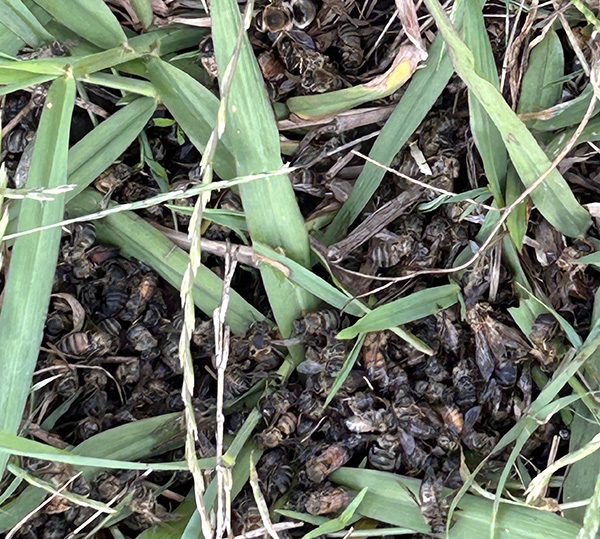
Washing a small number of bees regularly to monitor for mites is far better than seeing your whole colony abscond or look like this.
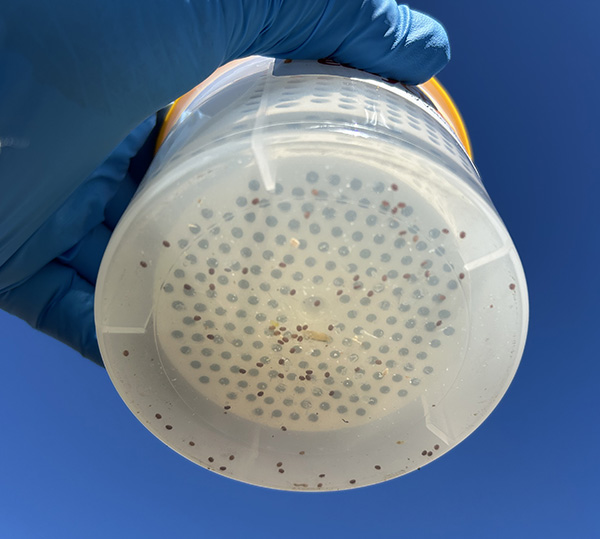
A wash result like this was previously nothing too urgent to worry about, but now that synthetics may not work so well is has become a critical situation. If you have resistant mites this wash count requires an immediate organic treatment application.
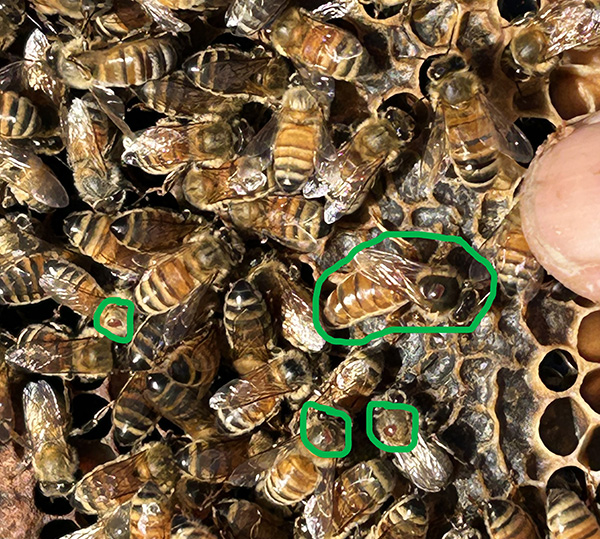
When you can visually see mites like this then the colony is on its last legs. Washing would have detected mite numbers requiring treatment months before this, enabling the colony to be saved.
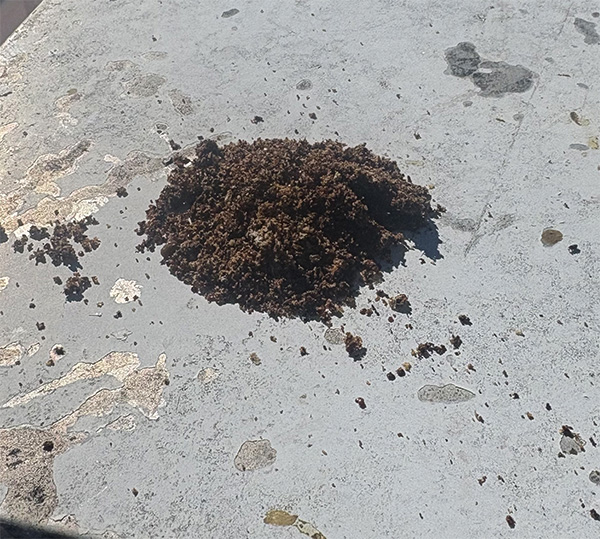
Large mite drop collected from the bottom board of 1 hive. Allowing mite numbers to build up this high will put the hive under an extreme amount of pressure and their health may continue to suffer long after the mites have been treated.
In 2013 Randy Oliver suggested that Colony Collapse Disorder in the US may have been caused by extreme overuse of a livestock drench containing Amitraz, which as a chemical also has the ability to increase the toxicity of other agricultural chemicals often encountered by bees in agricultural pollination and in urban areas. The resistant mite we are now seeing spread through NSW has likely been exposed to situations like this during its 20-30+ year evolution, so here in Australia we cannot even consider going down the same road of trial and error using all sorts of chemical cocktail remedies to control this newer, tougher mite.
The miticide treatments showing success against the resistant mite are the organics containing oxalic acid (sold as Api-Bioxal and AluenCap), formic acid (Formic Pro) and thymol (Apiguard). These chemicals do not always deliver the same fast knock-down punch that we saw using the synthetics, but when used regularly and before mite numbers get too high they will generally be reasonably effective at controlling mites.
Many beekeepers make the mistake of not alcohol washing their bees regularly, because “the bees look good”, and what eventually happens is that “when they start to not look good” and they do wash they discover they already had really high mite numbers in their bees. This situation is called “not managing your mites properly”, and it has led to massive hive losses amongst many beekeepers already since varroa arrived here. Many don’t like the idea of washing bees to monitor for mites because it kills ½ cup (~300 bees) every time you do it. But, if you don’t test and kill 0.5-1.5% of a healthy hive population you definitely risk losing 100% of that hive later on. To be a good beekeeper now you need to prioritise managing your varroa mites, because a healthy hive with low mite numbers now will do much better than that same healthy hive did before varroa arrived, as there is far less competition from feral and other managed bee hives now.
Integrated Pest Management (IPM) has always had a place in managing varroa, but with resistant mites arrival that role becomes bigger. Until such time that we can achieve better genetic traits in the bees to undertake their own varroa reduction activities it will still mainly rely on the use of chemicals, and some mechanical activities.
Research has shown that mesh bottom boards can remove a lot of mites from a colony, so it may assist slightly to reduce the overall mite population. They can also be very good for monitoring mite drop (both natural and also to gauge effectiveness of various treatments) if you use a sticky mat or oil in the tray underneath.
Drone brood removal can be extremely effective at harvesting mites from a colony of bees, so I urge every beekeeper to experiment with that to see how they may get it to work for them. The critical requirement for using this method is to ensure that you are removing the capped drone brood BEFORE it hatches, otherwise you will be increasing instead of reducing the numbers of varroa in the colony. Many beekeepers tell themselves that they are “too busy” to undertake drone brood removal, but the reality is that managing varroa requires far more work on your bees than before varroa, so you do need to attempt a rethink about what actually works (not how long it takes in the short term) and what doesn’t work over time.
If combining a few rounds of drone brood removal in spring with also using organic chemical options results in a major reduction in mites, then you are actually ahead on managing your mites. That sort of an outcome makes it worth undertaking, and if you find that removing a drone comb every 17-20 days from your colony also reduces drone numbers and the likelihood that your colony will swarm (generally hives build up large drone populations before they swarm) then this process may kill two birds with one stone. Drone brood removal by itself will not stop swarming, but if it can assist in slowing it and mite reproduction down then you are winning.
Since first discovering resistant mites there has been spread of them through bee colony movements (and queen bee sales) in many areas of NSW. It is probably safe and realistic to assume there are now low numbers of resistant mites nearly everywhere, and more so in areas that regularly see migratory beekeepers moving through or large metropolitan areas with many beekeepers purchasing outside sourced queens/bees. Once it is in any area then it will disperse further via natural spread, so it is time to start managing your hives like you already have resistant mites.
For beekeepers that are already primarily relying on organic miticides to manage their mites then they will be less shocked at how they change their management of resistant mites compared to those that have also been using synthetic strips. In the past, when organic treatments were not doing so well then many would resort to a synthetic and it was problem solved. As the resistant mite spreads it will be more a problem only partially solved if you have grown high mite numbers.
If you do use a synthetic treatment this season, then you should look to do a follow-up alcohol wash some weeks later to see how the mite numbers look. When you add a treatment it will start working on all phoretic mites (ones on bees) but not on reproductive mites. Therefore, over the next 2-weeks or so all worker brood that hatches out will be releasing mites that were protected when you added the synthetic treatment. Drones will take some extra days to hatch. Pyrethroids kill mites faster than amitraz (which paralyses them and acts far more slowly), so when using Bayvarol or Apistan it is recommended to do a follow-up monitoring at 3 weeks in a colony with drones, or closer to 4 weeks if using Apivar or Apitraz. If at that time you still have significant mite numbers versus the original wash (always keep records) then it is highly likely that the population is resistant, or you have extremely high reinfestation. A lower (but not zero) mite count may indicate that the surviving mites are your first resistant mites or some lower-level reinfestation.
The first of these scenarios is extremely dangerous, because if the treatment you added to deal with an already high mite number has not worked then your hive is on (or past) the point of collapse and you will need to consider some extreme treatment measures (FormicPro, or combinations of OA dribbling, fogging and AluenCap) to try to slow down the mite damage before the colony goes. These treatments can be extremely hard on bees already fed upon by mites, so if you let your mite numbers build up to high levels before initiating treatments then you are always gambling with your hive’s future.
With the second scenario where mite numbers have reduced, but not fully, then it is probably best to continue the treatment to the 6-week mark (as per the label) and then when you remove it do another wash and add an organic treatment if required.
If you find mites at the end of a synthetic treatment then it is likely they are mostly resistant, so you probably want to start treating them sooner rather than later to try to suppress their ongoing numbers.
Through all of these treatment scenarios having a mesh bottom is great, as it allows the beekeeper to visualize physical mite-drop into the tray over the course of that treatment. If you are getting high drop in the days following miticide addition that always adds some confidence that the treatment is working. You should still do a follow-up wash to see what residual mite numbers are present though, as that could be the resistant mites that you have just selected by wiping out all the susceptible ones.
So, one of the biggest changes when managing resistant mites is doing far more washing and always trying to keep your mite numbers low, whilst using organic miticides that don’t always work as well and often have more hive health side effects than the synthetics used to.