
The updated Code of Practice.
By Rod Bourke
Bee Biosecurity Officer NSW DPIRD
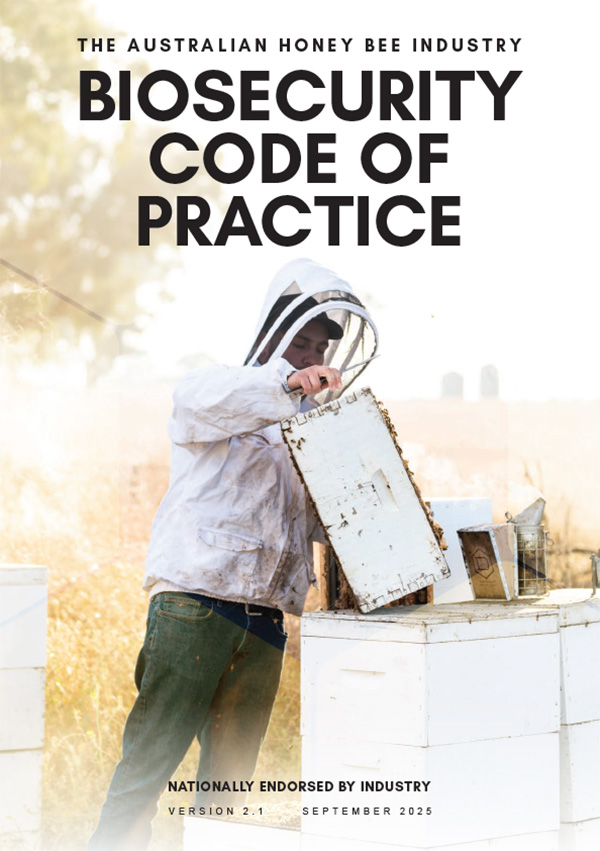
The Australian Honey Bee Industry Biosecurity Code of Practice (the Code) was developed and nationally endorsed by all Australian beekeeping member bodies of the Australian Honey Bee Industry Council (AHBIC), which includes the ABA, around 10 years ago. Since then, it has been widely adopted by many states including NSW as a condition of registration. This means, that as a beekeeper (someone that has even just one bee colony) you are legally required to be registered and to follow the management guidelines as set out in the Code.
The Code provides a clear management framework for Australian beekeepers to apply best practice biosecurity measures on every hive. A broad range of people with varying personalities and skill levels like to keep bees, so the Code is a guideline to ensure that everyone manages their bees to a certain standard. This aims to reduce the biosecurity threat to the beekeepers own bee colonies as well as to all others around them. Biosecurity is a shared responsibility, so every beekeeper has an obligation to do the right thing and reduce the opportunity for risks to emerge from within their own operation.
Many beekeepers tend to get swept up in the charm of beekeeping (and selling a bit of honey) and may over time get a bit carried away with the number of hives they actually have buzzing around the place. When this is tied in with life’s many other commitments including family, work and recreation the bees often end up getting far less attention then they require or deserve. This can also mean that the care provided is less than that outlined in the Code as the bare minimum they should be receiving.
If you are not following the Code’s level of hive management then it is likely that you will be getting far more swarming, failing queens, non-productive, diseased, slimed or wax mothed hives than you should be, resulting in a lot less honey per hive. You would also be passing these problems on to others by breeding up pests like small hive beetle or enabling robbing of your poorly managed colonies that then spreads American foulbrood (AFB).
If you are not cleaning up, sorting and storing your equipment properly, then your equipment and weak or dead colonies end up becoming exposed and the resultant robbing causes someone else’s colony to get AFB, and it just keeps going around and around. The Codes objective is to reduce all that.
With the advent of varroa into Australia the amount of work required to keep a hive alive has also increased dramatically, so as part of the Transition to Management Program (T2M) the Code was given an upgrade (along with the Biosecurity Manual) to align with the new challenges beekeepers are facing (or soon may be) in much of Australia.
Both these items as well as an updated editable Appendix 1 form can be downloaded from this site or from Biosecurity - Australian Honey Bee Industry Council
Main changes from the original Code
So, what are the main changes from the original Code, and why do they matter? I asked Bianca Giggins, Industry Development Manager at AHBIC to give me a quick rundown of these changes which she lists as follows.
“The simplest way I like to sumarise is to view the new fillable PDF Appendix 1.
The addition of 3 inspections for 3.1 & 3.2 are the biggest changes, along with reducing the required number of hives needed to follow the Appendix 1 down from 50 to 20 hives managed.
PART B (All Beekeepers)
Section 3
3.1 - inspect each hive in the apiary 3 times every year (up from 2 previously), at a minimum of 3 consecutive calendar months apart (was previously 4 months apart).
3.2 – In areas where varroa is not established, arthropod pest (including Varroa and Tropilaelaps mites) inspection of 1 hive per apiary, 3 times per year, spring, summer & autumn, including alcohol wash, soapy water wash, sugar-shake or drone uncapping, recording the method/s used.
3.3 - In areas where Varroa mite is present, more frequent inspections and tests should be completed to determine whether mite loads have reached treatment thresholds. -THIS POINT IS NEWLY ADDED.
Section 5
5.1 b) What Varroa mite test method was used including date of test and test results as per Part B 3.2.
- c) Details of all treatments and actions taken to manage any pests or diseases in the apiary.
PART C (Beekeepers with 20 or more hives now have to follow all conditions set out in Part C)
9.2 a) Biosecurity for Beekeepers BOLT training has been renewed: Biosecurity Online Training (BOLT) | Plant Health Australia”
So why does any of this matter to a recreational beekeeper or ABA member?
As many of you may have heard or seen for yourselves the introduction of varroa has very much changed beekeeping for all of us, with many losing their hives and many others losing hope to carry on with keeping bees.
Varroa makes it very difficult for some beekeepers who perhaps don’t have enough time, skills or luck to manage mite levels well enough and keep their bees alive, but at the same time many others have concentrated on managing varroa and mostly forgotten about all the other pests and diseases that were already here before varroa.
Many of these older issues are still a major threat to bee health and the Code has increased the requirement of brood inspections so that beekeepers are more compelled to manage their brood box adequately, because we all know that under the old Code that 2 brood inspections per year was not nearly enough to always run good bees.
Bee Biosecurity training is always an important aspect towards managing better healthier bee colonies, and it is concerning that even after varroa has been present for 4+ years that there are so many beekeepers who still haven’t undertaken any training at all. The Bee BOLT training is free to all beekeepers as the BBO programs fund its yearly operating costs, so please undertake it, even if you only have 1 hive or are new to beekeeping.
By reducing the hive numbers from 50 to 20 hives for completing the Appendix 1 requirement, the Code has been able to encompass literally thousands of additional beekeepers who have been running more hives than they probably should have without getting additional training skills, as well as compelling them to be looking for AFB more thoroughly.
Bee Biosecurity Officers are here to assist beekeepers to understand and follow the Code, so if you need assistance with any area of the Code please contact me at rod.bourke@dpird.nsw.gov.au or 0438 677 195