
Two Workshops for Beekeepers presented by NSW Apiarists Association and Cumberland Beekeepers
Mobile users can tap on the QR code to link to the booking system
HYGIENIC BEHAVIOUR
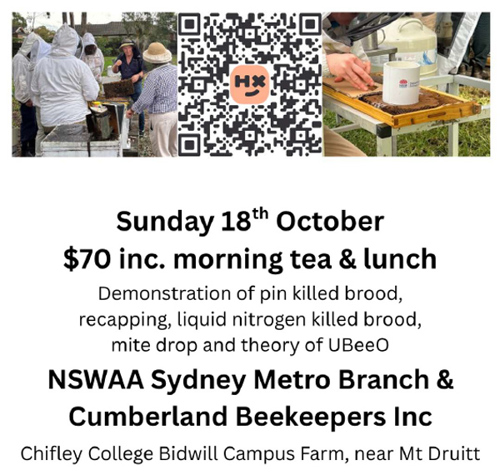
Join us to learn how to test your hives for hygienic behaviour.
Hygienic behaviour is one way in which honey bees reduce the impacts of disease in the hive. It is a type of social immunity behaviour which means that the bees work collectively to reduce the effects of pathogens and parasites in the colony. Hygienic behaviour involves three stages with each stage usually performed by different bees:
- detection of diseased brood;
- uncapping of brood cells; and
- either removal of brood or recapping of brood cells.
Bees use hygienic behaviour to control diseases such as AFB, chalkbrood, wax moth and also varroa mites. Recapping of brood cells is a common characteristic of bees showing varroa sensitive hygiene leading to varroa resistance. Bees displaying high hygienic behaviour have lower levels of disease and are better producers of honey.
In this one-day course, you’ll learn how to:
- perform the pin kill and the liquid nitrogen freeze kill methods;
- measure recapping rates in your hive (a strong indicator of Varroa Sensitive Hygiene);
- measure and interpret mite drop counts on sticky boards;
- carry out the Bawden Assay which is a rapid test for detecting mite load in the brood and is a more accurate test than the alcohol wash.
You will also learn about the UBeeO (Unhealthy brood odour) method and the freeze kill method using just your deep freeze at home. We will also discuss what to look for when evaluating a brood pattern with hygienic behaviour (spoiler alert – it’s not wall to wall brood).
Cost $60 for members of Sydney Branch NSWAA and Cumberland Beekeepers Inc. and $70 for non-members. Price includes morning tea and a light lunch. Book via the QR code or send an expression of interest to sydneybranch@nswaa.com.au to book directly.
POLLEN UNDER THE MICROSCOPE
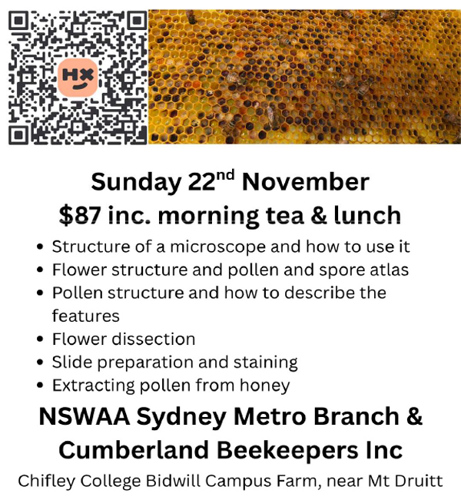
Curious about which flowers your bees are visiting, or which ones they prefer during your spring honey flow? These questions can be answered by joining us to learn how to extract pollen from fresh flowers and honey and how to prepare pollen slides for identification.
At the end of the course you will know:
- the components of a microscope and how to use it;
- the structure of a flower;
- pollen structure and how to describe it;
- how to prepare fresh pollen and pollen from honey for mounting on a slide and how to stain it;
- how to search Australia’s pollen and spore atlas to aid with identification of your pollen.
Bring your own honey (150g) sample to extract the pollen from it as well as a fresh flower with pollen on it. If you have a macro lens for your phone or a magnifying app bring that too so you can take photographs.
Cost $77 for members of Sydney Branch NSWAA and Cumberland Beekeepers Inc. and $87 for non-members. Price includes morning tea and a light lunch. Book via the QR code or send an expression of interest to sydneybranch@nswaa.com.au to book directly.