Honey bee pollination and varroa mite
Elizabeth Frost, Technical Specialist Honey Bees – Intensive Livestock Industries NSW DPIRD

NOTE: The following article has been written for growers. It will be published in NSW DPIRD’s Orchard Plant Protection Guide for Deciduous Fruits in NSW 2026-27. Beekeepers may find it useful to share and discuss with gardeners and farmers who need crop pollination.
Varroa mite (Varroa destructor) is a honey bee parasite that completes its entire life cycle inside bee hives and needs to feed on both juvenile and adult honey bees. Honey bees are varroa’s only host species, meaning it won’t negatively affect Australia’s 2,000+ native bee species. Varroa can hitch a ride on adult honey bees and in this way is able to be easily transported from one bee hive to another, including to feral hives.
New South Wales had some of the highest densities of feral honey bee colonies in the world until varroa became established across the state. With an abundance of nutritious native plant species to provide nectar and pollen throughout the year and a diversity of hollow-forming trees, unmanaged honey bee colonies were present across many landscapes. This included farmland with nearby suitable habitat. These feral hive populations appear to decline rapidly once varroa mite is established (Figure 1). The pollination each feral colony would’ve undertaken, mostly within the immediate 2 km radius to the hive, also disappears when the colony dies out due to varroa.
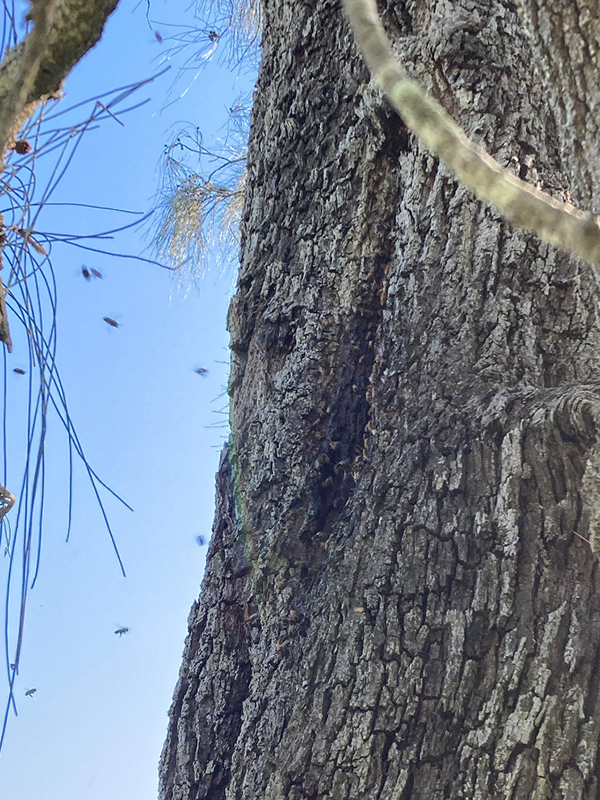
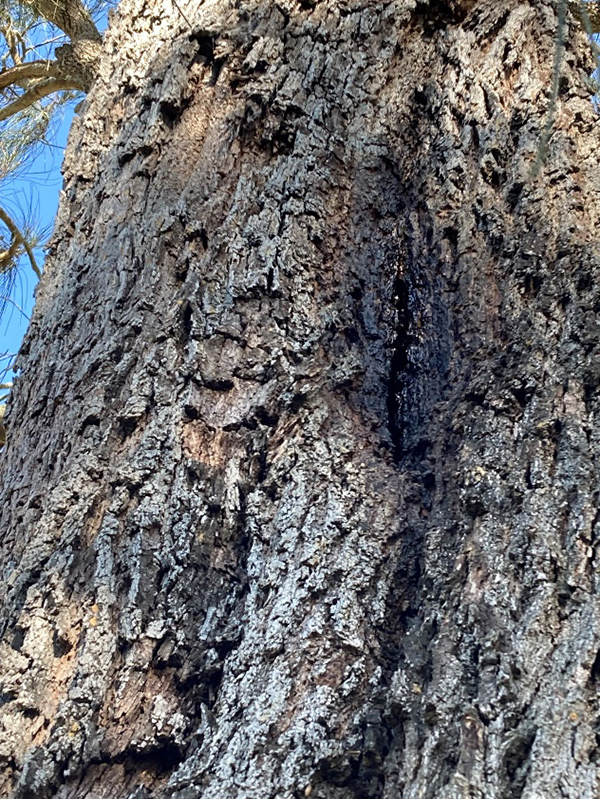
Figure 1. (L) Honey bees actively flying from their hive entrance in a sheoak trunk in March 2023 in the NSW Hunter Valley. (R) The same hive dead from varroa mites six months later in October 2023. Credit: Rod Bourke, NSW DPIRD.
Once varroa established in western Sydney, surveys indicated local feral hive numbers had been decimated. Research Apiculturist Michael Duncan has monitored five drone congregation areas around Western Sydney University’s (WSU) Richmond NSW campus over the past decade. A drone congregation area is where both male drone and female queen bees fly to mate when they’re sexually mature. Surveys may capture drones representing hives from within a 44 km2 area. Drone numbers caught at Richmond NSW drone congregation areas between 2015 to 2025 have changed dramatically since varroa established in the area. WSU’s results from March 2025 and the previous decade are:
Table 1. Western Sydney University honey bee drone surveys indicate feral hive decline post-varroa establishment.
|
Date |
# Drone honey bees |
|
Feb/March 2015-2024 |
500+ drones caught at each of 5 drone congregation areas on average.
|
|
March 2025 |
6 drones caught at 1 drone congregation area. 0 drones caught at 2 drone congregation areas.
|
Duncan links the low drone numbers surveyed in 2025 to the decimation of feral hives in the immediate area due to varroa. Once a bee hive has varroa, realistically, it can never be completely eliminated from the hive even through chemical treatment. Instead, beekeepers must monitor their mite thresholds and implement varroa integrated pest management (Lees et al., 2025).
What can growers do?
Varroa management is up to the beekeeper, but orchard management can attract the right beekeeper. Growers need pollination, particularly deciduous fruit orchardists whose trees are between 70-100% dependent on honey bee pollination (Table 2).
Table 2. Deciduous tree crops are between 70-100% reliant on honey bee pollination depending on the crop (Gillespie et al., 2024).
|
Crop |
Reliance for yield (%) |
|
apples |
100 |
|
apricots |
70 |
|
cherries |
90 |
|
peaches & nectarines |
60 |
|
pears |
75 |
|
persimmons |
80 |
|
plums & prunes |
70 |
Winter is the time of year when growers secure their beekeeper pollination contracts for next season. For pollination-reliant crop growers, the pollination window can be a make-or-break event which effects seasonal yield.
Growers should aim to be an attractive orchard for high calibre beekeepers and their well-managed colonies. Not every orchard is planned out with the logistics of hive delivery for pollination in mind, which can contribute to poor pollination outcomes and workplace health and safety risks for both the beekeeper and orchard employees during pollination.
Before bee hives are delivered to the orchard, some key points growers and beekeepers should agree on are:
- delivery/removal dates – set by the grower for hive introduction and removal from the crop. Any re-negotiation of these dates, such as for pesticide application, should be done with as much notice as possible;
- strength of the hive – the volume of bees within the hive required to meet grade to do the pollination job. This can vary by crop, but the starting grade for almond pollination, as an example, is generally an 8 “frames of bees” average per hive at 6-7 hives/hectare;
- shade – in spring, shade early in the season will reduce bee pollination activity as bee activity is related to temperature;
- slope – it is preferable to place hives on flatter land for access and to prevent driving rain pooling inside hives which causes hive stress and health issues;
- ground cover – it is preferable to mow the site before hives are delivered as tall plants may inhibit bee access to hives and pollen forager flights out of hives which is key for pollination;
- sufficient area to unload the hives – a difficult site to access will be less attractive to beekeepers and adjacent trees could be unintentionally damaged during hive unloading if there’s not enough room to operate;
- water – bees must have access to sufficient uncontaminated water which they use in cool months or drought times to soften stored honey to eat as needed and in warmer months to help them maintain the temperature within the hive.
Growers who have never contracted a beekeeper formally to pollinate their crop are advised to do so next season. Varroa mite is reducing feral, unmanaged honey bee hives, which previously provided free pollination services (Wheen Bee Foundation, 2026). It is high risk to rely on feral hives for pollination in the 2026-2027 season in states where varroa is established. Beekeeping industry associations, which represent commercial beekeepers across NSW, QLD, VIC, WA, SA, and TAS can point growers toward beekeepers who provide pollination services. Their contact details can be found on the Australian Honey bee Industry Council website: www.honeybee.org.au/industry-hub/industry-contacts/
More information
Gillespie, R., Clarke, M., & Frost, E. (2024). Value of honey bee pollination to the Australian economy. AgriFutures Australia.
Lees, K., Page, M., Frost, E., & Chapman, N. (2025). A guide to Varroa management. National Varroa Mite Management Program.
Somerville, D. (2007). National Best Management Practice for Beekeeping in the Australian Environment. Australian Honey Bee Industry Council.
Somerville, D., & Frost, E. (2018). Pollination using honey bees. NSW Department of Primary Industries.
Wheen Bee Foundation. (2026). Pollination Security Status Report 2026. Wheen Bee Foundation.