
Spider venoms – an unlikely ally for honeybees in their fight against varroa mites
by Shaodong Guo, Yachen Wang, Volker Herzig
Centre for Bioinnovation and School of Science, Technology and Engineering, University of the Sunshine Coast, Australia
The next weapon against varroa mites might come from an unexpected place - the venom of spiders. Our latest research suggests two tiny molecules from spider venoms could become a new tool to help Australian beekeepers manage varroa mites.
Spiders have spent hundreds of millions of years evolving ways to capture insects, but they are rarely considered as potential solutions for honeybee conservation. Nevertheless, they may hold clues to solving one of Australia’s most pressing beekeeping challenges – the parasitic varroa mites (Varroa destructor) which invaded mainland Australia in June 2022.
Our latest research has identified two small molecules from spider venoms that kill varroa mites without harming honeybees. While these results are mainly based on laboratory tests, more work such as field-based trials is required before these molecules might be introduced as new miticides. However, they represent a promising novel approach at a time when Australian beekeeping is facing a defining moment.
Since the first detection of varroa mites near Newcastle in 2022, Australia has launched an ambitious eradication campaign. Despite extensive efforts, including hive inspections, movement restrictions, and destruction of thousands of infected bee colonies, the varroa mite distribution within Australia continued to expand and eradication was declared unachievable in 2023. Consequently, Australia has now shifted from eradication to long-term management.
Varroa is no longer a temporary problem. It is here to stay and becoming a permanent feature of Australian beekeeping, as it has been in Europe, North America and New Zealand for decades. The question is no longer whether we can eliminate the mite, but how we can keep its numbers low enough for honeybee colonies to survive and stay productive.
Why we need new ways to control varroa
Varroa mites are minute parasites that feed on developing and adult honeybees. On their own they weaken bees, but the greater danger comes from the viruses they spread throughout a colony. As mite numbers rise, colonies become progressively weaker and, if left unmanaged, many eventually collapse.
Resistance development has already been confirmed against synthetic acaricides, and pyrethroid- and amitraz-resistant varroa mites have already been detected in Australia – less than four years after the mite's arrival. Like antibiotics or herbicides, relying on a single treatment for too long accelerates the emergence of resistance. Researchers around the world are now searching for entirely new ways to control varroa mites.
One place few people would think to look is spider venom.
Looking for a solution in an unexpected place
Spider venom is often associated with danger, but to scientists it represents something very different: a vast library of naturally evolved potent molecules with extremely interesting properties.
Rather than containing a single toxin, spider venom is a complex mixture of hundreds or thousands of peptides – small proteins refined over millions of years to act on the nervous systems of insects and other arthropods. Because varroa mites are also arthropods, we wondered whether they are also targeted by some of these venom peptides.
To find out, we screened venoms from 50 different arthropods – most of them spiders and scorpions – by applying small amounts directly onto varroa mites and the results were even surprising to us (Figure 1). Within 24 hours, 78% of the venoms caused complete mite mortality.
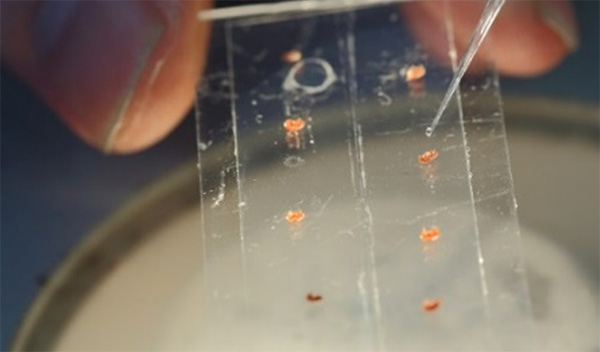
Spider venoms, it turned out, contain a remarkable diversity of molecules capable of killing varroa mites. The challenge then became identifying which individual molecules were responsible for the observed activity.
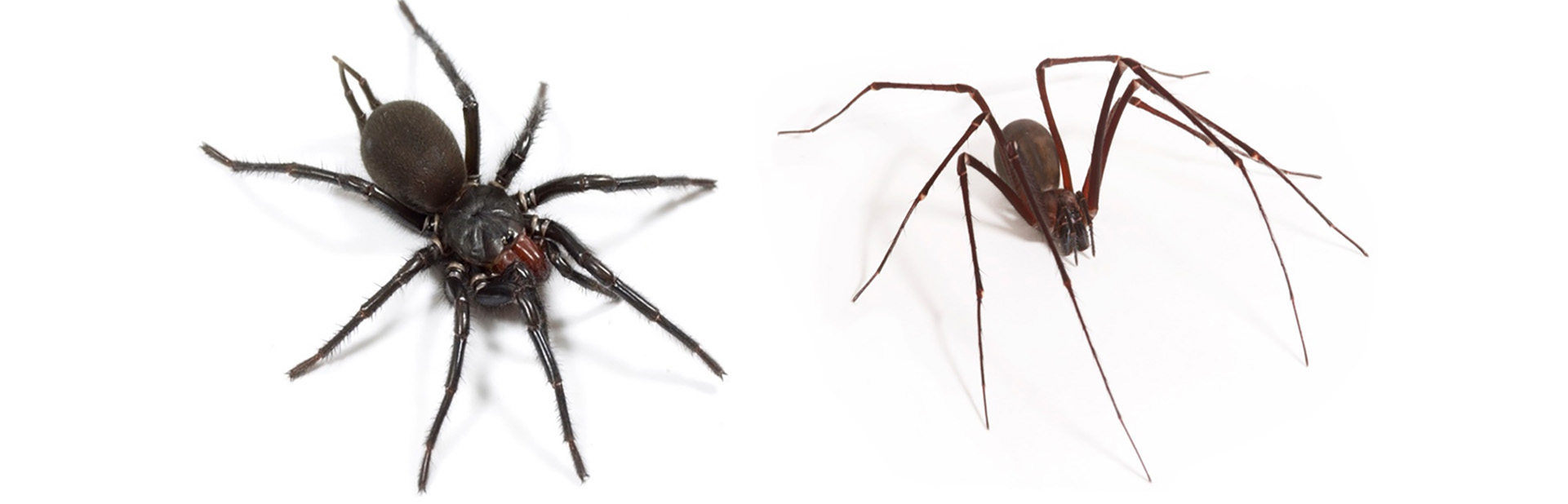
From those 50 venoms, we selected two particularly promising candidates (Figure 2): one from the Tasmanian cave spider (Hickmania troglodytes) and another from the giant Japanese funnel-web spider (Gigathele gigas). By separating each venom into smaller fractions and repeatedly testing them against V. destructor, we isolated one active peptide from each of those two spiders. We named these varroacidal peptides Ht1a and Gg1a.
Because spiders produce only small amounts of venom, harvesting enough active peptide directly from spiders is impractical for large-scale testing. Instead, we chemically synthesised both peptides in the laboratory, producing identical copies for further experiments. Both synthetic peptides successfully reduced varroa survival – confirming that these individual peptides were responsible for the varroacidal activity initially caused by the corresponding venoms.
Finding molecules that kill mites, however, is only half the story. The real challenge is ensuring they do not harm the bees or humans.
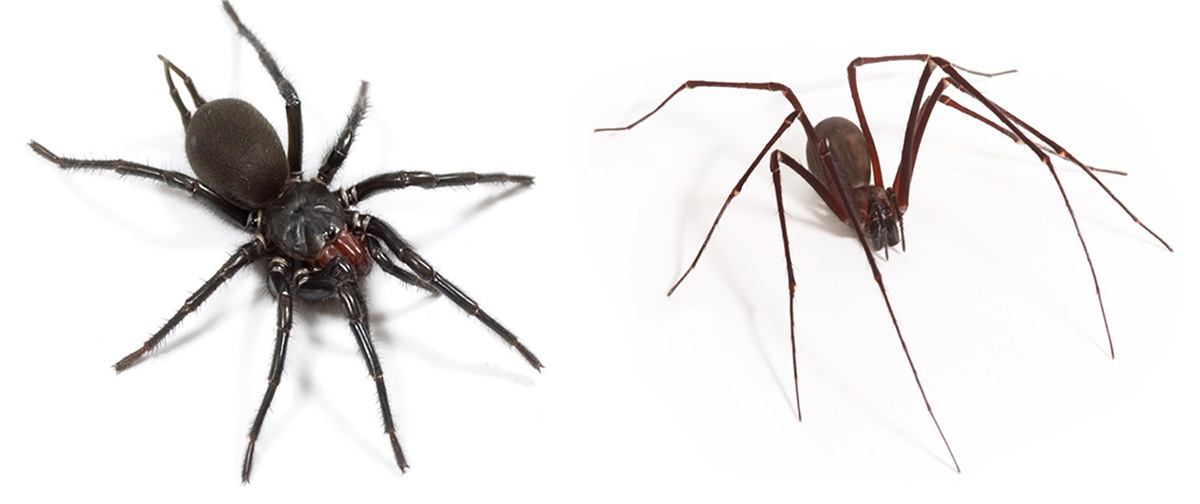
Figure 2: The giant Japanese funnel-web spider (pictured on the left, photo by Bastian Rast) and the Tasmanian cave spider (pictured on the right, photo by Eivind Undheim) contained the varroacidal peptides Gg1a and Ht1a in their venoms, respectively.
The real trick isn't killing mites – it's sparing the bees and the beekeepers
What makes treating varroa infestations difficult is, unlike many agricultural pests, varroa mites spend much of their lives attached directly to their honeybee hosts. Any treatment applied inside a hive will therefore contact both the parasite and the host at the same time. An effective treatment must achieve a delicate balance: lethal to the mite, but harmless to the bees and the beekeepers.
We worked out that honeybees have 34-fold larger body surface compared to varroa mites, which means that when applying a treatment via spraying, the bees will receive a 34-fold larger quantity of the respective treatment. To determine any effects of Ht1a and Gg1a on honeybees, we deliberately challenged the bees with a 52-fold higher dose (to leave some safety margin) than the dose that killed the mites. Encouragingly, neither peptide increased honeybee mortality in our laboratory experiments. It suggests these peptides may have a useful safety window, i.e. they are active against varroa mites under our experimental conditions, while being well tolerated by honeybees.
We also wanted to understand how these peptides work. Like all animals, mites rely on electrical signals travelling through their nervous systems to move or for any other tasks that are mediated by the nervous system. Those signals depend on microscopic proteins called ion channels – tiny gates controlling the movement of charged particles into and out of nerve cells. We found that Ht1a partly interferes with a protein known as voltage-gated sodium channel. Disrupting these channels impairs normal nerve function, which explains why Ht1a kills the mites.
The sodium channel from honeybees was also affected in our laboratory experiments – yet the peptide did not increase bee mortality after topical application. A potential explanation could be that the peptide may reach its target more readily in mites than in bees, or bees may have other biological mechanisms that protect them. That question is now part of our ongoing research.
We also found no significant activity against several important human ion channels under our experimental conditions, suggesting these peptides are highly selective for arthropods. While this is encouraging, comprehensive safety testing across a range of mammalian species would still be required before any of these peptides can be considered sufficiently safe for commercialisation.
The next challenge: making it work inside a hive
Our first study produced promising results, but it also highlighted the next major hurdles.
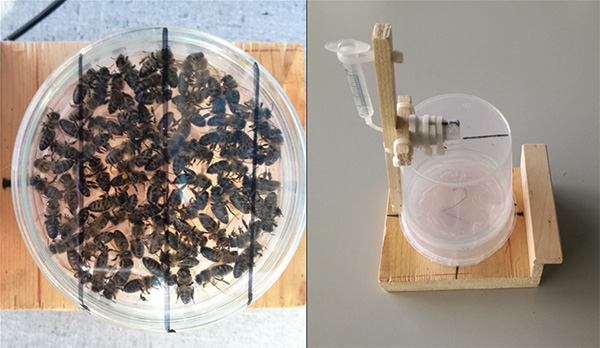
Our experiments thus far only tested mites and bees separately, while inside a real hive, varroa mites are usually attached to adult bees, hiding between abdominal segments where they are difficult to be reached. We are currently designing a new experiment to simulate the real-world beekeeping conditions by treating honeybees with their attached varroa parasites together (Figure 3). This will enable us to determine both mite mortality and bee health simultaneously and to identify peptide doses that can selectively target the parasitic mites.
Another challenge is ensuring the peptides reach the mites. Water-based solutions tend to form droplets on waxy surfaces like the bee or mite exoskeleton, limiting the overall coverage. To improve delivery, the silicone-based spreading agent Silwet L-77 will be applied together with the peptides, to help the peptide solution spread evenly across the surfaces of bees and mites alike. Potential synergistic effects of Ht1a and Gg1a will also be investigated, as their combined application might reduce the risk of the mites developing resistance.
If these scheduled laboratory studies continue to show promise, the next steps would involve testing formulations before attempting to treat varroa infested honeybee hives in the field.
Another tool for Australia's beekeepers
Spider venom probably isn't where most people would look for a solution to one of beekeeping's biggest challenges. But evolution has spent hundreds of millions of years refining these molecules to act on arthropods with extraordinary potency and precision. Sometimes nature has already solved the problems that plague our society and which scientists are just beginning to tackle.
Our research is still at an early stage. Ht1a and Gg1a are research candidates, not commercial products, and significant work remains to be completed and hurdles to overcome on their way to being available to beekeepers for treating varroa infestations.
Australia has entered a new phase in its response to varroa. No single treatment will solve this problem, but an integrated pest management strategy is required: combining regular monitoring with multiple complementary control methods to slow resistance development and protect honeybee colonies.
If spider venom peptides eventually become part of that toolbox, they won't replace existing treatments. They could instead give beekeepers another valuable option in the ongoing effort to keep varroa mites under control – and Australia's honeybees healthy.
Continuous investment is further required to support research on safe and environmentally-friendly miticide alternatives. Due to the extended time spans of 10-15 years that it might take for a new treatment to make it from the lab to the shelves of the beekeeping supply stores, we need to start looking for new solutions NOW, as many of the currently used treatments will be rendered ineffective by resistance within that time span. If we don’t invest in new treatment strategies now, we might be facing a future without any effective treatment options, which could be devastating not only to Australian beekeepers but also to the global food supply.