
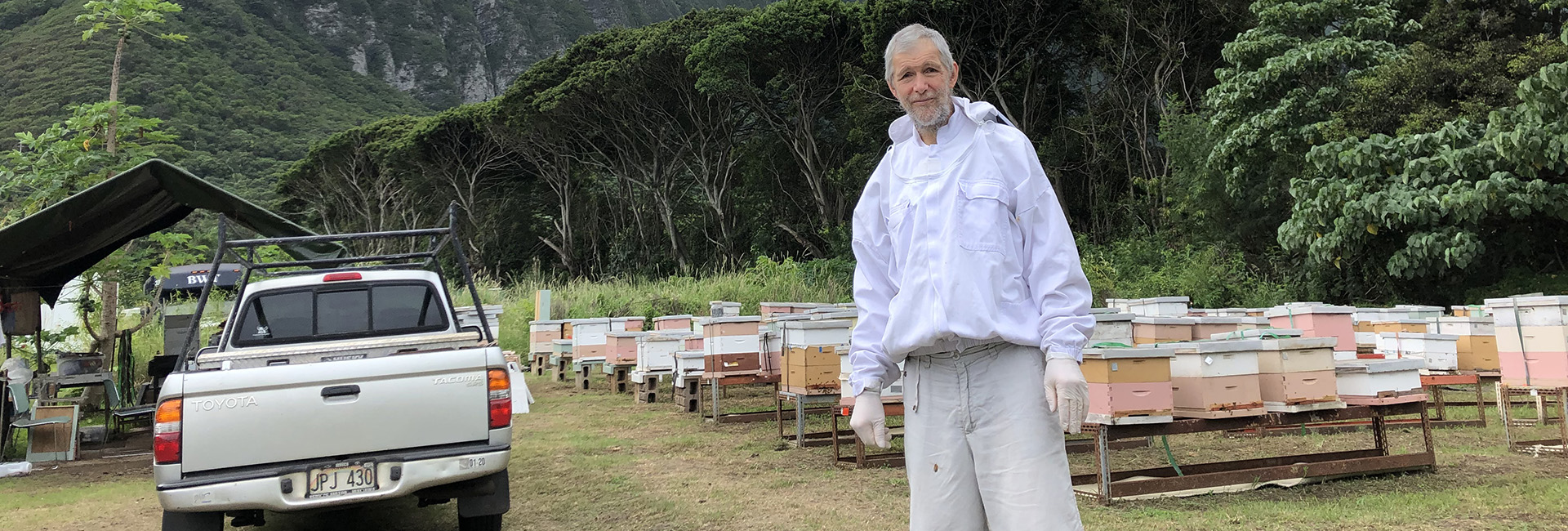
The author at one of his Hawaiian treatment-free research sites
Are Varroa resistant honey bees the long-term solution to the varroa problem?
By Prof. Stephen Martin
University of Salford, Manchester, UK.
When in 2022 eventually the globally devastating parasitic mite ‘Varroa’ arrived in Australia and the subsequent attempted eradication failed most beekeepers quickly started using chemical miticides to control their mite populations. This follows a similar pattern as has occurred across almost all of the northern hemisphere. However, Australia is currently in a unique situation since as of yet, the honey bee Deformed Winged Virus (DWV) has not been detected. This is very important since this alters greatly the number of mites required to kill a colony and provides an excellent opportunity for you to help your honey bees adapt to the mite. However, your bees will need your help to get over the first few difficult years. Understanding, how varroa kills your colonies and how your bees can adapt their hygienic behaviour to control the mites, is the key. But I hear you say in sub/tropical areas of Australia mites can reproduce all year so we have no chance. However, unknown to most beekeepers, across most of Latin America, the Caribbean and throughout sub-Sharan Africa beekeepers have been managing their bees without the need for any varroa-control for several decades now. How can this be?
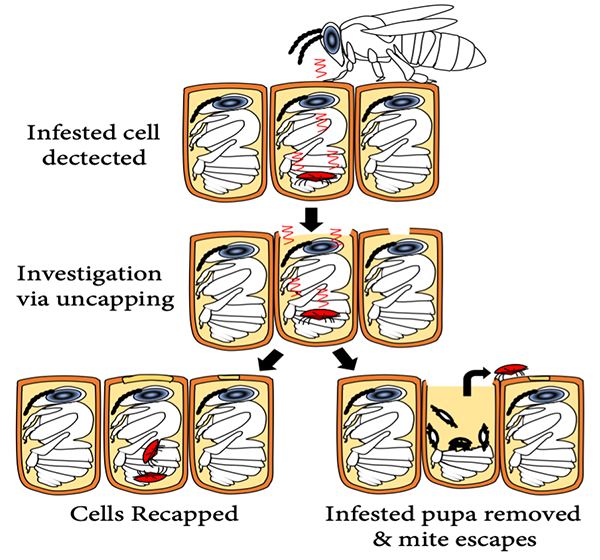
The honey bee varroa-resistance mechanism:
Scientists can now explain how and why varroa-resistance has arisen independently in many honey bee populations around the world [1]. Paradoxically the single most important factor is the role of treatments, since they remove the natural selective pressure on the honey bees to adapt their behaviour to deal with varroa. Throughout most of African, Latin America and the Caribbean miticides were not used or available and varroa-resistant honey bees started appearing in 5 to 10 years. During the initial invasion period biotechnical methods were used by beekeepers to help reduced their mite populations. Although initially the varroa-resistance mechanism was unknown, the mites in these resistance populations all had low levels of mite fertility and hence low population growth. In 2018 a PhD student ‘Melissa Oddie’ noticed that when comparing varroa-resistant and treated colonies in Norway, Sweden, and France that all the varroa-resistant populations had high levels of a behaviour called ‘recapping’. This is where the cap of a mite-infested sealed worker pupa cell is opened and then closed by resealing it with wax. This is an old behaviour and has long been used against wax moth. Although all colonies can do this behaviour, the level and accuracy are much higher in varroa-resistant populations indicating that these populations were much better at detecting mite-infested cells. Beekeepers notice this as ‘bald brood’. Subsequent studies indicated that while these mite infested cells are ‘uncapped’ (bald) some are cannibalised (Fig. 1, 2).
During this process the mother mite escapes, but she losses all her offspring as they cannot survive outside the confines of the sealed cell. Since varroa mites can only reproduce two or three times during their lifetime the loss of an entire batch of offspring greatly reduces her lifetime reproductive output. This explains the low mite fertilely previously seen in all other mite-resistant populations.
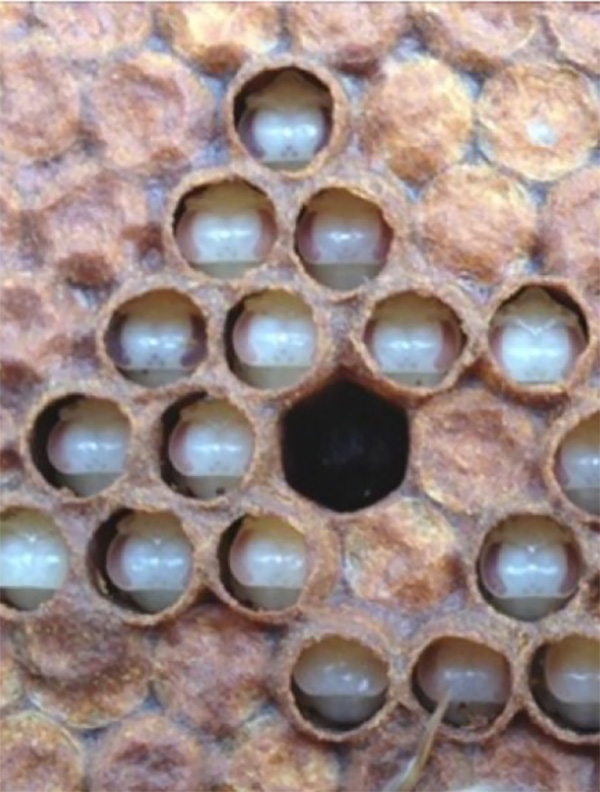
Figure 2.1 Typical uncapped (bald) brood often found in clusters. Most of the cells will be resealed within a day or two and continue to develop normally.
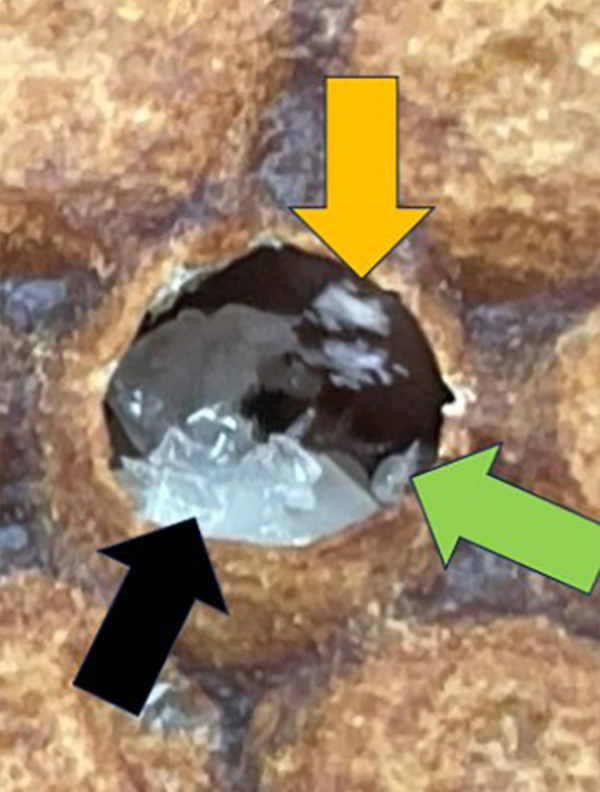
Figure 2.2 However, any varroa infested cells may be cannibalised resulting in the death of all the mite offspring. The yellow arrow indicates mite faeces, the green arrow indicates a mite protonymph and the black arrow indicates a half-eaten honey bee pupae.
Evolution of varroa-resistance in Hawaii [2]:
Honey bees were introduced into Hawaii in 1857 and thrived in the sub-tropical climate, establishing large, managed and free-living populations that freely mixed on all the main islands. Despite a 100-year-old ban on honeybee imports into Hawaii in 2007 the varroa mite was detected on Oahu and spread to Big Island a year later. On the island of Oahu 65% of managed colonies had already died and almost 80% of the free-living colonies where infested within a year of varroa’s arrival. A similar pattern occurred on Big Island which is home of several very large queen rearing operations. All beekeepers started treating their colonies, whereas the unmanaged free-living population collapsed, importantly DWV was already present in the honey bee population when varroa arrived, as was small hive beetle, so the situation was much worse than in Australia. However, as with all free-living populations they were subject to very strong (Darwinian) natural selection. With only the colonies that could quickly adapt to varroa surviving. Over the next six years the free-living population on Oahu started to recover. A small number of beekeepers started collecting swarms from the free-living population and stopped all varroa control. This approach was also taken by beekeepers in North Wales in the UK and is now home to the largest know varroa-resistance population in Europe, with some beekeepers now not treating their colonies for over 17 years. Studies in Hawaii and UK found the honey bees were again very good at detecting and removal of mite-infested worker cells, as found in South Africa, Brazil and Cuba. This caused poor mite reproduction, which subsequently prevented the mite population from building up in these varroa-resistant colonies, even under conditions that allow year-round brood production. Now the majority of beekeepers on Oahu have stopped all varroa treatments. Furthermore, the number of managed colonies now on Oahu has increased 3-fold compared to numbers managed just prior to varroa’s arrival. Annual losses of less than 20% are typical on Oahu, which is far lower than the 40-60% losses annually reported on the US mainland. On Big Island, unlike Oahu, most colonies are still treated this is due to large commercial queen rearing operations that cannot take the risk of transitioning away from treatments, but the beekeepers on Oahu and now enjoying the benefits, saving time and money by not having to treat their colonies.
What can you do to help your bees:
As long as DWV is not present in your honey bees then you have a unique window of opportunity to help the bees adapt to varroa. This is because in the absence of DWV the number of mites (threshold) needed to kill a colony is much higher, in fact its many thousands of mites. So, using the 3% threshold used by other countries that all have DWV is incorrect as your bees can survive a 10-20% infestation rate. But a word of caution mite numbers can increase quickly so continual monitoring is the key especially during the first few years. The main reason for this is the heavy re-invasion at occurs as free-living colonies collapse, which happens in the first few years after the mite’s arrival. It’s a tricky balancing act of allowing sufficiently large mite populations to force the bees to improve their hygienic behaviour i.e. the detection and removal of mite infested worker brood, but not enough mites to damage your colony. Monitoring your mite populations is the key and using biotechnical control methods (brood-breaks etc.) to reduce the mite population and give the bees more time to adapt. Time is what they need. Even use miticides as a last resort if things are getting out of hand. If you have some colonies that don’t appear to be able to keep the mite populations down as well as some of your other colonies, re-queen them with those that are coping better with the mites. We know this works as the resistant traits are carried by the queen [3]. At some point long-lived unmanaged free-living colonies will appear but that won’t possibility be for a few years, but keep your eyes peeled for such colonies, since we have no data of how quickly varroa-resistance will arise in DWV-free honey bees.
Future reading:
There is now lots of scientific studies, books, information including case studies from treatment-free beekeepers all freely available at www.varroaresistant.uk. This website also hosts a mite calculator that is a tool to help you estimate your mite population in each colony. It’s not perfect as no two honey bee colonies are the same but it will give you some more information about what is going on inside your colony.
Despite the current widespread panic over the varroa situation in Australia, you have an unprecedented insight into the situation, but only you can choose which path you decide to go down. That is get locked into endless treatment cycles as happens in the USA, China etc. or get your bees to do what they do best, adapt to new pests, as has happened throughout most of the southern hemisphere.
References
1 Grindrod I, Martin SJ (2021) Parallel Evolution of Varroa Resistance in Honey Bees; a common mechanism across continents? Proc. R. Soc. B 288: 20211375. doi.org/10.1098/rspb.2021.1375
2 Brettell LE et al., (2026) Coevolution stabilizes the honey bee–Varroa destructor–virus system on islands.Trends in Parasitology, 42, 6, 538-548 https://doi.org/10.1016/j.pt.2026.04.001
3 Martin SJ et al., (2024) Resistance to Varroa destructor trait is a trait mainly transmitted by queen and not via worker learning. Apidologie 10.1007/s13592-024-01084-6